






























Did “the Jews” kill Jesus? Are the Jewish people as a whole responsible for the death of Christ?
I was horrified recently to see this claim—which I thought was a fringe position—on a prominent conservative website, and I feel compelled to respond.
The claim traces back to Matthew 27, during the trial of Jesus, when the Roman Prefect Pontius Pilate washed his hands, proclaiming, “I am innocent of this man’s blood,” before turning Jesus over to be crucified. The crowd replied, “His blood be on us and on our children!”
Before I delve more deeply into the spiritual meaning of this passage, I feel compelled to note that—perhaps contrary to the suspicions of my fellow Protestants—the Catholic Church does not use this passage to blame the Jews for Jesus’ death.
The declaration “Nostra Aetate,” promulgated by Pope Paul VI at the Second Vatican Council, states that Jesus’ death “cannot be charged against all the Jews, without distinction, then alive, nor against the Jews of today.”
That’s only logical. After all, the historical record only mentions a specific group of people at a specific point in time making this statement. To blame all Jews everywhere for the death of Jesus would be tantamount to blaming all British people everywhere for the execution of Joan of Arc or all Greek people everywhere for the death of Socrates.
The notion of corporate guilt does play a role in the death of Jesus, but it has nothing to do with blaming the Jews, who remain God’s chosen people.
The Passion Narrative
If this verse does not implicate the Jewish people in Jesus’ death, whom does it implicate?
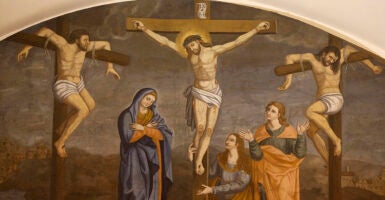
This passage appears in the narrative of Jesus’ “passion” (from the Latin word for “suffering”). After Jesus eats the Last Supper with his disciples and prays in the Garden of Gethsemane, Judas leads a group of guards to Jesus, handing him over to the Jewish religious leaders. The leaders hold an early-morning trial and use false testimony to find Jesus guilty, and they hand him over to Pilate because only the Romans can execute someone.
Pilate wants to release Jesus, but the crowd won’t have it. The crowd demands the release of a murderer and rebel by the name of Barabbas instead, and Pilate fears a revolt, so he goes along with it.
So, who is the guilty party? The clearest answer is Judas, who had Jesus arrested in the first place. Behind him come the Jewish leaders. Caiaphas, the high priest, prophesied that one man should die for the people (John 11:50), and the religious leaders repeatedly schemed to kill Jesus. The Bible presents the crowd as a catspaw for these leaders.
Despite Pilate’s symbolism of washing his hands of the guilt for Jesus’ death, the Roman leader did order Jesus’ execution, and the Roman authorities carried it out.
Yet Jesus didn’t blame Pilate.
When Pilate asks Jesus, “Do you not know that I have authority to release you and authority to crucify you?” Jesus answers, “You would have no authority over me at all unless it had been given you from above. Therefore he who delivered me over to you has the greater sin.” (John 19:10-11).
Jesus, who had been dodging previous attempts to execute him, ultimately made the key decision to sacrifice himself.
“For this reason, the Father loves me, because I lay down my life that I may take it up again,” Jesus taught. “No one takes it from me, but I lay it down of my own accord. I have authority to lay it down, and I have authority to take it up again. This charge I have received from my Father” (John 10:17-18).
While Pilate, the crowd, the religious leaders, and Judas share some responsibility for Jesus’ death, the savior has the ultimate agency—he gave his life to redeem sinners.
What of Corporate Guilt?
This has led some Christians to place the ultimate blame not on a historical figure nor on an ethnic group but on all of us who accept Jesus’ gift of forgiveness. In a sense, all the sinners who are redeemed by Jesus’ sacrifice share some guilt in his death. It is for our sake he died.
That is the real reason why, traditionally, when churches have a public reading of the Passion narratives, with separate speaking roles for Jesus, Pilate, a narrator, and others, the entire congregation reads the part of the crowd.
When I have said, “His blood be on us and on our children” in that context, I have understood this to be an echo of what the crowd then said—not as an attempt to blame the Jewish people for the death of Christ, but as an invitation for me to reflect on my own sins and the unfathomable love of God.
I believe the Passion narratives are faithful history, but they also bear the weight of heavy spiritual meaning. The theme of Jesus taking the place of another to save sinners runs through the entire narrative in subtle ways, from Caiaphas’ prophecy to Barabbas’ release at the crowd’s demand.
Historically, the crowd said those wicked words. But when it comes to corporate worship and our commemoration of Jesus’ Passion, those words are an invitation for us to examine our hearts and to repent of sin—not an excuse to indulge in sin by hating other people.

