





























The United Nations—that leechlike relic of the 20th century that still pretends to be important—last week passed a resolution to declare the trans-Atlantic slave trade the “gravest crime against humanity.”
While the resolution will likely have very little real-world effect for now, it’s a clear attempt by some countries to receive monetary reparations from those nations apparently guilty of the worst crime in all of history.
Argentina, Israel, and the United States voted against the resolution, but according to NBC News, “The United Kingdom and all 27 members of the European Union were among those that abstained.”
Frankly, I think it’s shameful that the U.K. abstained and didn’t vote against it.
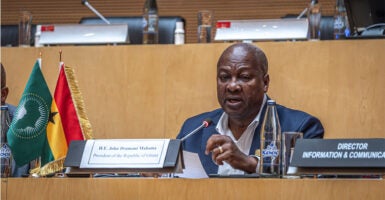
The reparations effort is being led by Ghana, which is, of course, setting itself up as one of the chief beneficiaries of the U.N. resolution.
“We are demanding compensation—and let us be clear, African leaders are not asking for money for themselves,” Ghana’s foreign minister, Samuel Okudzeto Ablakwa, said to the BBC. “We want justice for the victims and causes to be supported, educational and endowment funds, skills training funds.”
Ah, so Africa’s politicians aren’t trying to enrich themselves personally. That would be brazen and crass. No, they are merely attempting to loot other countries to pay off their constituents. How noble. How heroic.
That’s ultimately what this reparations push is about. It’s an attempt by several African countries to use globalist institutions and the façade of international law to essentially receive a permanent stipend from self-loathing Western suckers, I mean nations. It’s also a tool whereby other antagonists of the West can score some historical points against their rivals while ignoring their own modern crimes and tyranny.
The entire effort is a farce for several reasons.
The first obvious one is that those who directly participated in the trans-Atlantic slave trade and those victimized by it have been dead and gone for a long, long time. There are now no specific parties of transgressors and transgressed to make a clear line of guilt and restitution. This whole thing is about divining the collective guilt and aggrievement of past ages.
Let’s, for the sake of argument, take at face value that the trans-Atlantic slave trade was the worst example of slavery and that it is in particular need of rectification in 2026.
If that’s the case, then surely few nations are more on the hook to pay up than Ghana and neighboring West African countries, right?
Ghana’s statement about reparations very carefully made its condemnation of slavery entirely about the trans-Atlantic slave trade—a small tip of the iceberg of the entire history of that institution.
“Ghana has been precise on one point that admits no misreading: this campaign is not a humanitarian appeal,” read Ghana’s statement. “It is a legal claim, and the law, examined without the selective amnesia that has long served the interests of former colonial powers, is unambiguous.”
If there is selective amnesia, it’s not in the West where there exists now a near pathological obsession with slavery and racism. The amnesia is apparently in Ghana and other nations that would like to portray themselves purely as victims, as if the locals didn’t have a strong, or even the strongest hand in ensuring that human chattels would reach markets to their own enrichment.
What’s notable, if we really want to play this game of past collective guilt, is that West African slaver kingdoms practiced their sordid trade before the Western colonizers showed up and long after it had been abandoned in most Western countries. They often conducted it with relish and with extreme benefits to themselves.
For instance, consider Annamaboe, a major port city located in present-day Ghana.
Annamaboe was part of the Fante confederacy, a series of loosely connected city-states on the West African coast. In the 19th century, it became, according to one author, the “center of shipping and trade for the Gold Coast and one of the largest exporters of enslaved Africans along the West Coast of Africa.”
While the English placed a fort in town, African locals ruled over it. The city received a glut of slaves from the conquests of the militaristic African Asante Empire. The Asante plundered the African interior, brought their conquered slaves to Annamaboe, and elite African merchants sold them to Western slave traders.
The city and West Africa in general became so rich that despite it being on the “Gold Coast,” they became net importers of gold used in acquiring slaves.
So, if we are doing this collective guilt thing shouldn’t the descendants of those who sold millions of people into bondage be on the hook for a payout?
Let’s also consider the fact that these slave ports didn’t cease their operations willingly. No, it was the British Empire and other colonial powers in the 19th century that turned against slavery, that insisted the trade be shut down for good. The British Empire famously enforced its prohibitions on slavery around the globe.
Shouldn’t it be West African nations now paying the U.K. for the expense of operating their navy at great cost to shut down slavery in that region? Shouldn’t they be paying black Americans, British, and others around the globe for what their ancestors did in the past?
If you were to go by the social media chatter, you’d think that the nations that signed onto the reparations resolution were “brave” for demanding they get paid.
It seems to me they would have been braver had they acknowledged their own complicity and agreed to pay up. But that obviously wasn’t going to happen.
Much like the reparations talk in the U.S., the global version has always been based on a faulty philosophical basis. It doesn’t right the wrongs of history; it just creates new wrongs.
Frankly, Western countries need to grow a spine.
Slavery was a terrible, ancient practice somehow made more horrifying by its contact with the modern world. Few today would deny that. But the West isn’t uniquely on the hook for slavery’s evil. It is uniquely responsible for its extinction around the globe.

