



























At a time when we’re often told institutions are collapsing, trust is evaporating, and the truth is “relative,” a surprising trend is emerging.
As Easter approaches, thousands of Americans are flocking to one of the oldest institutions in the world: the Catholic Church.
A recent New York Times report highlighted a surge in adult conversions to Catholicism across the United States, with dioceses from New Jersey to Oregon reporting significant increases in new members entering the Church through the Order of Christian Initiation for Adults (OCIA).
Americans to Convert to Catholicism
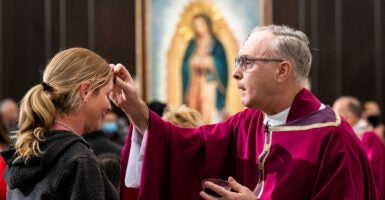
Traditionally, the night before Easter Sunday, at the annual Easter Vigil Mass, newcomers receive sacraments of baptism, confirmation, and eucharist, and are officially welcomed into the Catholic Church. Those already baptized in another Christian denomination receive confirmation and the eucharist.
By the time Easter arrives, these catechumens and candidates will have spent months studying the Bible and Catechism of the Catholic Church at weekly meetings, weekend retreats, and Sunday scripture lessons.
This Easter, the numbers suggest a surge across America, according to the Times story.
In the Archdiocese of Newark alone, more than 1,700 people are expected to enter the Catholic Church, a 30% increase from last year and a 72% jump since 2023.
And Newark is far from an outlier.
The Archdiocese of Detroit will receive 1,428 new Catholics into the church, its highest number in 21 years. The Archdiocese of Galveston-Houston will have its most in 15 years. In the Diocese of Des Moines, the count jumped 51% from last year, from 265 people to 400.
Stability in an Age of Chaos
For decades, American institutions, from universities to media outlets, have drifted away from objective truth, embracing relativism, identity politics, and ideological conformity. At the same time, social life has fractured: declining marriage rates, rising loneliness, and record levels of anxiety and depression.
The COVID-19 pandemic only accelerated these trends, leaving many Americans isolated and questioning the foundations of modern life.
“I think technology has isolated us from one other. I think that COVID just really magnified that isolation,” Archbishop Mitchell Thomas Rozanski of St. Louis told the Times. “We are realizing many of the ills of our society, particularly anxiety and depression, come about from that isolation.”
Rozanski, whose diocese is experiencing the highest number of converts since 2016, has found the loneliest group of people entering the church to be those ages 18 to 35, a cohort that’s growing in several dioceses.
In today’s anti-institution environment, the Catholic Church stands out—not because it has changed, but because it hasn’t.
“In our age of uncertainty, and in our age of great anxiety, is a thirst and hunger for God and stability that faith brings to people’s lives,” Rozanski told the Times.
For over 2,000 years, the Catholic Church has maintained a consistent set of teachings on morality, human dignity, and the nature of truth. For generations raised on constant change, that permanence is increasingly attractive.
A Rejection of Relativism
In many ways, this wave of conversions represents something larger than a religious trend.
It is a quiet rejection of the assumptions that have dominated American culture for decades: that truth is subjective, that tradition is oppressive, and that fulfillment can be found in material success or personal autonomy alone.
Instead, a growing number of Americans, especially young adults, are moving in the opposite direction.
They are choosing structure over chaos. Tradition over trend. Truth over relativism.
And in doing so, they are rediscovering a faith that, for centuries, has claimed to offer not just answers, but ultimate meaning.

