






























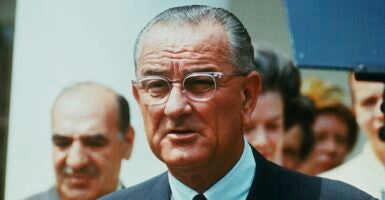
America’s “War on Poverty,” launched by President Lyndon Johnson in 1964, has expanded into a vast array of federal social welfare programs that today exceed $1 trillion per year.
Upon signing the Economic Opportunity Act, Johnson stated: “This is not in any sense a cynical proposal to exploit the poor with a promise of a handout” but rather a means to “help our people find their footing for a long climb toward a better way of life.”
While poverty has declined significantly over the past half century, however, recent reports indicate that these programs simultaneously reduced the share of private income for America’s poorest, locking them into long-term dependency and limiting their ability to move up into the middle class.
A recent study by economists Kevin Corinth and Richard Burkhauser, which analyzed poverty rates before and after America embarked on the War on Poverty, concluded that, while poverty decreased substantially since 1964, this was achieved largely by welfare supplanting “market” income such as wages, investments and profits. In addition, before the 1960s, market income had succeeded in reducing poverty at similar rates to what the War on Poverty achieved.
“Our new research shows that the United States made strong progress in reducing poverty during the quarter century before the War on Poverty began, and that this progress was entirely accounted for by increases in market income, not government transfers,” Corinth told The Daily Signal. “In other words, there was a lot of benefit and not much cost during this earlier period.”
Before the War on Poverty, poverty reduction was achieved across racial groups. Economist Thomas Sowell wrote in 2004 that the poverty rate among black families fell from 87% in 1940 to 47% in 1960, without government assistance.
According to Corinth and Burkhauser, “During that 1939–1963 period, it was the growth of market income rather than government transfers net of taxes that reduced poverty rates. In fact, poverty fell no faster in the 24 years after the War on Poverty was declared than in the 24 years before, even when applying the same initial poverty rate to both periods.”
And while some claim that government spending has reduced poverty by as much as 90% since 1964, it may have also built a barrier to upward mobility for America’s poorest.
A 2007 study of income mobility by the Internal Revenue Service that tracked individual earners (rather than income aggregates) found that Americans who occupied rich or poor income categories usually didn’t stay there long. The report found that between 1996 and 2005, 55% of taxpayers in the lowest income quintile had moved up to a higher group within 10 years.
Similarly, only 25% of those in the top (1/100 of one%) income category remained there a decade later. The IRS found similar results during the prior decade.
However, more recent studies indicate that income mobility is declining in America and that expansive welfare programs appear to be trapping more people in government dependence.
A January report by the Congressional Budget Office found that, for the poorest 20% of Americans, government payments increased from 26% of total income in 1979 to 42% in 2022. And as welfare programs expanded, market income for America’s poorest declined as a share of total income. Whereas in 1979 welfare payments were only about half the amount of private income sources for the lowest quintile, the two income sources were roughly equal by 2022.
According to a February report in The Daily Economy by analyst Tyler Turman, based on this Congressional Budget Office data, “despite historically unprecedented economic gains for low-income Americans, more of them are dependent on government assistance than at any point in the country’s history.”
The “welfare state’s perverse incentives” often discourage recipients from taking the steps that typically move Americans into higher income categories, such as pursuing higher-paying jobs, accumulating wealth and property, or getting married, Romina Boccia, director of entitlement policy at the Cato Institute, told The Daily Signal.
“Government anti-poverty programs have succeeded in alleviating material poverty by pushing low-income families above the poverty line, but they have done little to make them independent or self-sufficient to the point of not needing to relyon government assistance, which, ostensibly, was the entire goal of LBJ’s War on Poverty in the first place,” Boccia said. “Instead, they have merely created a growing share of Americans who rely on Washington more than their own wages.”
She cited a 2022 study from the University of Chicago and the Atlanta Fed regarding the penalties for welfare recipients who breach income thresholds. It showed that a family’s wage increase from $54,000 to $55,000 could cause them to lose more than $25,000 in childcare benefits.
“For working age adults and their children, dependency tends to make it more difficult to rise out of poverty through increases in their own earnings, because they are the most at risk or losing substantial amounts of government aid by doing so,” Corinth said.
If the goal of the War on Poverty was to boost Americans’ self-sufficiency, it appears to have fallen short. What it has achieved, rather, is a costly expansion of government, long-term dependency for the poor, and a perennial voting bloc for politicians who feed the addiction.
We publish a variety of perspectives. Nothing written here is to be construed as representing the views of The Daily Signal.

