








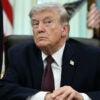












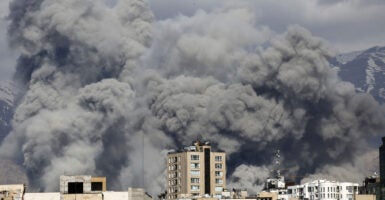
Early Saturday morning, President Donald Trump announced the start of what he described as “major combat operations in Iran.” In a statement, Trump outlined what he said were decades of hostile actions by the Iranian government, along with more recent failed efforts to reach diplomatic settlements.
Trump said Iran’s refusal to halt its pursuit of nuclear weapons poses a threat to U.S. national security and Western stability. The announcement sent shockwaves around the world, prompting the U.S. embassy in Israel to issue a shelter-in-place order and triggering widespread flight cancellations across the region.
Beyond the immediate military and diplomatic consequences, the announcement raises broader moral questions. Military strategies must be carefully planned, and service members must be supported.
But as history shows, decisions of war are often weighed in the balance of objective morality. Those who govern are meant to protect the rights given to people from God. While there are countless rational questions to ask in these circumstances, considering what it means for there to be a just war is certainly one of them.
So, what makes for a just war?
The Catholic tradition of just war theory was most notably articulated by St. Augustine and later developed by St. Thomas Aquinas. In his section on war in his groundbreaking work, Summa Theologiae (Summary of Theology), Aquinas outlines three basic criteria that must be met for a war to be considered just.
First, a war must be declared by the supreme authority. This was clearly met with Trump’s order for war against Iran. As president, he has the most authority in the land.
Second, St. Thomas says that a just cause is required. This is where most cases of consideration for a just war find ambiguity.
Trump claims the assault against Iran is warranted because of Iran’s clear refusal to cease production of nuclear weapons. The country’s unwavering desire for “death to America” and harm to the West leaves the world endangered. Trump’s act claims to be preventive but also the result of numerous chances for Iran to reconsider its pursuit of nuclear arms and support of terrorism.
The third criteria for a just war is that the one waging war “should have a rightful intention, so that they intend the advancement of good, or the avoidance of evil.”
Trump said the goal of the operation is to prevent what he described as a “radical dictatorship” from threatening U.S. security interests. The president’s intention is to protect his nation, and others, from harm while preventing evil from occurring that would further place global harmony at risk.
Based on those three criteria alone, the conflict meets the classical definition of a just war. However, the Catholic Church’s teaching expands on this framework. In the Catechism of the Catholic Church (#2309), the church states that nations have a right to protect themselves against an unjust oppressor. Catholics are not pacifists.
Along with the criteria from Aquinas, the Catechism notes that war should be a last resort. In his remarks, Trump said: “We tried. They wanted to do it. They didn’t want to do it. Again, they wanted to do it. They didn’t want to do it. They didn’t know what was happening. They just wanted to practice evil. But Iran refused, just as it has for decades and decades. They’ve rejected every opportunity to renounce their nuclear ambitions.”
Trump appears to truly believe that all other means to bring about peace had been traversed. There was nothing more he could do. As citizens who don’t have clearance for top secret documents nor insights into the ins and outs of Iranian-American diplomacy, we don’t have perfect answers.
Critics of Trump would claim that this criteria for a just war was not met, arguing that diplomatic avenues had not been fully exhausted and that military action risks escalating the conflict. Supporters counter that Iran’s actions left the administration with no viable alternatives, and view Trump’s efforts as proactive and strong regarding American interests.
The Catechism also teaches that in a just war the harm inflicted must be proportional to the harm that would be prevented or extinguished and that there must be a reasonable chance of success in winning the war.
These final two criteria will be more known as the days and weeks ahead. Church teaching further holds that attacks on civilians are never morally permissible, even in wartime.
Some might also claim that the religious and ideological stubbornness of the Iranian regime appears to be immovable, and that any attempt to shift the regime’s mindset regarding America and the West is futile. Can this type of worldview really be defeated?
This war is happening, and there is not much we can do to stop it. The best course of action would be to consider how we practice justice in our daily lives and how we can be peacemakers in our own families and communities. For evil can only be defeated if human hearts are converted to seeing and clinging to the true and the good.
Let us pray for our troops and for our world. May justice reign, good triumph, and God be with all those in harm’s way.
We publish a variety of perspectives. Nothing written here is to be construed as representing the views of The Daily Signal.

