




















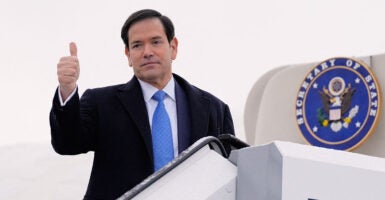
Much has been said about Secretary of State Marco Rubio’s landmark speech at the Munich Security Conference last week.
It was a confident and unapologetic defense of the economic, defense, and political ties that underpin the American-European transatlantic partnership. It was also, crucially, a defense of Western civilization itself forged through “centuries of shared history, Christian faith, culture, heritage, language, ancestry, and the sacrifices our forefathers made together for the common civilization to which we have fallen heir.”
Yet less has been written on the implications of his address for the United States’ engagement with multilateral organizations and international institutions that will shape the world for years to come.
When I first wrote on this issue last year, following President Donald Trump’s inauguration, the foreign policy priorities for his second term were only beginning to take shape.
For example, the president announced the U.S.’ withdrawal from certain United Nations institutions and agencies, including the Human Rights Council and the World Health Organization; reform of development assistance and the U.S. Agency for International Development; reinstatement of the pro-life Mexico City Policy; and rejoining the Geneva Consensus Declaration Coalition.
In the last few months, we have witnessed renewed impetus through executive orders withdrawing from additional international organizations, conventions, and treaties, and the formalization of new rules prohibiting the funding of abortion, gender ideology, discriminatory equity ideology, and unlawful diversity, equity, and inclusion programs in foreign assistance.
Such policies not only protect American taxpayers from subsidizing harmful practices but also preserve the long-standing international consensus that each nation has the sovereign right to implement programs and activities consistent with their laws and policies.
None of these actions should be surprising. The world is witnessing a generational U.S. realignment in its bilateral, multilateral, and foreign assistance engagements to ensure they are consistent with core national interests rather than the priorities of unaccountable, unelected international technocrats.
In this regard, Rubio acknowledged before his European counterparts the folly of nations “increasingly outsourc[ing] our sovereignty to international institutions.” He specifically referenced neo-liberal policies in energy, migration, and trade, which have contributed to inflationary crises, affected social cohesion and national identities, and hollowed out the West’s industrial base.
Accordingly, Rubio extended both a reassuring invitation and a bold challenge to those assembled:
We can no longer place the so-called global order above the vital interests of our people and our nations. We do not need to abandon the system of international cooperation we authored, and we don’t need to dismantle the global institutions of the old order that together we built. But these must be reformed. These must be rebuilt.
Nowhere should this charge be taken more seriously than at the U.N. Secretary-General Antonio Guterres recently lamented that the U.N. was on the verge of “imminent financial collapse” as early as this summer if member states—particularly the United States—did not pay their dues.
However, the U.N. crisis has been simmering for years and cannot be attributed solely to the U.S.’ arrears.
While there has always been a tension between idealists and realists among practitioners of international law, Rubio cut through the debate by asserting that proponents of multilateral institutions often pay lip service to a “rules-based” international order or to international law but disregard them in practice too.
For example, the organization has been plagued by allegations of fraud, mismanagement, and abuse, critiqued for prioritizing ideological colonization over universally agreed human rights and fundamental freedoms, and for disregarding the legitimate sovereign rights of U.N. member states.
As the League of Nations failed to stop crises in Manchuria, Ethiopia, and Central and Eastern Europe, Rubio likened the situations in Gaza, Ukraine, and Iran to contemporary failures: “The [U.N.] still has tremendous potential to be a tool for good in the world. But we cannot ignore that today, on the most pressing matters before us, it has no answers and has played virtually no role.”
Although it’s still too early to tell how successful the process will be in addressing concerns, the U.N. General Assembly adopted Resolution A/RES/79/318 last summer on the UN80 Reform initiative to identify efficiencies, review how mandates are implemented, and examine potential structural changes and program realignment within the U.N. system.
Responding with a gesture of goodwill, Ambassador Mike Waltz, U.S. ambassador to the U.N., announced that the United States planned to make initial U.N. payments and support efforts to ensure it is a more fit-for-purpose and focused organization: “We’re going to pay those dues, and we’re going to continue to demand reforms. We’re off to a good start.”
However important these reforms may be, the barometer of success for multilateral institutions cannot be measured solely in terms of improved economic output, technical proficiency, or military prowess. Ultimately, such institutions do not exist for their own sake but to serve the human person and the common good.
As Rubio’s speech echoes the shared moral, ethical, and religious heritage that undergirds the West, it is only from this posture that such a reinvigorated alliance can, in turn, “boldly race[s] into the future” to encounter other civilizations and seek to resolve humanity’s most pressing challenges.
We publish a variety of perspectives. Nothing written here is to be construed as representing the views of The Daily Signal.

