

























The U.S. Supreme Court ruled Friday that President Donald Trump must obtain congressional approval before imposing new tariffs, a decision that significantly reshapes U.S. trade policy.
The 6-3 ruling is expected to have political and economic repercussions heading into the midterm elections—and might ultimately work to the Republican Party’s advantage, according to a veteran pollster.
Scott Rasmussen, founder of the Napolitan Institute, said the court’s decision aligns with public sentiment.
“We polled this consistently over the year, and 6 out of 10 voters tell us that of course congressional approval should be required for tariffs. That’s part of our system of checks and balances,” Rasmussen said Friday. “So, while many of the Trump base will be outraged, I think most of the voters will be comfortable with this decision.”
Voter Attitudes and Economic Concerns
Rasmussen’s polling also highlights mixed public perceptions of tariffs even before the court’s ruling.
“Before this ruling came down, 41% were saying these tariffs were good for the economy, 50% were saying they were bad,” he explained. “And 6 out of 10 were saying they raised prices and that they were adding to the immigration problem. We will obviously be following the fallout from the decision and polling next week.”
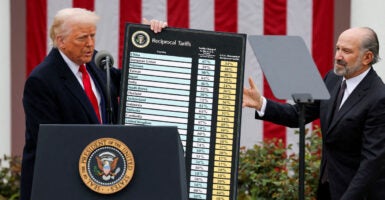
The decision effectively curtails one of Trump’s tools for shaping trade policy—a power he used to reshape U.S. trade relations with China, the European Union, and Mexico.
Political Fallout Ahead of the Midterms
When asked whether the ruling helps or hurts Republicans heading into the midterm elections, Rasmussen said the answer depends largely on the economic impact.
“It depends on what it does to the economy,” Rasmussen said. “If the economy does better, with tariffs off, that would be good news for the Republicans in two ways. First, as the economy does better, it’s better for the GOP. Second, the Supreme Court ruling is likely to enrage the Trump base and encourage their turnout at even higher levels. If you assume adjustment and provide good news for the economy, this could be a big plus for the GOP.”
What Comes Next
The Supreme Court ruling puts new pressure on Congress to take a more active role in trade policy—a task likely to be contentious given divisions within both parties.
Economists are watching closely to see whether easing tariffs will curb inflationary pressures or affect domestic industries that benefited from tariff protections.
Rasmussen and other analysts are expected to release new polling data next week measuring public reaction to the court’s decision and its potential influence on the political landscape.

