





















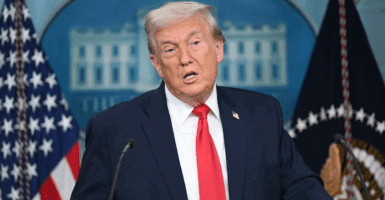
In a 6-3 decision, the Supreme Court ruled that President Donald Trump’s executive actions on tariffs exceeded his constitutional authority.
During oral arguments in November, even Trump-appointed justices seemed skeptical of the government’s arguments that the president could impose tariffs without congressional approval.
In the case of Learning Resources, Inc. v. Trump, two companies sued in May 2025 after Trump’s “Liberation Day” announcement of tariffs.
At issue was whether the president exceeded his executive branch authority by imposing tariffs under the 1977 International Emergency Economic Powers Act, a law intended to address emergencies only.
The Trump administration has argued the trade imbalance constitutes a national emergency. Trump has consistently argued the United States has gotten a raw deal on trade with other countries that impose tariffs.
Normally, trade policy, including tariffs, is enacted through legislation in Congress and signed by the president.
Chief Justice John Roberts, who authored the majority opinion, wrote that the law Trump used “contains no reference to tariffs or duties.”
“The Government points to no statute in which Congress used the word ‘regulate’ to authorize taxation. And until now no President has read IEEPA to confer such power,” Roberts wrote.
“We claim no special competence in matters of economics or foreign affairs. We claim only, as we must, the limited role assigned to us by Article III of the Constitution. Fulfilling that role, we hold that IEEPA does not authorize the President to impose tariffs.”
Justices Neil Gorsuch and Amy Coney Barrett—both Trump appointees—joined the chief justice and the court’s three liberal justices in the majority.
Justices Samuel Alito, Clarence Thomas, and Brett Kavanaugh all dissented from the majority opinion, writing that “interpreting IEEPA to exclude tariffs creates nonsensical textual and practical anomalies.”
“The plaintiffs and the Court do not dispute that the President can act in declared emergencies under IEEPA to impose quotas or even total embargoes on all imports from a given country,” the dissent says. “But the President supposedly cannot take the far more modest step of conditioning those imports on payment of a tariff or duty. Textually, however, if quotas and embargoes are a means to regulate importation, how are tariffs not a means to regulate importation? Nothing in the text supports such an illogical distinction.”
The case was uncharted waters for the Supreme Court, which had never before ruled on the extent of the International Emergency Economic Powers Act.
Tariffs have long been core to Trump’s trade and economic agenda, often clashing with the more libertarian-leaning conservative views on free trade that dominated the Republican Party going back to at least the Ronald Reagan era.
Gorsuch, in his concurrence with the majority, wrote, “For those who think it important for the Nation to impose more tariffs, I understand that today’s decision will be disappointing.”
“All I can offer them is that most major decisions affecting the rights and responsibilities of the American people (including the duty to pay taxes and tariffs) are funneled through the legislative process for a reason,” he added.
“Yes, legislating can be hard and take time. And, yes, it can be tempting to bypass Congress when some pressing problem arises. But the deliberative nature of the legislative process was the whole point of its design. Through that process, the Nation can tap the combined wisdom of the people’s elected representatives, not just that of one faction or man.”
This story is developing and will be updated.

