













Having removed Venezuela’s socialist President Nicolas Maduro in January, the Trump administration is now endeavoring to rebuild Venezuela after decades of corruption, neglect, and theft.
Under Maduro and his predecessor, Hugo Chavez, Venezuela declined from what was once South America’s richest country and among the 20 wealthiest in the world to “a failed petrostate.” Between 2014 and 2021, Venezuela’s gross domestic product shrank by more than 70%.
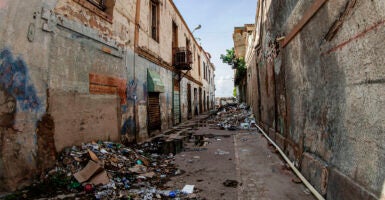
Today, the country’s infrastructure is in tatters, its judicial system is riddled with corruption and cronyism, and, given Venezuela’s history of expropriating private assets, many foreign investors say the country is “uninvestable.”
In addition, much of the country’s wealth and savings evaporated as the nation’s currency, the bolivar, endured two episodes of hyperinflation, peaking at 234% per month in 2018, and again exceeding 150% per month in 2020.
How does a country begin to recover from this?
Having spent decades advising governments on how to fix their broken economies, Johns Hopkins economist Steve Hanke, known as the “money doctor,” says he has seen worse.
“China was in a lot worse shape than Venezuela in 1979, so all these things are possible,” Hanke told The Daily Signal. But the first critical step is stabilizing a currency that has been in free fall.
“If they can’t get the inflation genie back in the bottle,” he said, “nothing much really is going to happen.”
When Hanke was adviser to Bulgaria in 1997, that country was likewise suffering from economic ills, including runaway inflation and a banking crisis. The solution he proposed was a currency board, in which a country’s domestic currency is 100% backed by a foreign reserve currency, like the U.S. dollar or euro, at a fixed exchange rate.
“The inflation rate was 242% per month, and we put in the currency board in July and smashed inflation immediately, down to below 10% on an annual basis,” he said.
Within a year, Bulgaria’s foreign exchange reserves had tripled, short-term interest rates were down to 2%, the banking system returned to solvency, and the economy was growing again.
Last month, Bulgaria qualified to join the euro area.
Following this model, currency stability was similarly achieved in countries like Estonia, Lithuania, and Bosnia. Hanke had also recommended a currency board to Venezuela’s then-President Rafael Caldera in the 1990s, but those were different times.
“The rule of law has deteriorated so much that I would never recommend a currency board right now,” Hanke said. Instead, he said, Venezuela should do away with the bolivar entirely and adopt U.S. dollars as the national currency.
In a process called dollarization, “you essentially get rid of the central bank, get rid of the local currency and replace it with what would have been the anchor currency under a currency board,” he said.
Dollarization has been implemented effectively in Panama, El Salvador, and Ecuador. Venezuela is informally dollarized, with estimates that more than half the transactions there are conducted in dollars already.
Once macroeconomic stability is achieved, the government can then begin to “chip away at all these other things that have to be done,” he said.
“If you look at the big reforms, like in New Zealand or Great Britain with [Prime Minister Margaret] Thatcher, or the Chicago boys in Chile, these things didn’t happen overnight,” Hanke said. “You have to build confidence and momentum, and let the momentum carry you along opportunistically, and pick these things off one at a time.”
Much of the focus since January has been on Venezuela’s massive oil reserves, though its wells are currently in disrepair after decades of government mismanagement and theft.
“Chavismo has rendered the world’s largest crude oil reserves effectively worthless,” Hanke said, and to date, Western oil companies have been reluctant to reinvest.
In January, Venezuela’s parliament passed a new law intended to open its oil industry to private development, but it will probably have to do more to attract investment back into the country. Venezuela must establish a credible legal system to guarantee property rights, such as the laws that Chile put in place for mining concessions in the 1980s, Hanke said.
“Chile’s mining law established sound property rights and clear rules of the game,” Hanke said. “Among other things, the law mandates that if an expropriation by the state occurs, the state must pay the owner the full present value of the future cash flows from the property that has been expropriated,” as well as stipulating that foreign investors are treated the same as Venezuelans.
Beyond oil, other industries that have great potential include agriculture and mining, which were also subject to nationalization under Chavez and Maduro.
Venezuela has a wealth of unused agricultural land and extensive freshwater resources, but “land prices are extremely depressed under the weight of severe legal and political risk,” Hanke said. “Property rights insecurity, input-market disruption, price and exchange controls, and infrastructure decay have combined to push the sector far below its production possibility frontier.”
In addition, “there are considerable reserves of gold, iron ore, bauxite, coal, nickel, and some critical materials, like coltan,” Hanke said. “But, like agriculture, mining is plagued by infrastructure problems.”
For America’s part, Hanke called for a complete end to the U.S. embargo.
“The first immediate action the U.S. should take in Venezuela is to remove all sanctions, and this could literally be done with the stroke of a pen,” he said.

