













Telecom executives didn’t give satisfactory answers to senators when asked about assisting former special counsel Jack Smith’s team in scooping up phone data of members of Congress.
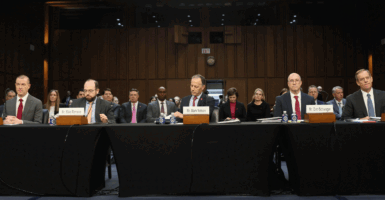
Lawyers for AT&T, T-Mobile, and Verizon testified on Tuesday before the Senate Judiciary Subcommittee on Privacy, Technology, and the Law about why they willingly cooperated with investigators’ demands, without notifying the Republican senators targeted.
Smith’s team gathered the toll data as part of his investigation into Donald Trump’s challenge to the 2020 election outcome, an operation dubbed “Arctic Frost.”
The Justice Department gained a nondisclosure order for the subpoena, meaning the members of Congress did not have to be notified that their phone records were being collected for the investigation.
Late last year, Senate Judiciary Chairman Charles Grassley, R-Iowa, and Sen. Ron Johnson, the chairman of the Permanent Subcommittee on Investigations, released Smith’s subpoenas issued in 2023.
Smith’s subpoenas, directed at 34 individuals and 163 organizations, sought broad information, including the communications of several Republican senators, conservative organizations, and multiple individuals supporting Trump’s 2020 reelection.
Here are four key takeaways from the hearing.
1. ‘Worst Weaponization of Government in American History’
Subcommittee Chairwoman Marsha Blackburn said Smith will have to answer questions from the Senate Judiciary Committee for “the worst weaponization of government in American history.”
“I’m determined to ensure that Jack Smith is held accountable to prevent another Arctic Frost from happening again,” Blackburn said.
“Jack Smith took a page out of the old Russian playbook by saying, ‘Give me the man, and I will give you the case against him.’ In this case, the man was President Trump, and hundreds of conservative Americans who supported him,” Blackburn said.
2. ‘Didn’t Bother’
Several senators noted that AT&T did not provide the information to Smith’s investigators upon realizing the potential clash with separation of powers laws.
AT&T began asking questions upon realizing that data on Sen. Ted Cruz, R-Texas, had been subpoenaed.
Sen. Josh Hawley, R-Mo., asked David McAtee, AT&T’s senior executive vice president and general counsel, how the company flagged this.
“It was fairly obvious the subscriber name was Ted Cruz for Senate, so we put it together,” McAtee replied.
Hawley noted a nondisclosure order didn’t stop AT&T from asking questions of the investigators. He later turned to Chris Miller, senior vice president and general counsel for Verizon, to ask, “Why didn’t you do any of this?”
“At that time, we did not train our subpoena analysts to do a searching inquiry into the subscriber associated with a particular number,” Miller answered.
“You just didn’t bother to try and associate the phone number with any name?” Hawley followed.
“Senator, we respect the privacy of our customers,” Miller said.
“Apparently not, because you turned over every piece of information from every senator sitting on this dais who got any illegal subpoena,” Hawley said.
3. ‘Double Standard’
Sen. Lindsey Graham, R-S.C., said the Smith team didn’t follow up on AT&T’s question because it was a “fishing expedition.” But he accused the other companies of “folding like a cheap suit.”
Graham asked Miller about complying with the company’s contract with the Senate.
“That contract had a clause in it, that if anybody comes after a senator’s phone records, you will tell us so we can defend ourselves,” Graham said.
He noted that both his official Senate account and campaign account were provided to the Smith team.
Miller responded, “Senator, I would certainly agree, we have frustrated you.”
“No, failed me,” Graham interrupted. “You failed to honor the contract protecting all of us.”
Graham noted Democrats on the committee suggested the conduct was justified.
“The double standard is clear. If someone went after Democratic senators’ phone records, it would be breaking news all over the world … had subpoenas issued by some right-wing prosecutor,” Graham said. “The cavalier attitude that some of you have, ‘Well, you know, nothing really bad here happened,’ I disagree, fundamentally disagree.”
4. ‘Not Harmed’
Republican senators raised concerns about the separation of powers. Democrats on the panel argued the nondisclosure orders were necessary because Trump may have attempted to intimidate witnesses.
Mike Romano, a former federal prosecutor and one of the Democrats’ witnesses, argued the senators were not harmed by the data gathering.
“This collection of toll records was not weaponization. It was not weaponization, period, much less the worst weaponization of the government in American history,” Romano said. “It was not a witch hunt. It was not a pretext to harm political opponents. If it was any of those things, the special counsel would have used this information against you somehow.”
“Your toll records were collected, and you are unhappy about that, and that’s understandable,” he added. “Nobody enjoys having the government collect their information. But apart from that unhappiness, you were not harmed.”

