














The London Metropolitan Police restricted the “Walk with Jesus” procession, originally planned for Tower Hamlets, a predominantly Muslim area in East London.
The Jan. 31 U.K. Independence Party-affiliated event was moved to Central London, where a few hundred people marched from Marble Arch to Trafalgar Square, led by Nick Tenconi.
No major incidents were reported, but the event’s proximity to a pro-Palestine demonstration led to 14 arrests across the city.
Critics say police actions favor Muslim sensitivities over Christian traditions, fueling concerns about free expression and religious equality.
Organizers intended to hold a straightforward procession within Tower Hamlets, a diverse borough with a significant Bangladeshi Muslim population and differing cultural norms. This marks the second recent UKIP event to be blocked, following the “Mass Deportations Tour” in October. Such interventions are interpreted as preemptive measures targeting groups perceived as provocative, regardless of whether the events are peaceful or faith-based.
Police cited past counter-protests as justification, but critics call this a “heckler’s veto” and question police neutrality.
Tommy Robinson, a prominent figure known for expressing concerns about mass immigration and the perceived Islamization of the U.K., publicized the ban in contrast to permitted Muslim processions such as Shia marches. He recounted his initial aversion to the church until a prison pastor introduced him to the Bible. Although not an organizer, Robinson’s commentary highlights the broader cultural tensions and amplifies the perspectives of working-class communities who feel alienated by these changes.
Perceptions of favoritism were also evident during the December Whitehall carol service, “United for Christ this Christmas,” organized by Robinson, which featured hymns and bible readings.
Despite its peaceful nature and attendance of approximately 2,000 people, police classified the event as a protest and deployed significant resources. Critics argue that this classification reflects bias, with authorities treating Christian gatherings with suspicion while being more accepting of Islamic events. This situation is cited as an example of the politicization of religious events associated with conservative groups.
This situation reflects broader societal tensions, as England, historically defined by Christian traditions, now includes areas such as Tower Hamlets that are described by some as “no-go zones” for Christians, with associated risks of violence. The existence of such zones is seen as challenging the concept of shared public spaces within a tolerant society.
Reports show rising Christian nationalism and concern about Islamization.
Left-wing groups like Hope Not Hate warn against divisive religious mobilization, but critics say these groups oppose patriotic, faith-based movements. Critics also say these restrictions create a two-tier policing system, undermining liberties and public trust in equal treatment.
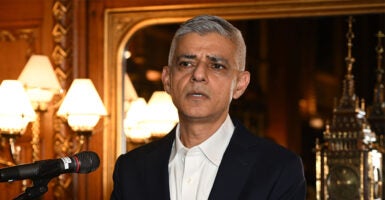
Those critics link this to Muslim Mayor Sadiq Khan’s oversight. A December Policy Exchange report slams “two-tier policing” and recommends that Khan lose control over impartiality failures. Khan denies bias, citing crime drops, but the report ties his policies to trust erosion and protest disparities. Findings spark calls for reform and transparent accountability.
Examples include protected pro-Palestine marches and stricter policing of anti-immigration protests. Critics cite inconsistent responses to different groups and events, calling for change.
From an American perspective, these developments are seen as analogous to the silencing of conservative and Christian voices on university campuses.
In the U.K., the issue is framed as a challenge to national identity, exacerbated by perceptions of policing that prioritize Muslim communities. This situation prompts broader reflection on how increasing diversity affects the nation’s cultural heritage.
The expansion of areas with significant Muslim populations is viewed by some as testing the limits of societal tolerance, particularly when demands for deference are perceived to be enforced through threats or policing practices seen as favoring Muslim communities. This dynamic raises questions about the sustainability of multiculturalism in the absence of mutual respect for longstanding traditions.
Proposed amendments to the Crime and Policing Bill regarding protests near places of worship may further institutionalize disparities and exacerbate existing societal divisions.
The march signals a shift: exclusion risks confining Christian heritage to books. Without equality, Britain’s Christian principles yield to fragmentation with an Islamic veto, aided by anti-Christian police. This calls for defending fundamental values.
The American experience with the First Amendment serves as a cautionary example regarding how tensions and perceived bias can undermine fundamental freedoms. These issues are increasingly relevant in global discussions on religious liberty and underscore the importance of advocating for balanced coexistence.
We publish a variety of perspectives. Nothing written here is to be construed as representing the views of The Daily Signal.

