


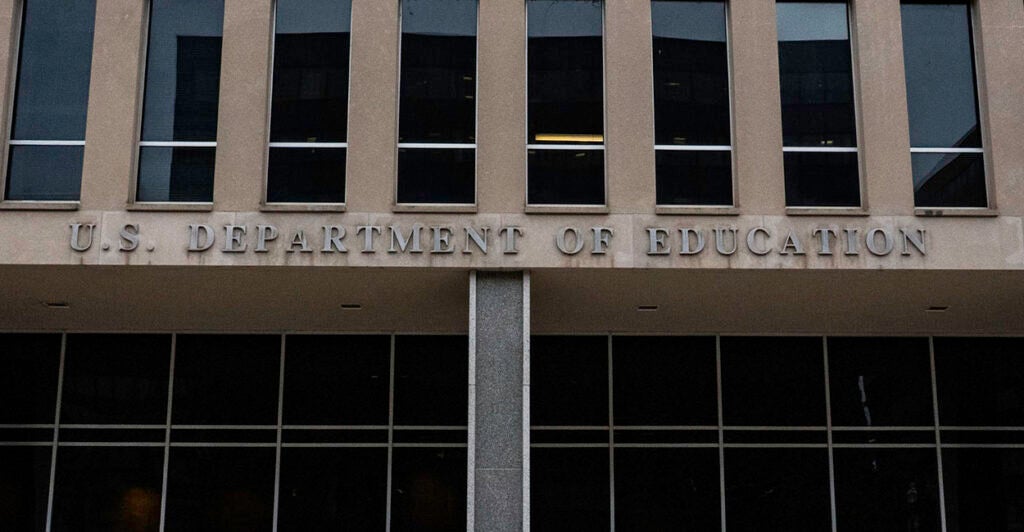
Rep. Rosa DeLauro criticized House Republicans last fall for passing a downsized education budget, accusing them of attempting to “eliminate public education” and “decimate support for children in K-12 schools.” The charge was overdramatized and incorrect.
Federal education funding accounts for roughly 10% of total K-12 spending nationwide. Despite decades of increasing federal investment, student achievement has stagnated. Math and reading scores on the Nation’s Report Card are at or near historic lows. The Department of Education has existed only since 1980, making it younger than most members of Congress.
This week, the Senate is set to vote on the final spending bill for fiscal year 2026, which includes funding for the Department of Education. The bill represents a striking reversal from what the House of Representatives advanced just months ago, and from what the president himself requested.
The House version passed out of the Appropriations Committee last September would have cut education spending by roughly 15%, reducing the Department’s budget to about $67 billion. That approach aligned with the president’s fiscal year 2026 request and reflected a long-overdue recognition that federal education programs are duplicative and ineffective. At the same time, the president explicitly preserved funding for Title I and IDEA, ensuring that low-income students and students with disabilities would continue to receive support.
The president’s budget also proposed consolidating 18 competitive grant programs into a single $2 billion formula grant, giving states greater flexibility to distribute funds and set priorities.
Yet after closed-door negotiations, the final conference bill does the opposite. The bill allocates roughly $79 billion for the Department of Education, an increase of $217 million over fiscal year 2025 levels. It boosts funding for charter schools, rural education programs, and Impact Aid, while preserving nearly every K-12 program House Republicans previously sought to right-size. Only modest cuts were made to the Institute of Education Sciences and the Education Innovation and Research grants.
In short, right-of-center lawmakers walked away from their own reform agenda.
That retreat matters because the underlying programs have failed to deliver results. Title II, Part A, which funds teacher and principal professional development, has failed to raise student achievement. The president rightly proposed consolidating program funding into a single State formula grant program that would give states and localities greater flexibility to use the funds for a range of education activities consistent with their community’s needs, rather than just for professional development. In the conference version of the bill, Congress decided to keep level funding and maintain its dedicated line budget.
Per-pupil education spending is already at record levels. In inflation-adjusted terms, spending per student has more than tripled since the mid-1960s, rising from $5,053 in the 1963-64 school year to $18,614 in 2020-2021. Over the course of the 20th century, real per-pupil spending increased by an average of 3.5% per year.
Lawmakers also appear to have forgotten recent history. In response to the pandemic, Congress poured nearly $190 billion in emergency funding into K-12 schools, the largest infusion of federal education funding in U.S. history, and it took most states years to spend it down, even as enrollment was declining.
Those enrollment declines are not temporary. Due to falling birth rates, districts are projected to lose between approximately 3 million and 6.5 million students over the next 25 years. At the same time, families are increasingly choosing alternatives to traditional district schools, such as charter, private, or parochial schools, putting further pressure on status quo funding structures.
Given stagnant academic outcomes, the unprecedented surge in post-pandemic federal spending, declining student enrollment, and growing demand for alternatives to district schools, expanding or even maintaining federal education spending is far from the right choice.
If right-of-center lawmakers are serious about improving education outcomes and restoring fiscal discipline, they should return to first principles: reduce federal overreach, consolidate ineffective programs, block-grant remaining funds to the states, and consider proposals that wind down the Department of Education.