

















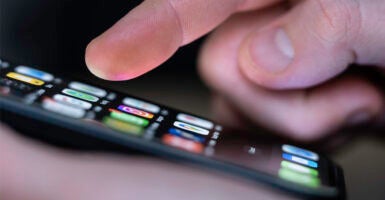
In the years ahead, artificial intelligence has the potential to transform how we work, learn, communicate, travel, and live. In Tennessee and across America, we are already seeing what this emerging technology can accomplish.
In Nashville, health care companies are developing new AI-powered tools to improve diagnostics, monitoring, patient scheduling, and task management. Across the state, manufacturers—from Nissan’s Smyrna assembly plant to LG Electronics’ Clarksville plant—are integrating AI into their production processes to spot defects, lower costs, and increase efficiency.
While scientists at the University of Tennessee, Knoxville, are studying how AI can strengthen our nation’s hypersonic defense, researchers at nearby Oak Ridge National Laboratory are using Frontier—the second-fastest supercomputer in the world—to develop AI models that support nuclear energy.
These incredible developments represent just a fraction of the work Americans are doing every single day to develop this promising technology. John Deere, which first opened doors in 1837, is incorporating AI in its farming equipment to improve performance and better target weeds.
Banks from Wells Fargo to Capital One are using the new technology to detect and prevent fraud. AI powers SpaceX’s autonomous rocket launches and landings, reducing the cost of space travel for NASA and American businesses.
Nationwide, AI could significantly boost economic growth, with estimates of gross domestic product gains ranging from hundreds of billions to trillions of dollars. Even as we realize AI’s potential, however, communities across the country are confronting the unintended harm it poses.
No state is more familiar with these drawbacks than Tennessee.
While our world-famous creative community explores innovative uses of AI, bad actors are using AI technology to steal artists’ voices and likeness to create new songs without their consent—directly threatening their livelihoods.
Just last month, an AI-generated song, “Walk My Walk,” reached No. 1 on Billboard’s Country Digital Songs Sales Chart, racking up millions of streams. The only problem? The song mimicked the voice and likeness of country star Blanco Brown without his permission. The month before, an unauthorized, AI-generated album purporting to be recorded by country legend Don Williams—who passed away in 2017—appeared on streaming services, like Spotify and Amazon Music, featuring an AI-produced image of Williams on the cover. Such abuses of AI could reduce artists’ incomes by a quarter within the next four years.
Unfortunately, this misuse represents just one way AI is harming Americans. Predators are using AI to produce child sexual abuse material, while AI chatbots have sexualized children in role-playing fantasies. AI data centers have sent energy costs soaring for host communities by as much as 267%. AI models have demonstrated systemic bias against conservatives, going so far as to fabricate entire criminal allegations against them, including me.
In the absence of congressional action, state governments have stepped in to protect their citizens from AI-related harm.
Tennessee, for example, enacted the ELVIS Act, which protects artists from having their voice and likeness used in unauthorized music. To preserve such protections, I led the fight last year to defeat an AI amnesty proposal that would have decimated state AI laws across the country, succeeding by a decisive 99-1 vote in the Senate. This victory garnered national attention, and it was an honor to be recognized alongside other world AI leaders following this effort.
Instead of implementing a blanket AI moratorium that would eliminate state protections without federal laws to replace them, President Donald Trump issued an executive order last month that calls on Congress to pass federal standards as part of a national AI policy framework.
To that end, I recently unveiled the framework for my TRUMP AMERICA AI Act, which would preempt state protections with strong federal guardrails that both encourage innovation and protect Americans from Big Tech exploitation—all while ensuring that America remains the global leader in technology.
The bill provides protections for what I call the four Cs: children, creators, conservatives, and communities.
To protect children, the legislation would place a duty of care on AI developers in the design, development, and operation of AI platforms to prevent and mitigate foreseeable harm to minors. It would also include my Kids Online Safety Act to ensure social media platforms are safe for children by default.
To protect creators, the legislation includes my NO FAKES Act to protect artists from unauthorized replications of their work. It would also create a federal right for individuals to sue companies for using their data and copyrighted material for AI training without explicit consent.
To protect conservatives, the bill would require high-risk AI systems to undergo regular bias evaluations to prevent discrimination based on protected characteristics, including political affiliation.
To protect communities, the legislation would require data center operators to be responsible for the full cost of all energy and water infrastructure needed for their operation, including construction, maintenance, and upgrades, with no impact on ratepayers
I look forward to introducing this legislation and getting it to Trump’s desk as soon as possible. By encouraging responsible innovation while protecting Americans from AI’s harms, the TRUMP AMERICA AI Act would secure a brighter future for generations to come.
We publish a variety of perspectives. Nothing written here is to be construed as representing the views of The Daily Signal.

