

























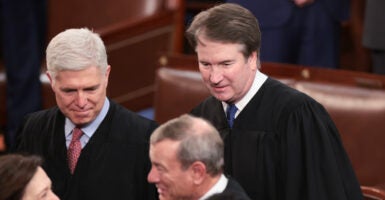
The Supreme Court heard arguments Tuesday over Hawaii’s ban on carrying a handgun in public accommodations—such as stores, restaurants, and gas stations—without the property owner’s permission.
Alan Beck, lawyer for the plaintiffs, said that entering such spaces is an “implied right,” unless the property owner opposes. He said Hawaii’s law flips that presumption and requires the property owner’s prior consent.
Neal Katyal, attorney for Hawaii and former acting U.S. solicitor general, argued the state law protects private property rights, and asserted, “it’s pretty clear an invitation to shop is not an invitation to bring your Glock.”
The ruling in the case of Wolford v. Lopez, expected this summer, will apply to any state that seeks to regulate guns. At least four other states have laws similar to Hawaii’s restrictions.
During Tuesday’s oral arguments, Justice Sonia Sotomayor asked, “Is there a constitutional right to enter private property with a gun, without an owner’s express or implicit consent?”
Beck answered, “No. You can’t enter an owner’s property without their consent, correct? Express or implicit. Correct, because that would be a trespass your honor.”
Beck argued the question, instead, was “carrying on private property that’s open to the public.” He added that Hawaii’s law preemptively bans possession of a gun in privately-owned spaces that are open to the public, rather than leaving it up to the owner to prohibit entry with a firearm.
“Every private property owner has the right to affirmatively put up a sign or otherwise not give permission for people to enter a property with a firearm,” Beck said.
“The crux of our argument is that clients flip that historical default from them having to affirmatively say ‘guns are not allowed here’ to the current law.”
Hawaii’s Act 52 enacted the policy after the Supreme Court’s 2022 decision in New York State Rifle & Pistol Association v. Bruen. That ruling struck down New York’s law requiring concealed carry holders to demonstrate a need for self-defense.
Hawaii’s Act 52 states that someone with the license to carry a handgun may not “enter or remain on private property of another person while carrying a loaded or unloaded firearm … unless the person has been given express authority.” The law applies regardless of whether the property is open to the public.
Four other states have similar laws: California, Maryland, New York, and New Jersey, according to SCOTUSblog.
The high court is hearing the case because of a circuit split. The 2nd U.S. Circuit Court of Appeals struck down the New York law. The 3rd U.S. Circuit struck down New Jersey’s law. However, the 9th U.S. Circuit upheld Hawaii’s law.
Hawaii points to a 1771 New Jersey law and an 1865 Louisiana law as precedent of states requiring the prior consent of a property owner for someone to enter the property with a gun.
Justice Neil Gorsuch noted that Louisiana law was part of the “black codes” aimed at discriminating against the rights of freed slaves to defend themselves against violence in the post-Civil War era.
“You rely very heavily on an 1865 black code law in Louisiana. You say it’s a dead ringer, and a reason alone to affirm the judgment,” Gorsuch said. “I want to understand how you think black codes should inform this court’s decision-making.”
Katyal stressed that black codes were a shameful part of American history, but argued that this particular law was race-neutral. He noted that the Republican Congress admitted Louisiana back into the union with this law intact.
“The United States Congress, the same Congress that ratified the 14th Amendment, implicitly blessed [the law] by admitting Louisiana back in,” Katyal said.
When Gorsuch earlier asked plaintiffs’ lawyer Beck about the Louisiana law, Beck said that Hawaii’s law is not comparable since the Louisiana law was intended to discriminate.
Justice Samuel Alito told Katyal, “You’re just relegating the Second Amendment to second-class status.” He presented a First Amendment hypothetical.
“If someone owns a store, or let’s say it’s a little restaurant, and this person has very strong political opinions, and does not want anybody in that restaurant who is wearing attire that is expressing approval of a particular political candidate, the owner of that restaurant has the right to say, you can’t come in, right?”
Katyal answered, “Yes.”
Alito followed, “Could Hawaii enact a statute that says that if you were wearing the attire expressing approval of a particular political candidate, you cannot come in unless you get express consent from the owner of the restaurant?”
Katyal conceded that it would be unconstitutional viewpoint discrimination, but added that the Second Amendment does not have “the same components” as the First Amendment.

