












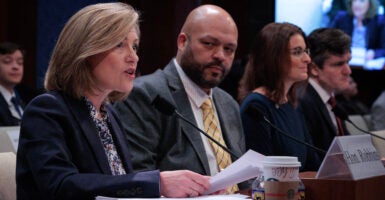
Congress probed the matter of what Minnesota Gov. Tim Walz knew about the $9 billion fraud scandal in his state at a hearing on Wednesday.
Several Minnesota state lawmakers, who have investigated fraud in the state for the past year, testified at a hearing of the House Oversight and Government Reform Committee about what they learned from whistleblowers.
They testified two days after Walz dropped his reelection bid for a third term as governor amid years-long welfare fraud scandals in the state. Federal prosecutors have charged almost 100 in Minnesota so far with welfare fraud.
The witnesses claimed that Gov. Walz knew about fraud scandals as they were occurring, alleged that the state intimidated whistleblowers, and broached the possibility of funding of foreign terrorism.
Here are four key takeaways from Wednesday’s hearing.
1. ‘Any Doubt That Tim Walz Knew?’
The scandal hit home for House Majority Whip Tom Emmer, R-Minn., who blamed Walz and Minnesota Attorney General Keith Ellison for not preventing it.
He asked the members of the Minnesota House Fraud Prevention and State Agency Oversight Policy Committee if they believed Gov. Walz knew about the fraud as it occurred.
The three state committee members were Chairwoman Kristin Robbins, and state Reps. Walter Hudson and Marion Rarick. Each said they had no doubt, or “none whatsoever,” that Walz knew.
Later, Oversight Committee Chairman James Comer, R-Ky., asked Robins, “Do you have any examples of how the Walz administration blocked investigators from moving forward?”
Robins said that an inspector general investigation of the state’s human services department–at the center of the state’s fraud scandals–was shut down.
“They were told they could no longer do criminal investigations,” Robins said.
For his part, Walz has said he is trying to root out fraud, and did not benefit from it.
2. ‘Constant State of Fear of Retaliation’
Minnesota state Rep. Marion Rarick, a Republican member of the Minnesota House Fraud Prevention and State Agency Oversight Policy Committee, gave several examples of state bureaucrats intimidating whistleblowers.
“They have explained that they live in a constant state of fear of retaliation,” Rarick said.
She gave the example of a state employee who notified supervisors at the Department of Human Services about “sloppy contracting practices,” and who was subsequently escorted from the building.
“In our face-to-face meetings with a group of whistleblowers, they reveal that retaliation now includes threats of being fired with cause, which means you do not get unemployment insurance in the state of Minnesota, being blacklisted from all state agencies,” Rarick continued.
Rarick noted that In April 2024, Minnesota Lt. Gov. Peggy Flanagan publicly called state employees who raised concerns about potential fraud “weirdos and losers sitting in their mother’s basement.”
3. Evidence of Terrorism Funding
Rep. Byron Donalds, R-Fla., asked about financial ties of fraudulent welfare recipients to international terrorist networks. Robins said that an informal network of money exchangers transmits money to Somalia.
“So, United States dollars that have been remitted into Somalia, in part, have been utilized, or have fallen into the hands of Al Shabbab?” Donalds asked Robins.
Al-Shabaab is a Somalia-based terrorist network linked to Al Qaeda.
Robins answered, “We have plenty of evidence of that from money directly going to Al-Shabbab, but then also indirectly because they take a cut of whatever gets sent to Somalia.”
4. Trump, George Santos, and Anything but Minnesota
Democrats on the committee used most of their time to talk about President Donald Trump and subjects other than the Minnesota fraud scandal.
Oversight Committee ranking member Rep. Robert Garcia, D-Calif., said, “some of the worst fraud and corruption is actually found at 1600 Pennsylvania Avenue.”
Rep. Ayanna Pressley, D-Mass., called the witnesses “hypocrites” and asked them to comment on expelled Rep. George Santos, R-N.Y., as well as the Jan. 6, 2021, protest at the Capitol.
After Pressley exceeded her allotted time, Comer stopped her to say, “You’ve already secured your MSNBC spot tonight.”
Rep. Melanie Stansbury, D-N.M., was one of the only Democrats to acknowledge the Minnesota fraud, saying, “This, of course, comes after weeks of viral videos from a young man YouTuber who was literally creeping around daycares by himself.”
The lone Democrat-called witness, Brendan Ballou, former special counsel for the Justice Department, said, “I fear that the actions of a few people will be used to demonize an entire population, Somali, East African, Minnesotans.”
Robins said exposing fraud was not targeting the Somalian population.
“It is true that the majority of the fraud in Minnesota has taken place in the Somali community, and it is also true that some of our best whistleblowers are from the Somali community,” Robins said.

