

















The Supreme Court will decide on several cases in 2026 that revolve around President Donald Trump in the near term but will have far-reaching consequences for future presidents.
Here are the biggest high court decisions to watch for in 2026.
First out of the gate, a case that will affect state laws across the country regarding women’s sports.
1. Deciding on Men in Women’s Sports
The first major case to be argued in 2026 comes Jan. 13, when justices will hear arguments in combined Idaho and West Virginia cases. The cases of Little v. Hecox and West Virginia v. B.P.J. will affect 25 states with laws preventing biological males from competing in women’s sports.
“These are the cases in which states have banned biological males from competing in women’s sports and that’s a very, very important decision,” Han von Spakovsky, a former senior legal fellow at The Heritage Foundation, told The Daily Signal. “It’s going to affect women and girls in K-12 sports in many different states.”
The arguments could also have federal implications since Trump signed an executive order in February to withhold federal funds from states that allow biological males to play in women’s sports.
In 2020, Idaho lawmakers enacted the Fairness in Women’s Sports Act, banning men and boys from competing in women’s and girls’ sports across all ages and levels of competition.
Lindsay Hecox, a self-identified transgender athlete who wanted to be on the women’s track and cross-country teams at Boise State University, sued the state, and lower courts sided with the athlete, including the 9th U.S. Circuit Court of Appeals.
In the West Virginia case, a transgender middle school student wanted to play on the female sports teams at her school. The 4th U.S. Circuit Court of Appeals ruled West Virginia’s law violates Title IX, the federal law that prohibits sexual discrimination in educational programs and school athletics.
2. Tariffs Mark First Test for Emergency Law
The Supreme Court could decide early in 2026 on Trump’s executive action to impose sweeping tariffs, part of his core economic and trade policy.
During oral arguments in November, even Trump-appointed justices seemed skeptical of the government’s arguments.
Two private companies sued in May after Trump’s “Liberation Day” tariffs announcement on foreign goods in the case of Learning Resources, Inc. v. Trump.
“The tariffs case is the gorilla in the room, the blockbuster case,” Thomas Berry, director of the Robert A. Levy Center for Constitutional Studies at the Cato Institute, told The Daily Signal, “This extends well beyond the issue of tariffs and into the executive power of future presidents.”
At issue is whether the president exceeded his executive branch authority by imposing tariffs under the 1977 International Emergency Economic Powers Act, which is intended to address emergencies only. Normally, trade policy, including tariffs, is enacted through legislation in Congress and signed by the president.
This is uncharted waters for the Supreme Court, which has never ruled on how far the International Emergency Economic Powers Act could go, von Spakovsky said.
“Keep in mind that the statute under which the president acted, which was passed in the early 1970s, they’ve never considered that statute,” von Spakovsky said. “We have no precedent really to go on because this is the first case.”
3. Reversing Birthright Citizenship?
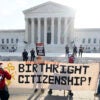
In early December, the high court agreed to hear arguments on Trump’s executive order to end birthright citizenship. Under Trump’s order, agencies would not recognize citizenship for U.S.-born children who do not have at least one parent who is an American citizen.
Birthright citizenship is the view that anyone born in the United States, even a child of illegal immigrants, is automatically a U.S. citizen.
This has the potential to overturn a Supreme Court precedent going back to 1898, when the majority upheld birthright citizenship under the 14th Amendment, which was enacted to grant citizenship to freed slaves after the Civil War.
“In the birthright citizenship case, Trump could be running into rough waters,” Paul Kamenar, counsel for the National Legal and Policy Center, told The Daily Signal. “But the current precedent is based on a 1898 Supreme Court ruling, which is way different from what is happening now.”
The disputed provision of the 14th Amendment states, “All persons born or naturalized in the United States, and subject to the jurisdiction thereof, are citizens of the United States and of the State wherein they reside.”
The point of contention in the case is the phrase, “subject to the jurisdiction thereof,” which Solicitor General D. John Sauer has argued was misinterpreted by the court’s late 19th-century ruling.
4. Scrapping Humphrey’s Executor
In what could be a powerful blow against the deep state, a majority of justices seems poised to reverse the 90-year-old precedent of Humphrey’s Executor.
This specific case regards Trump’s ouster of Federal Trade Commissioner Rebecca Slaughter, but it will affect other federal boards and commissions with members appointed by Republican and Democrat presidents. The members, in theory, operate without political concerns. They serve for a set term until it expires, regardless if a new president of a different party assumes office during that term.
The high court, in the 1935 precedent in Humphrey’s Executor v. United States, ruled Congress could enact laws limiting the power of a president to fire executive officials of an independent agency.
“We are not big fans of executive power, but overturning Humphrey’s Executor will make the president more accountable,” said Berry of the Cato Institute. “The problem with so-called independent executive agencies is that the president can avoid accountability. He can say, the agency did it. The president should be checked by Congress and the courts, not by appointees of the prior president. The framers never had that intent.”
5. Politics and the Federal Reserve
On Jan. 26, justices will hear a case of Trump v. Cook. In an October emergency docket ruling, the court ruled that Federal Reserve Board Governor Lisa Cook could keep her job—for now—after Trump attempted to oust her.
The question in the case is whether a president can fire a member of the Federal Reserve Board of Governors or whether the organization created in 1913 is independent.
It’s not the same question as the posed in the Humphrey’s Executor matter. Although Kamanar, of the National Legal and Policy Center, anticipates Trump will win the FTC case, he said the Federal Reserve could be viewed as an entirely different institution.
“The Federal Reserve board is different from the SEC, the FTC, or the FEC,” Kamaner said, also referencing the Securities and Exchange Commission and the Federal Election Commission. “The Federal Reserve is funded through the private banks, not by Congress.”
Members of the board are appointed by the president and confirmed by the Senate, but Trump’s ouster of Cook marked the first time a president removed a board member.

