
































Americans grappling with affordability just got a helpful boost from the Trump administration, which on Friday announced a new push to reduce health care costs.
The move helps patients get health care prices upfront rather than astronomically high surprise bills later.
The new Transparency in Coverage (TiC) proposed rule will improve data structure, reduce unnecessary file size and increase usability. This will make transparency easier to analyze and more accessible to employers, researchers and innovators working to lower health care costs.
By receiving prices upfront in a clear, easy-to-use format, Americans can shop around for the best provider at the lowest cost—driving more competition and empowering patients. Friday’s move was announced jointly by the Department of Health and Human Services, Centers for Medicare & Medicaid Services, Department of Labor, and Treasury Department.
President Donald Trump already fought hard in his first term to improve health care price transparency, and Friday’s announcement continues that momentum which continued in Trump’s February executive order.
In December 2020, Trump also signed the No Surprises Act, meant to provide patients detailed upfront price information about their care. But the Biden administration delayed implementing these policies, and the American people never saw the full benefit of price transparency.
Additionally, the Consolidated Appropriations Act of 2021 requires insurance companies and brokers to reveal all historical claims data and broker fees while also removing gag clauses. Hospitals must not surprise patients with bills after insurance companies refuse to pay more.
Yet these regulations are rarely followed, in part due to the HHS only very rarely assessing penalties against noncompliant hospitals. Critics argue these penalties are also tiny relative to the operations of these medical giants, simply a small cost of doing business.
As a result, health care costs—especially hospital prices—have far outpaced overall inflation for decades in the United States. Taxpayer health care subsidies may move money around, but they do not address the underlying rising cost problem—they simply throw more money at it (just like taxpayer-subsidized student loans, which incentivize skyrocketing tuition hikes well above inflation).
There’s a simple reason health care prices skyrocket above overall inflation: no free and fair competition. Costs for hospital services in particular have seen the highest rates of inflation among major U.S. consumer goods and services, per economist Mark J. Perry.
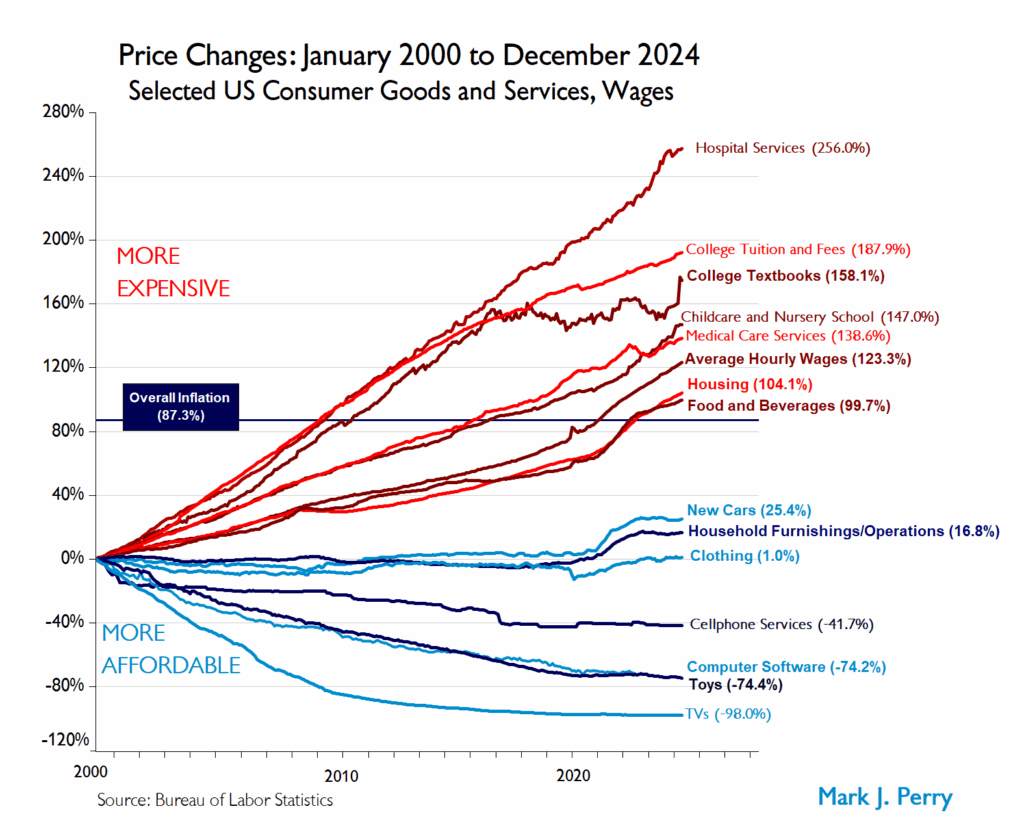
Critics of America’s health care system argue that’s happening at hospitals, which comply with government rules on health care price transparency just 17% of the time.
This data is according to the non-profit advocacy group Patient Rights Advocate (PRA), which found less than 17% of hospitals in their published review are fully compliant with the federal Price Transparency Rule.
Imagine if car mechanics performed safety checks on only 17% of a car, restaurants only served 17% of a steak and taxis dropped riders at correct addresses just 17% of the time.
Patient Rights Advocate found just 16.8% of hospitals reviewed were posting sufficient dollars and cents prices to allow consumers financial certainty when making health care decisions. The advocacy group also reported that prices within the same hospitals varied wildly, up to more than 40 times.
For example, cervical spinal fusion at the University of Kansas Hospital Main Campus ranged from a low of just $650.00 to a high of $26,100.59.
Patient Rights Advocate also reported that prices across hospitals in the same state varied as much as nearly 469 times—far more than non-health care goods and services among various metro areas within a state. For example, a mammogram of both breasts in Florida ranged from a low of $32.00 at Cleveland Clinic Martin North in Stuart, Fla., to a high of $15,000.00 at HCA Florida North Florida Hospital in Gainesville, Fla.
In economic terms, these wide price variations are in part due to information asymmetry, which limits negotiating power, especially for smaller entities and individual consumers.
A bipartisan legislative effort also seeks to permanently counter rising costs by improving competition through price transparency because America’s working families deserve relief from rising cost-of-living expenses.
The Patients Deserve Price Tags Act, introduced by Sens. Roger Marshall, R-Kan., and John Hickenlooper, D- Colo., would strengthen the requirements for hospitals to disclose their prices and empower patients to make informed choices. It would also increase the penalties and enforcement mechanisms for non-compliant health care providers.
Economists and academics in a November open letter to the U.S. Senate estimated that full health care price transparency could save the U.S. economy $1 trillion annually. It will end the era of secret prices, surprise medical bills and unchecked middlemen who profit from confusion.
By acting now, Trump and his allies are delivering a victory that will significantly reduce health care costs and improve affordability.
Carrie Sheffield is a senior policy analyst at Independent Women’s Voice and author of ”Motorhome Prophecies: A Journey of Healing and Forgiveness.”
We publish a variety of perspectives. Nothing written here is to be construed as representing the views of The Daily Signal.

