


















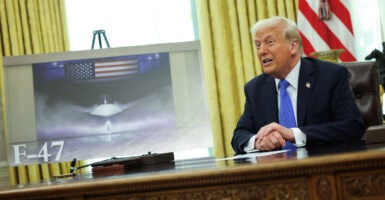
As of Friday, President Donald Trump is considering signing an executive order which would reclassify cannabis (marijuana) from Schedule I of the Controlled Substances Act of 1970 (CSA) to Schedule III. That unprecedented action would allow physicians to prescribe cannabis to treat patients’ medical ailments.
The president’s decision to reschedule marijuana would be a mistake on multiple levels, as I have explained previously.
Executive Orders Cannot Take the Place of Agency Notice and Comment Rulemaking Procedures
Most presidents make policy in the White House and leave the actual lawmaking to the relevant administrative agencies.
Here, those agencies would be the U.S. Department of Justice, the Drug Enforcement Administration and the Food and Drug Administration.
By contrast, Trump prefers to issue executive orders to combine policy and law into one ukase. That is a mistake.
Congress did not create the administrative process because Congress has tried to take decision-making authority away from the president.
Instead, agencies were created to complete a notice and comment period because the public needs to know what expert federal agencies, like the FDA, think about an issue involving a drug like cannabis.
The agencies use the APA “notice and comment” period to solicit opposing information, evidence, and arguments.
By issuing an executive order, the notice and comment period becomes a farce because the outcome is fixed from the outset. It is a fait accompli. Unless the agency officials want to be fired, they must reach the conclusion that the president ordered them to find.
Moreover, the president can force agencies to remain silent about their views on an issue even after the APA process is completed.
If they don’t want to be dismissed, agency officials asked “Is the cannabis plant ‘safe’?” can say no more than that “The President has decided the issue, and I must obey his order.” As a result, the public aren’t informed about the pros and cons.
The Cannabis Plant is Not a “Safe” Drug
On the merits, the cannabis plant is not a “safe” drug.
More importantly, the FDA has never found botanical cannabis to be safe, and the agency could not make that finding today.
Cannabis is currently Schedule I, the category for drugs lacking a legitimate medical use. For 87 years, the nation has entrusted the FDA with the responsibility to decide what is a “drug” and what drugs are “safe.”
Why is botanical cannabis unsafe?
First, today’s cannabis sold is far more powerful than the version smoked at Woodstock.
Back in the 60s and 70s, the THC content was 3-6%. Now, some concentrated products approach a 100% THC content, meaning that comparing the two is the same as comparing near beer to grain alcohol.
That difference matters.
Most recent studies have found significant risks in use of today’s ganja.
Second, growing evidence links cannabis use to adverse physical problems such as oral, head, and neck cancers; cardiovascular disorders; pulmonary disease; acute, short-term hallucinations; earlier onset of psychosis; Cannabis Hyperemesis Syndrome; harm to the adult executive functioning of unborn or nursing children; reduced IQ; childhood poisonings.
Atop all these side-effects are also adverse social outcomes such as amotivational syndrome; increased school absenteeism; and a reduced likelihood of graduating high school, enrolling in a university, or completing higher degree requirements. Heavy cannabis users and people who begin its use as minors and continue into adulthood are particularly susceptible.
Third, the cannabis plant can contain a host of dangerous, unhealthy, or disgusting contaminants, such as a microbials (e.g., E. coli, fungi, mold), toxins (e.g., aflatoxins), hazardous chemical solvents remaining from the extraction process (e.g., butane, hexane, propane), pesticides (e.g., organophosphates), heavy metals (e.g., arsenic, cadmium, lead, mercury), and other harmful (e.g., formaldehyde) or distasteful (e.g., insects) substances.
Fourth, the claim that no one has died from smoking cannabis is a canard. Rescheduling cannabis as Schedule III will lead to increased use, and some users will drive under its influence, crash their vehicles, or harm and kill other drivers.
States with medical or recreational cannabis programs have already seen that occur.
The FDA has found that some cannabis plant ingredients have legitimate medical uses, such as synthetic THC analogues dronabinol (Marinol) and nabilone (Cesamet) for treatment of chemotherapy-induced nausea and emesis. However, this is only the case when those ingredients are properly manufactured by a reputable pharmaceutical company—not by members of Chinese transnational criminal organizations, Dwight “The General” Manfredi, or hippies left over from the 1960s. The FDA could not find that the plant itself is “safe.”
The Cannabis Plant is Not an ‘Effective’ Drug
The most common justification is that cannabis has a calming effect, and therefore a legitimate alternative to opioids for pain. But cannabis is too weak to substitute for opioids as a treatment for severe pain—in fact, cannabis use hinders cessation of opioid use by anyone trying to kick an opioid dependency—and scientific proof is lacking that THC is a valid treatment for lower levels of pain.
“[E]very intoxicant would pass that sort of test because you don’t experience pain as acutely when you are high. If weed is a pain reliever, so is Budweiser,” as Dr. Peter Bach, director of the Center for Health Policy and Outcomes at the Memorial Sloan Kettering Cancer Center, explained.
The Cannabis Plant is Not a ‘Uniformly Made’ Drug
To be FDA approved, a drug must contain precise and uniform ingredients, formulations and potency in every batch.
Cannabis plants cannot qualify because of differences in their genetics, region, cultivation conditions, growing environment, growth conditions, harvesting stage, and storage time.
Cannabis and its products are sold as the botanical flower (and its components), hash, hash oil, ointments, and edibles, whether solid (e.g., brownies or “Gummy Bear” look-alikes) or liquid (e.g., soft drinks or sauces). Those forms vary in their composition and potency. A physician in Maine would have no assurance that the cannabis grown (or processed) in that state is the same as what is grown (or processed) in the other 49.
The Chinese Will Laugh at Us if We Reschedule Cannabis
The primary beneficiaries of any rescheduling decision will be the Chinese transnational criminal organizations who control 75% of the illegal cannabis industry—which means that the Chinese Communist Party and the People’s Republic of China will also benefit.
CCP and PRC’s profits from selling black market cannabis will help underwrite their efforts to become the leading military and economic power in the 21st century. If the president reschedules cannabis, the next sound that you hear from Beijing will be laughter.

