



























Amid their push to pass ambitious health care legislation, Republicans have many proposals, but no clear path to consensus.
At the end of the year, President Joe Biden’s COVID-19-era boosts to premium tax credits are set to expire.
Democrats’ messaging on the issue has repeatedly accused Republicans of taking away Americans’ health insurance, putting pressure on Republicans to deliver a popular health care package to counter their messaging before year’s end.
On Thursday, as expected, both a Republican and a Democrat health care bill to address this issue failed to reach the 60-vote threshold necessary to come to a final vote.
One was the Democrat proposal to simply extend the enhanced credits for three years, while the other was the Republican-backed overhaul from Sens. Bill Cassidy of Louisiana and Mike Crapo of Idaho, which would allow the credits to expire.
The vote to end debate on the Democrat bill and bring it to the floor failed by a 51-48 margin. The cloture vote on the Republican bill also failed 51-48.
Cassidy and Crapo’s bill would put in place of premium tax credits new health savings accounts that would have funds deposited by the Department of Health and Human Services. The funds could not be used for abortion or gender-transition procedures.
Additionally, the Cassidy-Crapo bill would widen plan options for consumers and include provisions to prevent taxpayer funds from going to illegal immigrants and transgender procedures.
Alaska Republican Sens. Lisa Murkowski and Dan Sullivan both voted against it, with Murkowski telling reporters, “Well, neither proposal did it all for me. There were increments in both that I support. I also recognize that both proposals were destined to fail. So today was a bit of a messaging exercise.”
She added, “My message is, I want to see an extension to allow people a safe landing and not see this spike in inflation in premiums, and I want to see some reforms.”
Sen. Susan Collins, R-Maine, also voted against the Republican bill.
Heritage Action, a Washington-based conservative advocacy organization, whipped against the Democrat proposal Thursday, writing in a statement that the Senate Democrats’ COVID-19 subsidy extension bill “is an unserious attempt to mask the failure of Obamacare at the taxpayers’ expense.”
Of the Cassidy-Crapo proposal, they stated that it “takes a step in the right direction” but “there is so much work yet to be done to lower costs across the Obamacare and private insurance markets.”
Now that Republicans have been unable to pass the Cassidy-Crapo bill, they might look at other options.
Rick Scott’s Proposal
Republican Sen. Rick Scott of Florida, for example, has a bill that would allow states to waive having to abide by elements of Obamacare and would enable consumers to shop across state lines for plans.
These waiving states would have access to “Trump Health Freedom Accounts,” a replacement of the premium tax credits under Obamacare.
These accounts would “ensure federal dollars to support families are delivered to them directly, not funneled to insurance companies,” a statement from Scott’s office reads.
Ted Cruz’s Proposal
Republican Sen. Ted Cruz, joining together with fellow Texas Republican Rep. Chip Roy, has introduced the “Personalized Care Act (PCA),” which “expands Health Savings Accounts (HSAs), enabling millions of Americans to access and utilize these tax advantaged savings tools to manage their health care costs,” per a statement from Cruz’s office.
The bill “expands HSAs for individuals with Medicare, Medicaid, CHIP, direct medical care, health care sharing ministries, short-term limited-duration plans, and medical indemnity plans” and raises the HSA contribution limit from “$3,550 (2020 limit) to $10,800 for individuals.”
This plan would provide benefits to a much wider swathe of the population than current the premium tax credit recipients.
Like other Republican plans, it also promises flexibility in how consumers use their HSA, since it “defines direct medical care and health care sharing ministries as qualified medical expenses and not health plans or insurance plans.”
The Great Impasse
So, what comes next? Some Republicans say it is time to sit down at the negotiating table with Democrats who want to pass health care legislation before the end-of-the-year cut-off.
Sen. Mike Rounds, R-S.D., told The Daily Signal that Democrats and Republicans must have a serious talk about advancing health care policy they can agree on.
“Republicans and Democrats will get together, and we’ll start talking about where we have disagreements and where we have agreements. We’ll start working through the areas of disagreement,” he told The Daily Signal.
“No. 1 is, if you’re using taxpayer money, it has to be protected by Hyde Amendment protections that it is not using any taxpayer money for abortions. That’s critical. Second of all, we’ve got to eliminate the fraud and abuse. Both Republicans and Democrats agree on that. The Republican plan did that, the Democrat plan ignored it.”
Sen. Thom Tillis, R-N.C., who favors a temporary extension of the credits with reforms, told The Daily Signal he thinks the majority of Democrats do not want to find a solution, but there is a sufficient subsection of them to get legislation passed.
“I think a handful do [want a solution]. But fortunately, I think that there are a sufficient number,” he said. “If [Senate Minority Leader Chuck] Schumer was serious about it, serious about coming up with a solution, he’d have done something more than just a three-year extension … trying to get us to vote for something we’d already voted against.”
Murkowski told The Daily Signal she sees no point in the potential strategy of continuing to put Republican bills on the floor without negotiation.
“Well, what would that do?” she said. “I’m not interested in just more bills that don’t gain the support that we need. If it’s just a pure partisan proposal each time, I think you’re going to get the result that we saw today.”
Another Big, Beautiful Bill?
It’s worth asking whether or not Republicans might want to pursue a budget reconciliation bill to enact part of their health care agenda.
Reconciliation—a budgetary process immune to the Senate filibuster—was used to boost the premium tax credits during the Biden administration, to enact sweeping Medicaid work requirements in the July budget reconciliation bill, and was employed in Republicans’ previous failed attempt to repeal Obamacare.
In fact, conservatives in the House are already calling for it.
Rep. Josh Brecheen, R-Okla., told The Daily Signal on Tuesday, “We have the muscle memory of the Budget Committee, and that is my encouragement that we do this again. We can thread the needle and do a reconciliation part two with health care-specific changes, and that would require only 51 votes in the Senate. And let’s go big.”
But there are problems with this approach. For one thing, the premium tax credits expire in three weeks, and Republicans generally want to avoid giving Democrats a cheap talking point that the GOP let them expire without providing Americans a health care affordability alternative.
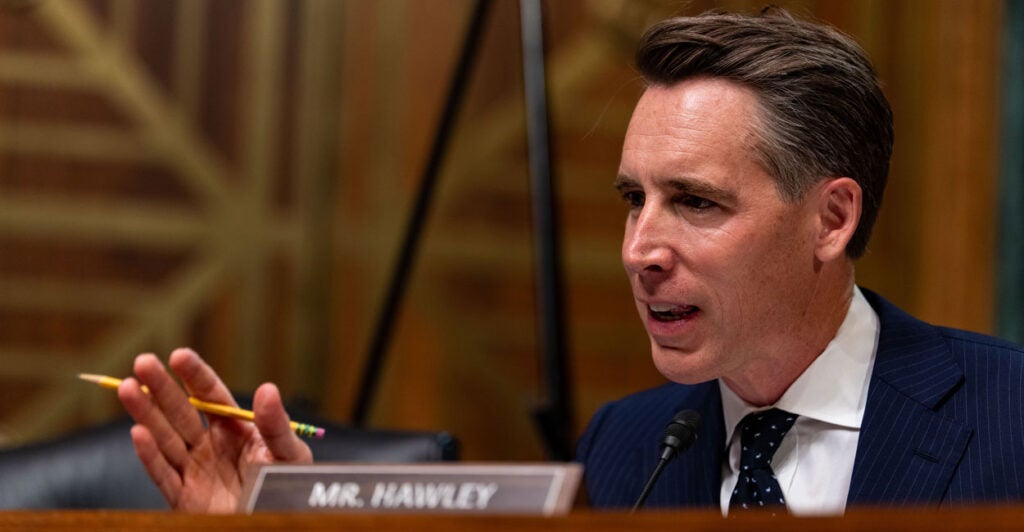
“Reconciliation is slow,” Sen. Josh Hawley, R-Mo., told The Daily Signal. “I think it’d be very difficult to do much on premiums and reconciliation, just because, I mean, realistically, we’ll be looking at a reconciliation bill sometime middle of next year. “
“I am not opposed to doing something on health care and reconciliation,” Hawley said. “We did try to do that in the last time around, a lot of that got kicked out by the parliamentarian, so I don’t think that will change.”
Budget reconciliation bills must be, as the name suggests, focused on budgetary issues. If the Senate parliamentarian—essentially the chamber’s rule-keeper—rules that these provisions are more policy-oriented than budgetary, they are struck from the bill under the Senate’s “Byrd Rule.”
Rounds told The Daily Signal after the failed vote that he is open to some use of reconciliation for the broader health care and insurance issue, but prefers a durable, bipartisan solution.
“I haven’t talked about that,” he said. “You know, you never rule out that, but I’d like to have something that would stand the test of time, and it would be better if we could do this in a bipartisan basis. And we’ll see. But right now, reconciliation is going to take a whole lot longer than negotiating on this is.”

