
















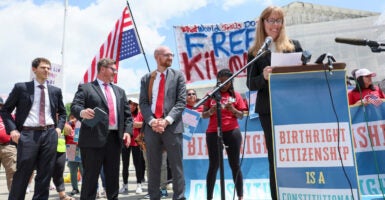
From the moment President Donald Trump issued his executive order on birthright citizenship back in January, a Supreme Court showdown on the meaning of the citizenship clause was almost inevitable. And, indeed, the nation’s highest court agreed last week to decide whether the order is constitutional, after nearly a year of high-profile litigation that has largely kept the administration from enforcing the order.
While the task of securing votes of at least five Justices likely remains an uphill battle for the Trump administration, the historical evidence in Trump’s favor is stronger now than ever.
The Background
Trump’s order directed federal agencies to stop issuing citizenship documents for children born in the United States unless at least one parent was a citizen or lawful permanent resident at the time of the child’s birth.
As I explained at the time (and again here, here, and here), the order is perfectly consistent with the original understanding and earliest applications of the 14th Amendment. The primary purpose of the citizenship clause was to permanently establish the citizenship of the freed slaves, whom the Supreme Court had earlier held were not U.S. citizens, despite having lived and died here for generations.
Congress clearly sought to remove race-based barriers to citizenship and enshrine birthright citizenship into the Constitution—but not for virtually any person born on U.S. soil under virtually all circumstances, as many people today believe. Instead, the men who drafted and debated the clause understood that birthright citizenship belongs only to the U.S.-born children of parents who, like the freed slaves, owe this nation their political allegiance and are subject to the fullest extent of its political jurisdiction.
Moreover, the lawsuits seeking to stop it are riddled with flawed arguments that badly mischaracterize the 14th Amendment’s legislative and legal history. In the last year of near-constant litigation seeking to stop Trump’s order from going into effect, the arguments put forward by advocates of universal birthright citizenship haven’t improved.
On the other hand, as more and more scholars have taken a serious look at the historical record, they’ve increasingly unearthed evidence that undermines the universal birthright citizenship narrative and significantly bolsters the Trump administration’s position.
Take, for instance, my own additional research on birthright citizenship, which will soon be published as a law review article in Texas A&M’s Journal of Law & Civil Governance.
Universal Birthright Citizenship Proponents Get History All Wrong
In the article, I tackle head-on a claim often made in support of universal birthright citizenship—that the citizenship clause reflects nothing more than Congress’ adoption of the old English common law rule of jus soli, where the mere geography of birth dictates a person’s subjection to a particular ruler. According to advocates of universal birthright citizenship, this remnant of feudalism had always been the unquestioned legal theory underpinning American citizenship, anyway.
I argue that this narrative gets history all wrong. Whatever the national consensus on citizenship may have been in the antebellum United States (and it’s not at all clear there was a prewar consensus), the political realities wrought by the Civil War led to a dramatic evolution in how the federal government understood concepts of citizenship, allegiance, and political jurisdiction.
Contrary to claims by proponents of universal birthright citizenship, when Congress drafted and debated the 14th Amendment, its operative framework of citizenship didn’t strictly adhere to the English common law.
Instead, the United States government solidified a particular set of operating principles that, at best, represented a uniquely Americanized version of the common law and required consideration of factors such as permanent domicile, intent to fully integrate oneself as a member of the nation, and lawful participation in the national body politic.
How Earlier Debates Impacted Citizenship Clause Thinking
I make this case by examining the broader political framework of citizenship in the years before and after Congress drafted the 14th Amendment, particularly by analyzing debates over drafting noncitizens during the Civil War and over the expatriation of American citizens after the war.
Just like debates over the language of the citizenship clause, these concurrent debates required Congress and the executive branch to wrestle seriously with and ultimately resolve questions about who, exactly, was subject to what extent of U.S. political jurisdiction and under which circumstances.
Throughout both debates, Congress and the executive branch drew practical lines centered around one universally agreed-upon premise: While all aliens residing within the geographic borders of the United States are subject to its laws, not all of them are subject to its complete political jurisdiction.
Yes, the debates provide evidence that when unnaturalized resident aliens avail themselves of legal processes demonstrating their intent to become citizens, the nation may at times consider them as, if not yet full-fledged Americans, then at least as something less than total strangers for purposes of invoking political rights and duties.
But otherwise, the consistent presumption throughout these debates was that even resident aliens with a lengthy and lawful presence in the country remained subjects of foreign powers over whom the United States had no claim of political allegiance and no pretense of complete political jurisdiction.
The most logical presumption is that, when these same members of Congress defined and debated the parameters of birthright citizenship, they worked within this same operative framework about who was and wasn’t subject to the nation’s political jurisdiction.
The jurisdictional qualifiers they added to the citizenship clause didn’t reflect their unqualified embrace of the English common law. Rather, they conformed the clause’s meaning to the Americanized understanding of political jurisdiction they employed in parallel debates—in this case, extending birthright citizenship only to the U.S.-born children of citizens and to the U.S.-born children of permanent resident aliens whose lawful integration into American society rendered them at least arguably subject to the nation’s complete political jurisdiction.
What Did the Author of the Phrase ‘Subject to the Jurisdiction Thereof’ Mean?
Finally, my research helps settle one of the most fiercely contested arguments in the modern birthright citizenship debate: What, exactly, did the man responsible for the phrase “subject to the jurisdiction thereof”—Sen. Jacob Howard of Michigan—mean during congressional debates over the citizenship clause when he explained that this jurisdictional language would exclude “persons born in the United States who are foreigners, aliens, who belong to the families of [a]mbassadors or foreign ministers.”
Advocates of a more limited interpretation of the citizenship clause believe that Howard meant the jurisdictional language would broadly exclude foreigners, aliens, and members of the families of ambassadors or foreign ministers. Proponents of universal birthright citizenship, meanwhile, insist that Howard meant it would exclude only those foreigners and aliens who are also members of the families of ambassadors or foreign ministers.
It’s now evident that only one of these interpretations can be squared with Howard’s well-documented attitudes and use of language regarding the nation’s political jurisdiction over noncitizens.
My article details how, during debates on alien conscription just a few years earlier, Howard consistently and ardently opposed making aliens eligible for the military drafts—even aliens who’d declared their intention to become citizens. In his view, they remained foreigners who owed their political allegiance to a foreign sovereign. The United States government, therefore, lacked sufficient political jurisdiction over them to compel their military service on its behalf.
While Howard eventually softened his stance on drafting declarant aliens, he always maintained that unnaturalized U.S.-resident immigrants were still, broadly, foreigners and aliens subject to the political jurisdiction of other sovereigns.
The most reasonable conclusion, then, is that when Howard spoke just years later of the jurisdictional limits in the citizenship clause, he likewise considered that noncitizens broadly remained outside of the nation’s political jurisdiction. In other words, he meant that the clause excluded “foreigners, aliens, [and those] who belong to families of ambassadors.”
Other Legal Scholars Strengthening Trump’s Case
Importantly, I’m far from the only scholar to uncover additional evidence over the past year that undermines the narrative of universal birthright citizenship. Just look at the critical work of professor Kurt Lash, a highly respected scholar of constitutional law and constitutional history. His forthcoming law review article demonstrates how the citizenship clause, as originally understood, excluded children born to parents bearing allegiance to a foreign government—and likely doesn’t apply to the U.S.-born children of parents who illegally enter the United States.
Professors Ilan Wurman and Samuel Estreicher have similarly joined the chorus of scholars advancing strong arguments against the universal birthright citizenship narrative.
It’s true that, over the past year, opponents of Trump’s birthright citizenship order have been the unanimous victors in lower-court battle after lower-court battle. But that year of delay has allowed Trump to secure far more scholarly ammunition than he had back in January. And it may well prove to be the reason he ultimately wins the war.

