



















The House of Representative passed the National Defense Authorization Act, an annual defense bill, by a vote of 312-112 Wednesday evening after a drama-filled day on the House floor.
The NDAA, with over a $900 billion price tag, received support from both Republicans and Democrats, a rarity this Congress, as House Speaker Mike Johnson has regularly had to pass major legislative items through the lower chamber with just a few votes to spare.
The 312 in support of the bill was divided between 197 Republicans and 115 Democrats.
Only 18 Republicans joined 94 Democrats in opposition.
Both the House and the Senate have previously passed their own versions of the NDAA, and the text is a compromise between the two.
The topline spending number set in the bill is $8 billion above the White House’s budget request and includes some major wins for conservatives.
These include a 4% pay raise for enlisted service members, ending “authorizations for use of military force” for previous Middle East wars, and a prohibition on programs related to diversity, equity, and inclusion initiatives, as well as critical race theory.
Wins also came in the form of provisions left out of the bill, such as an artificial intelligence regulation moratorium and language that would have expanded IVF coverage.
The bill additionally has oversight provisions over the executive branch.
The Pentagon would not be allowed to reduce the number of active troops stationed in Europe below 76,000 for longer than a 45-day period unless it has certified to Congress that it is in the best interest of the United States and the decision has been reached after consultation with NATO allies.
How the NDAA Almost Failed
Drama came to the chamber during the vote on the rule to bring the bill to a vote, as Democrats refused to back the annual legislation, which is often considered “must-pass” legislation.
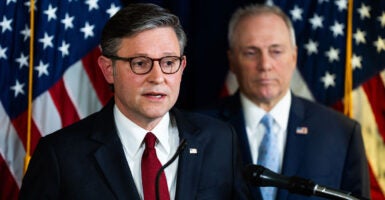
A large contingency of swing district Republicans, many of whom support extending Affordable Care Act premium tax credits, also withheld their votes for an extended period. House Majority Whip Tom Emmer, R-Minn., and Speaker of the House Mike Johnson, R-La., huddled with these members for an extended period of time before they voted for the bill.
These informal huddles on the House floor between holdouts and leadership are often used to resolve policy questions and disagreements
This group of swing district Republicans slow to make their vote included Reps. Mike Lawler and Nick LaLota of New York, as well as Brian Fitzpatrick and Rob Bresnahan of Pennsylvania.
Additionally, multiple conservative firebrands, such as Reps. Eric Burlison of Missouri, Marjorie Taylor Greene of Georgia, Anna Paulina Luna of Florida, and Lauren Boebert of Colorado, initially voted against the rule before ultimately backing it.
House Majority Leader Steve Scalise, R-La., engaged in a one-on-one conversation with Greene before she flipped her vote.
On X, Greene, who is set to resign her seat on Jan. 5, 2026, said she had struck a deal with House leadership for her support on the NDAA.
“I made a deal and changed my NO vote on the rule to a Yes in exchange for a floor vote next week on my bill that is one of President [Donald] Trump’s key campaign promises and executive orders,” Greene said. “Leader Steve Scalise has promised me that my bill Protect Children’s Innocence Act, H.R. 3492, will be brought to the floor for a vote next Wednesday, Dec 17th.”
The bill, Greene said, “would make it a class c felony to trans a child under 18. Every Republican campaigned to protect kids from the trans agenda.”
CNN correspondent Manu Raju reported after the rule vote that Rep. Tim Burchett, Luna, and Boebert had been won over after a few leadership concessions: a phone call with Secretary of State Marco Rubio, a promise of a vote on a bill to prohibit stock trading among members of Congress, and a vote on banning the potential creation of a digital U.S. dollar.
An anti-central bank digital currency provision in the bill had been left out after previously being promised to members.
Shortly after flipping her vote, Luna posted on X, “Our Secretary of State [Marco Rubio] is incredible. He talked to us on the phone and told us he is cutting off all funding of US tax or dollars to Taliban. We will be providing him with the vehicle in which that is happening!”
Burchett is the author of a bill to prevent United States funds from being sent to the Taliban in Afghanistan. It has not come to a vote in the Senate, causing frustration for Burchett.
Luna had earlier on Wednesday complained of the NDAA, “The Senate GOP is pulling some massive trash with the NDAA meanwhile undermining POTUS with his confirmations. Guess what? NO ANTI-CBDC legislation in NDAA? Taxpayer dollars for Taliban? The same POS’s that shot my husband? UKRAINE funding? NDAA in current form is NO GO sincerely WE THE PEOPLE.”
It appears that the phone call with Rubio may have been part of a deal to satisfy Luna and others’ concerns about taxpayer funds ending up in the hands of the Taliban.
The bill will now go to the Senate, where it will require 60 votes to proceed to a vote on the floor.

