



























I know, I know. We have been in the midst of a blizzard of important domestic and world events this summer, from the final week of the Supreme Court’s term with a slew of important decisions to the fight over the “Big, Beautiful Bill” to the war in the Middle East and the Russian/Ukrainian conflict. We also just celebrated the 249th birthday of the United States.
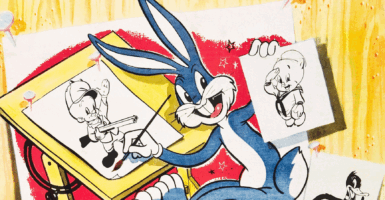
But in the midst of all this, we should not forget the 85th birthday of that beloved all-American trickster and practical joker, Bugs Bunny. A look back at the original cartoon series shows just how much that rabbit reflected the culture, the politics, and the patriotism of the times and how some of his antics wouldn’t play well for the woke generation of today.
On July 27, 1940, the wisecracking, mouthy bunny with a Brooklyn accent got his official start in the Looney Tunes classic “A Wild Hare,” in which he bamboozles and confuses the most unsuccessful and hapless hunter in American history, Elmer Fudd, for the first of many times.
For the past 85 years, in addition to Elmer Fudd, Bugs Bunny has been trouncing, defeating, and outtalking a host of surly but memorable characters, including Yosemite Sam, the roughest, toughest hombre east of the Pecos; Porky “Th-Th-Th-That’s all, folks” Pig; and Daffy Duck. Elmer Fudd never managed to catch that wascally wabbit, and the same goes for Daffy Duck, who was never able to outsmart Bugs or get the better of him.
Trouncing, defeating, and outtalking a host of surly characters? Gosh, who does that remind you of in today’s political world?
There are even two cartoons, “Operation: Rabbit” (1952) and “To Hare is Human” (1956), in which Wile E. Coyote is up against Bugs Bunny instead of his usual opponent, the Road Runner, who is on vacation, with the same disastrous results. Wile E. Coyote actually speaks in that second cartoon, something he does not do in any other appearance, except by holding up a sign, usually about something stupid that he just did.
Don’t you wish there really was a company like ACME, Wile E. Coyote’s go-to company for equipment? I know Amazon comes close, but it just doesn’t have the same expansive inventory as ACME of bombs, cannons, TNT, anvils, missiles, rocket sleds, and every other kind of fiendish device our fevered imaginations can imagine.
While kids have always liked these cartoons, they were really designed by adults for adults, since they were shown in movie theaters before the feature films. The original cartoons contain many politically incorrect scenes that these days would get them instantly criticized by the “woke police,” another reason they remain so timeless.
While Bugs Bunny was the main star, he had a host of other colleagues who appeared in other cartoons, including Pepe le Pew, Foghorn Leghorn, and Sylvester the cat, to name just a few. Besides Bugs Bunny, I have to admit that Foghorn Leghorn, the loud, blustering, overbearing rooster, is one of my other favorites characters, in large part because he resembles so many of the politicians one encounters here in the nation’s capital.
Speaking of politicians, you shouldn’t miss “Ballot Box Bunny” (1951), where Bugs runs against Yosemite Sam for mayor of a small town. They play every trick you can imagine on each other to try to win—not too different from the tricks we see in real campaigns today—and Yosemite Sam’s campaign promises alone are worth watching. Bugs and Sam spend so much time attacking each other that, in the end, they are both beaten by a dark horse—in this case, literally a dark horse. Fortunately, neither of them is prosecuted by an overzealous U.S. Justice Department.
While Daffy Duck may have never gotten the better of Bugs Bunny, he was the first American duck to go into space to battle aliens in 1953, long before Harrison Ford in “Star Wars,” when he fought Marvin the Martian in “Duck Dodgers in the 24 1/2th Century,” a takeoff on the “Buck Rogers” serial that premiered in movie houses in 1939. One of the cleverest of the Daffy Duck/Bugs Bunny confrontations also premiered in 1953. In “Duck Amuck,” an unidentified animator keeps changing Daffy’s shape, location, and even his voice. Of course, it turns out in the end that the animator is Bugs Bunny.
But getting back to the woke police, there was actually criticism of Pepe le Pew as supposedly glorifying a sexual harasser and of Elmer Fudd for carrying a gun. In fact, the idiots at HBO Max decreed that Fudd had to be gun-free in their reboot of Looney Tunes in 2020. Just more proof that liberals really have no sense of humor, something the Babylon Bee proves every day.
Bugs Bunny was a star for Warner Bros., the Hollywood studio started in 1923 by the four Warner brothers, Harry, Albert, Sam, and Jack. The animators at Warner Bros. created 167 brilliant and memorable Bugs Bunny cartoons during the golden age of American animation. I don’t count more recently produced Bugs Bunny cartoons, all of which lack the comedy, wit, and cleverness of the originals. These were cartoons created by adults for adults with a mischievous sense of humor.
While Bugs Bunny always came out on top, he was not infallible. There were actually three cartoons that were takeoffs on the Aesop fairy tale about the race between the tortoise and the hare: “Tortoise Beats Hare” (1941), “Tortoise Wins by a Hare” (1943), and “Rabbit Transit” (1947). In each one, the tortoise gets the better of Bugs Bunny, including “Rabbit Transit,” in which Bugs Bunny actually wins the race but then is arrested by the police for speeding.
Whenever he went on vacation, Bugs Bunny always took a wrong turn in Albuquerque. Having been to “Albukoykee,” as Bugs Bunny pronounces it, I can understand why. Those wrong turns led him to some dangerous places, including the middle of a bull ring in Mexico in “Bully for Bugs” (1953) or Nazi Germany in “Herr Meets Hare” (1945), where he confronted Adolf Hitler and Hermann Göering, and Bugs imitates Joseph Stalin.
Speaking of Nazi Germany, Bugs did go to war like a lot of Hollywood during World War II. He became an honorary master sergeant in the U.S. Marine Corps after he appeared in a Marine Corps dress blue uniform in “Super-Rabbit” (1943). Some of these wartime cartoons like “Bugs Bunny Nips the Nips” (1944) have been “banned” by oversensitive cartoon channels because of the racial or ethnic stereotypes used at the time. Bugs Bunny even got drafted during the Korean War in “Forward March Hare” (1952) when he got his neighbor’s draft notice by mistake. And no, he did not abscond to Canada to avoid service.
If you love opera, you can’t beat the Bugs Bunny versions. Turns out that the directors and animators were all big opera fans. So, we have “The Rabbit of Seville” (1950) and “What’s Opera, Doc?” (1957), where Bugs and Elmer Fudd give us their versions of great Rossini and Wagner operas. You have to be an opera fan to get the joke at the end of “The Rabbit of Seville,” which was a takeoff of Rossini’s “The Barber of Seville.” At the end, Bugs drops Elmer Fudd into a huge cake that is labeled “The Marriage of Figaro,” which was Mozart’s version of “The Barber of Seville.”
And what better way is there to learn about English or American history than watching the story of Robin Hood in “Rabbit Hood” (1945) or the American Revolution in “Bunker Hill Bunny” (1950). Or if you love the great American pastime, don’t miss “Baseball Bugs” (1946). Bugs Bunny takes on the Gas-House Gorillas in the Polo Grounds in New York City, the original home of both the Mets and the Yankees, playing all of the positions. He wins the game when he makes the ultimate play—catching a flyball at the top of the “Umpire” State Building, which he reaches by taking a cab from the baseball field to the skyscraper.
There are many well-known lines from famous movies that have entered our culture, including from great classics like “Casablanca”: “I am shocked, shocked to find that gambling is going on here,” or “Round up the usual suspects,” and the Bugs Bunny cartoons have those, too.
All of the voices in the original cartoons were voiced by the brilliant Mel Blanc, probably the most talented and versatile voice that ever came out of Hollywood. One of his most repeated lines as Bugs Bunny besides “What’s up, Doc?” is “Of course, you realize, this means war.” Or “He don’t know me very well.”
And one of Bugs Bunny’s commonly uttered derisions, “What a maroon,” comes to mind fairly often as I watch a slew of liberal politicians and left-wing activists at work in Washington each day.
So, happy birthday, Bugs Bunny. You may be 85 years old, but you will always remain young in our hearts and a hare-raiser on the screen.
That’s all folks!

