
Finland Study Exposes the Harms of ‘Gender-Affirming Care’ and Hints at the Real Cause of Gender Dysphoria
Tyler O'Neil /
Imagine you are confused about your gender, and you think you were “born in the wrong body.” Do you really think a series of experimental drugs and surgeries to erase your biology and make you appear as the opposite sex would improve your psychological condition?
It should come as no surprise that a landmark study from Finland suggests the exact opposite: Fins under 23 who were diagnosed with gender dysphoria proved more likely to receive specialist-level psychiatric treatment, both before and more than two years after the first referral to a gender clinic—and “gender-affirming care” made things far worse.
The study, published Saturday in the journal Acta Paediatrica, finds that young people who were referred for gender identity services were more than three times more likely to receive specialist-level psychiatric treatment than other Fins, both before and after their first appointment.
Those who underwent medical interventions after such referrals proved even more likely to need specialist-level psychiatric help.
Most studies on the issue suffer from a lack of follow-up and a lack of consistent control groups. This study included both.
Working with the Finnish government, Statistics Finland, and a hospital with one of the country’s two gender clinics, the study analyzed eight groups: men and women with gender dysphoria who did not undergo sex-rejecting procedures; men and women with gender dysphoria who did undergo such procedures; and men and women from the general public, matched by birth year and municipality to each patient in the other groups.
The study used the 11-digit personal identification number that each Finnish resident receives to track medical data and psychiatric visits.
The study found that 61.7% of the gender-dysphoric young people received specialist-level psychiatric treatment more than two years after being referred to a gender clinic, while only 14.6% of the control group received such treatment in a comparable time period.
These young people also proved more likely to receive psychiatric treatment before their gender dysphoria diagnosis (45.7% compared to 15.0% of the control group).
The study also finds that young people diagnosed with gender dysphoria after 2010 had greater psychiatric needs than those who were diagnosed before 2010. Only 15.3% of young Fins diagnosed before 2010 had visited a specialist beforehand, and 14.2% had done so two years after their first referral. Meanwhile, 47.9% of those who were diagnosed after 2010 had received specialist-level help beforehand, and 61.3% received it two years afterward.
Psychological problems increased even more during follow-up after “gender-affirming care,” rising from 9.8% to 60.7% among men trying to appear female and from 21.6% to 54.5% among women trying to appear male.
These findings suggest two important things: that sex-rejecting procedures do not improve mental health long term, and that the people who are diagnosed with gender dysphoria are more likely to have psychological problems—both before and after the diagnosis.
The study presents a population in crisis: nearly 50% of the gender-dysphoric youth had visited a psychiatric specialist more than 25 times in their lifetimes, compared to 11% of their peers.
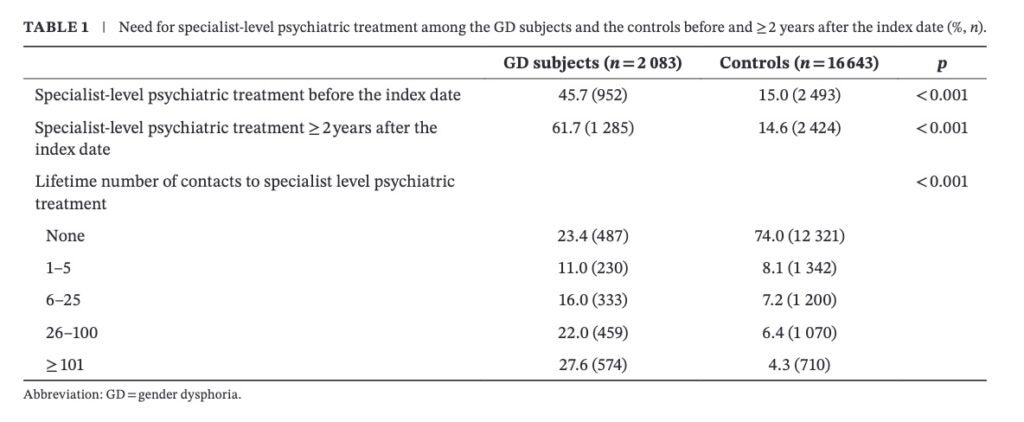
“Finland’s more than two decades of nationwide data show a clear pattern: youth who undergo medical gender reassignment use psychiatric services at markedly higher rates than even prior to that intervention,” Dr. Kurt Miceli, a psychiatrist and chief medical officer at Do No Harm, told The Daily Signal.
The study admits its own limitations: it did not analyze what sort of psychiatric services patients received, and it did not control for patients’ socioeconomic backgrounds.
Why This Makes Sense
Contrary to transgender activists’ claims, it stands to reason that the grotesque transgender experiments often dressed up in pretty language as “gender-affirming care” might harm a person’s mental health long-term.
When a doctor diagnoses a minor with “gender dysphoria”—the painful and persistent condition of identifying with the gender opposite one’s sex—the doctor may go on to prescribe “puberty blockers” (drugs that law enforcement uses to chemically castrate sex offenders), cross-sex hormones (which often cause permanent interventions in a person’s body to make them appear as the opposite sex), or surgeries to remove breasts or genitals.
These “treatments” often leave patients stunted, scarred, and infertile. Detransitioners like Joni Skinner have testified that this “care” left them unable to experience sexual satisfaction. A jury recently awarded one detransitioner more than $2 million in a medical malpractice suit.
How Americans Should Respond
While opponents of “gender-affirming care” should find ourselves emboldened by these results, we should also respond with compassion to those who are struggling.
This study suggests that people who are diagnosed with gender dysphoria also suffer from other psychological problems, and they need counseling that helps them process the mental issues that lie beneath gender dysphoria.
The Supreme Court recently struck down part of a Colorado law preventing mainstream patient-directed talk therapy from addressing the potential underlying causes of gender dysphoria, but activists are already working on other ways to demonize and outlaw this kind of therapy.
This study doesn’t just undercut the arguments for sex-rejecting procedures—it highlights how important this alternative kind of therapy is, and why Americans should champion it, not condemn it.
If we want to actually help people who suffer from gender dysphoria, we must champion therapy that helps them come to terms with their biology, rather than a medicalization that engages in experiments aimed at erasing it.