




























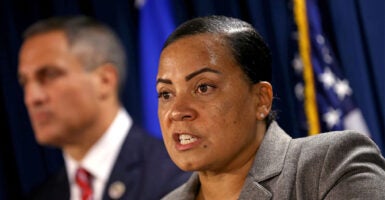
The news that Rachael Rollins has filed to run for Suffolk County district attorney again should send chills down the spine of anyone concerned with the safety, integrity, and future of Boston’s communities.
Rollins’ tenure as district attorney was marked not by justice, but by a radical prosecutorial philosophy that prioritized ideology over public safety, culminating in a disgraceful resignation after a damning federal report.
As Boston faces the prospect of Rollins’ return, it is critical to examine her record, her policies, and the grave implications for the city and the nation if we ignore the lessons of her past.
Rollins’ Tenure as DA
When Rollins first assumed office as Suffolk County district attorney in 2018, she immediately made waves by publishing “The Rachael Rollins Policy Memo,” an unprecedented document that listed 15 crimes for which prosecution would generally be declined.
The memo was a blueprint for radical non-prosecution, fundamentally altering the role of the district attorney from enforcing the law to selectively ignoring it.
Among the offenses Rollins chose to overlook were trespassing, shoplifting, larceny, disorderly conduct, disturbing the peace, receiving stolen property, driving offenses, breaking and entering, malicious destruction of property, threats, minor in possession of alcohol, drug possession, resisting arrest, and even resisting arrest if the underlying charge was one of the other 14 listed crimes.
This sweeping policy sent a message: accountability for criminal behavior was optional, not mandatory, in Suffolk County.
Rollins’ approach wasn’t merely a departure from tradition—it was a rejection of the very purpose of prosecution.
The memo’s rationale, couched in the language of social justice, ignored the tangible consequences for victims and communities. Instead of deterring crime, it emboldened offenders, fostered lawlessness, and undermined the public’s confidence in the justice system.
Her memo was not a nuanced exercise in prosecutorial discretion—it was a wholesale abdication of responsibility.
By refusing to prosecute crimes like shoplifting and larceny, Rollins effectively gave a green light to petty theft and property crime. The decision to decline prosecution for breaking and entering and malicious destruction of property signaled to would-be criminals that they could violate the sanctity of homes and businesses with impunity. Even offenses like drug possession, resisting arrest, and threats were swept under the rug, eroding the deterrent effect of the law and leaving victims without recourse.
The consequences were predictable. Businesses faced soaring losses from theft, neighborhoods wrestled with rising disorder, and police officers found themselves demoralized and constrained by policies that made enforcement futile.
Rollins’ memo wasn’t just misguided, it was dangerous. It demonstrated a fundamental misunderstanding of the district attorney’s role: to protect the public, not to experiment with unproven theories that put communities at risk.
Biden Makes Her US Attorney
The radical prosecutorial philosophy embodied by Rollins didn’t end with her tenure as district attorney.
In a move that should have alarmed anyone paying attention, then-President Joe Biden nominated Rollins to serve as U.S. attorney for the district of Massachusetts.
This was a clear signal that the administration favored the George Soros-backed model of rogue prosecution—a model that prioritizes nonenforcement, ideological activism, and disregard for the rule of law.
The Senate confirmation process was contentious, with many senators raising concerns about Rollins’ record and suitability for federal office.
Sen. Tom Cotton, R-Ark., gave a seven-minute speech at her Senate Judiciary Committee hearing, essentially echoing what we had been saying for years about Rollins.
Ultimately, Rollins was confirmed only after then-Vice President Kamala Harris broke a 50-50 Senate tie, underscoring the divisive nature of her nomination.
This episode was not just a political drama but a warning. When the highest levels of government are willing to embrace radical prosecutors, whose records are marred by controversy and failure, the consequences for American justice are profound.
Egregious Ethical Lapses and Resignation
Rollins’ tenure as U.S. attorney was short-lived, but not before she became the subject of one of the most damning ethics investigations in recent memory.
On May 17, 2023, the U.S. Department of Justice Office of the Inspector General and the Office of Special Counsel released a report detailing Rollins’ serious ethical lapses and violations of the Hatch Act. The report described Rollins’ conduct as “among the most egregious ever investigated,” highlighting her misuse of official resources, improper political activity, and flagrant disregard for federal ethics rules.
The findings were unequivocal.
Rollins had abused her position, undermined the integrity of the office, and violated the trust placed in her by the public.
The report was not just a critique—it was an indictment of her judgment, temperament, and fitness for public service. The severity of the violations left no room for ambiguity: Rollins was unfit to serve as a prosecutor, let alone at the highest levels of federal law enforcement.
In the wake of the Justice Department and the Office of Special Counsel report, Rollins resigned in disgrace, leaving a legacy of controversy and ethical failure. Her departure was met with relief by those who had witnessed the erosion of prosecutorial standards under her leadership. For the citizens of Massachusetts and Boston, the episode was a painful reminder of the risks posed by radical prosecutors who place ideology above law, and ambition above integrity.
Public reaction was swift and critical. Community leaders, law enforcement officials, and policy advocates called for a return to prosecutorial standards that prioritize safety, accountability, and ethics. The damage done by Rollins’ tenure was not easily repaired, but her resignation offered an opportunity to restore trust and reaffirm the principles that should guide the office of the district attorney.
Suffolk County—and Boston—deserves a real district attorney, not more of the same failed soft-on-crime polices. The citizens of Suffolk County deserve a prosecutor who puts their safety first, who respects the rule of law, and who embodies the integrity the office demands.

