


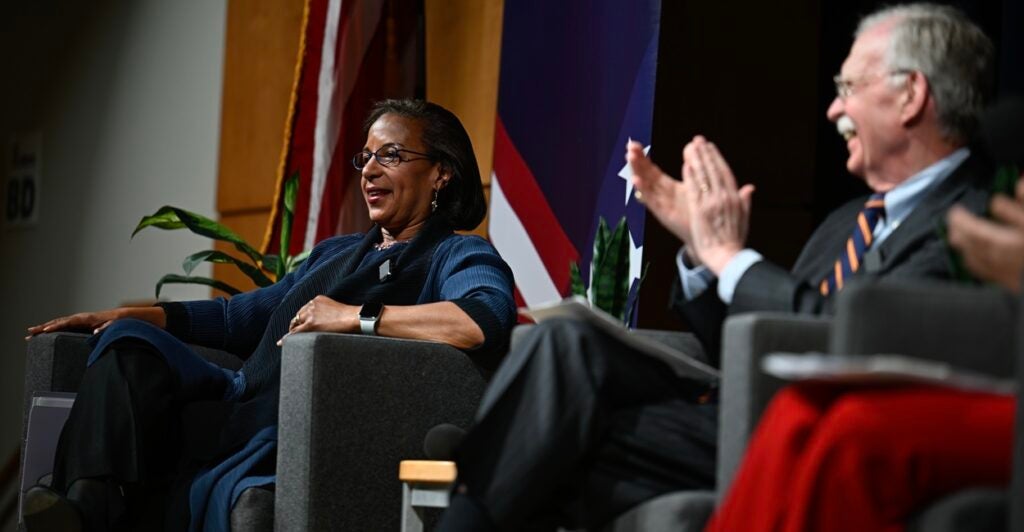
Is the United States committing superpower suicide? That was the question recently posed to Susan Rice and John Bolton at the University of Colorado.
Both officials previously served as America’s ambassador to the United Nations and as national security adviser—Rice for Democrat presidents, Bolton for Republican. As such, one would think that Rice would argue in the affirmative, using President Donald Trump’s policies and war in Iran as triggers for the suicide, while Bolton would serve as an apologist for the administration.
What happened was both more interesting, but also—somehow—more yawn-inducing.
Rice argued that America’s post-1945 strength as a superpower comes from five pillars: military might, economics, a global network of alliances, domestic resilience, and global soft power. She argued that each of these strengths are being deliberately undermined by Trump to achieve a goal of “dismantling America as a global superpower,” thus shrinking the U.S. to the role of being simply a “regional great power.”
While Rice failed to give a reason as to why the Trump administration wants to destroy America as a superpower, she did give reasons as to how, in her mind, the administration is undermining the five pillars.
Despite praising Trump for spending more money on defense, the ambassador claimed those efforts were outweighed by expending munitions needed to deter China on Iran and by the leadership of Secretary of War Pete Hegseth, whom she referred to as “unqualified and immoral.” Further, Rice said that American operations in Venezuela and Iran come at the expense of being ready to deter China and Russia.
When it comes to ways the Trump administration is supposedly undermining the nation’s economic strength, Rice offered that the “One Big, Beautiful Bill” increased inequality in America, weakened the dollar, and eroded the dollar’s standing as a global reserve currency.
As for the third pillar, alliances, Rice claimed that the Trump administration has weakened them through tariffs, through demands for Greenland and territory from Canada, by not aiding Ukraine and pressuring it to capitulate to Russia, by renewing threats to leave NATO, and by insulting European governments. Rice said Russia and China are the biggest beneficiaries of these policies.
Rice suggested that American resiliency is being undermined as the president’s policies cut funding for the National Institutes of Health and federal funding for scientific and technological research, particularly when it comes to “green energy” technologies. The ambassador tossed in “losing access to affordable health care for common Americans” as a key factor undermining American resilience.
Rice closed her remarks by focusing on soft power in America’s foreign relations. Soft power, she correctly pointed out, has long been a source of U.S. strength. She said, however, that the nation has abandoned its commitment to democracy, human rights, development, and rule of law overseas by dismantling the U.S. Agency for International Development and the Voice of America and by withdrawing from international organizations such as the World Health Organization.
She also claimed that attacking Venezuela and Iran violates international law, which further undermines American soft power. Oddly, Rice argued that soft power is somehow weakened overseas by reducing DEI requirements in federal offices and enforcing U.S. immigration law through Immigration and Customs Enforcement operations.
In short, Rice concluded that the Trump administration has deliberately weakened all five core elements of global superpower.
Bolton made no effort to counter any of those critiques. Instead, he opined that post-Cold War administrations made multiple mistakes and that the Trump administration has made some of these same mistakes, but that the real threat to American power comes from underestimating our adversaries. This underestimation manifested in reduced military expenditures as a share of global wealth. American military might, he said, has never recovered from this underinvestment.
This underinvestment was deeply irresponsible, as was the “consistent misreading of Russian intentions.” In Bolton’s analysis, Russia did not seek to be partners with the U.S. but has been on a decades-long nationalistic campaign to undermine American power. Bolton praised Trump for raising U.S. defense spending but questioned whether future administrations would sustain such increases.
Bolton said that the second major bipartisan problem is a 35-yearslong misreading of China. He shared that even when China abandoned communist economics in the late 1980s, American elites didn’t realize it was for a purpose. They believed Beijing would become a responsible, democratic international stakeholder. They were wrong.
China is not a responsible stakeholder or anywhere near a democracy. Chinese aggressive intentions have been misread across all administrations, including the present one. Economic growth did not change China’s behavior.
Bolton asserted that our major adversaries, Russia and China, have benefited from U.S. mistakes. In his mind, the U.S. is not committing superpower suicide but political suicide.
According to Bolton, Trump doesn’t understand that international relations are not about interpersonal relationships or deals, but about national interests. In Bolton’s analysis, Trump never learned how international relations work between nations (as opposed to negotiations between individuals).
Both ambassadors touched on the need for NATO to spend more and to reform the United Nations, but the moderator, The Washington Post’s Carine Hajjar, inserted questions that did not interrogate the proposition. She instead turned the evening into that most boring of discussions: a current events panel.
Hajjar asked about whether a post-war Iran would preserve U.S. interests, or if regime change was the only option; what the U.S. should have done differently in the Middle East over the last 12 months; whether or not China would invade Taiwan (the one interesting response to these questions was from Bolton, who offered that the U.S. should abandon strategic ambiguity and give a clear security guarantee to Taipei.)
One highlight was when Hajjar asked what a superpower looks like. Rice said that the U.S. should be “actively engaged in the world to pursue our own security and prosperity,” and exhibit a leadership that is based on “enlightened self-interest,” resulting in policies that would allow the U.S. to work with other nations to reduce conflict, increase security, and become more prosperous.
Bolton stated that both parties are now increasingly isolationist and are abandoning the proposition that American security and prosperity are based on security and prosperity overseas. He went on to blast the elite view that peace and security are secured through “the rules-based international order,” which he likened to a fiction that has never existed. Instead, Bolton said, what provides peace and security in the world is American military power and the allies. He added that allies have not contributed enough, and that the American alliance system is in place not out of charity, but because it benefits American interests.
In short, the debate was a wasted opportunity with few surprises. Rice provided well-crafted and well-delivered but entirely predictable partisan talking points. They may or may not have stood up to scrutiny if Bolton or the moderator had engaged with them.
Bolton offered a larger and potentially interesting critique of Republican and Democrat failures to prioritize the threats posed by China and Russia, resulting in a slow political suicide for American interests, security, and prosperity, but there was no response to this proposition. Even when Bolton raised non-traditional policy proposals such as raising defense spending to 6% of gross domestic product or abandoning strategic ambiguity for Taiwan, neither the moderator nor Rice engaged.
Finally, there was no full-throated defense of Trump’s policies, particularly his apparent willingness to employ military force muscularly. Debating the recent use of force and whether it strengthens or weakens the U.S. as a superpower would have been interesting and a good use of time.
Unfortunately for those watching, no debate occurred, due to the moderator’s desire to have merely a current events panel.