


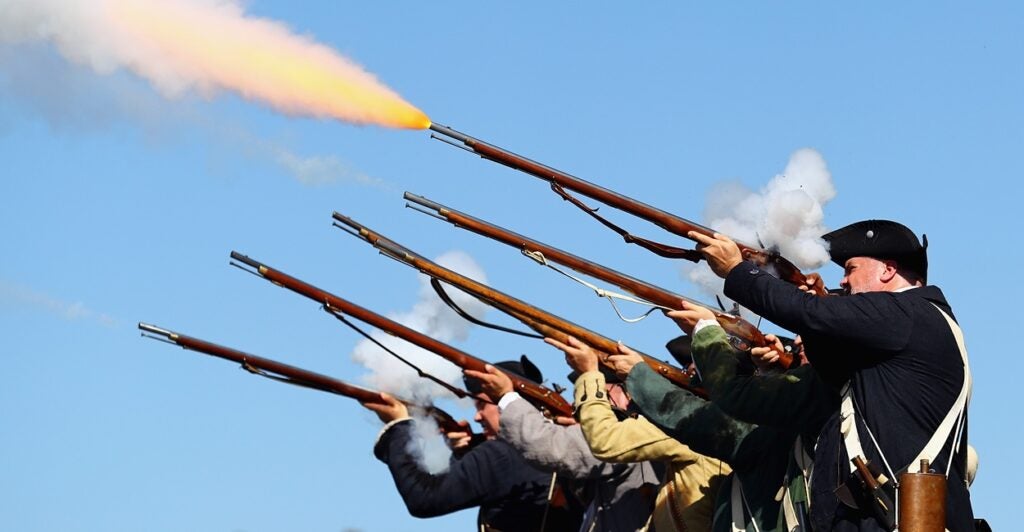
The Revolutionary War began on April 19, 1775, at the Battle of Lexington.
Rebellions are, at root, when the people of a place make a stand against the status quo.
What pushed so many men and women in the American colonies to the ledge of revolt? What motivated them to risk their lives taking a stand for their rights and liberties?
Ultimately, it was their fortitude, character, and faith that emboldened them to revolt.
It is easier to understand this within the context of the decades leading up to the War for Independence. Historian Nathaniel Philbrick notes that, after the end of the French and Indian War in 1763, Britain was bogged down by a massive debt (more than $22 billion in contemporary American currency).
Great Britain decided that the colonies should contribute to repaying the debt, particularly since it was incurred by the mother country coming to their aid. So ended the “salutary neglect,” and so began the decades of taxation.
The taxation that followed formed the backbone of the colonists’ motivations for revolting. These taxes crippled economic growth. Americans came to view the taxes as nothing more than an expression of the British greed and demeaning attitude toward them as the subjects of the monarch.
Barely two years after the end of the French and Indian War came the institution of the Stamp Act (1765). This was a tax on all paper goods purchased by the colonists. Colonists had no say in the tax, which was just the beginning of many such taxes that would be instituted by Parliament without representation from the colonists.
Enraged, a mob of colonists swarmed the local lieutenant governor’s home. It tore apart the inside of the home, sending a clear message to British authorities. Within a year, the Stamp Act was rescinded by Parliament.
Historians have remarked that the distaste towards this and other bills was something to be expected. However, the violence that ensued was an entirely different beast. In hindsight, Parliament may have perceived an unrest in the colonies that went far deeper than finances. But the British government needed money, so it continued to tax the colonies.
The earliest members of the revolt against Great Britain faced unimaginable odds, but they were convinced they had to fight for their freedom. These were people from many walks of life, from farmers and countrymen to lawyers and doctors.
Colonists from all walks of life were tired of the oppression and taxation that came from a power that found itself over 3,000 miles away.
The rebels were convinced that Great Britain, the world superpower, was in the wrong, and they were dedicated to opposing this injustice, no matter what, even if it cost them their livelihoods or their lives.
Some names and words echo through history. Patrick Henry’s “Give me liberty or give me death” is well-known to this day, as are Nathan Hale’s last words: “I only regret that I have but one life to lose for my country.” However, the American experiment began because of countless men and women—known and unknown—who possessed courage, character, and faith.
They were willing to risk their lives for the benefit of their families and the future of the colonies. This courage came from doing what is right for its own sake. That is ultimately built on a faith in God.
In a time when many claim that America is a fundamentally irreligious and atheistic project, this is a truth worth emphasizing. We mustn’t forget that even the religious freethinker Thomas Jefferson made clear in the Declaration of Independence that man’s inalienable rights are no mere political convenience. They are given by God, and it is because of this divine source that all are bound to respect them.
As we approach the 250th anniversary of our independence, Americans ought to remember and honor our forebears by living for justice, truth, and faith. That way we will ensure that our nation thrives for centuries to come, no matter the odds we face.
We publish a variety of perspectives. Nothing written here is to be construed as representing the views of The Daily Signal.