


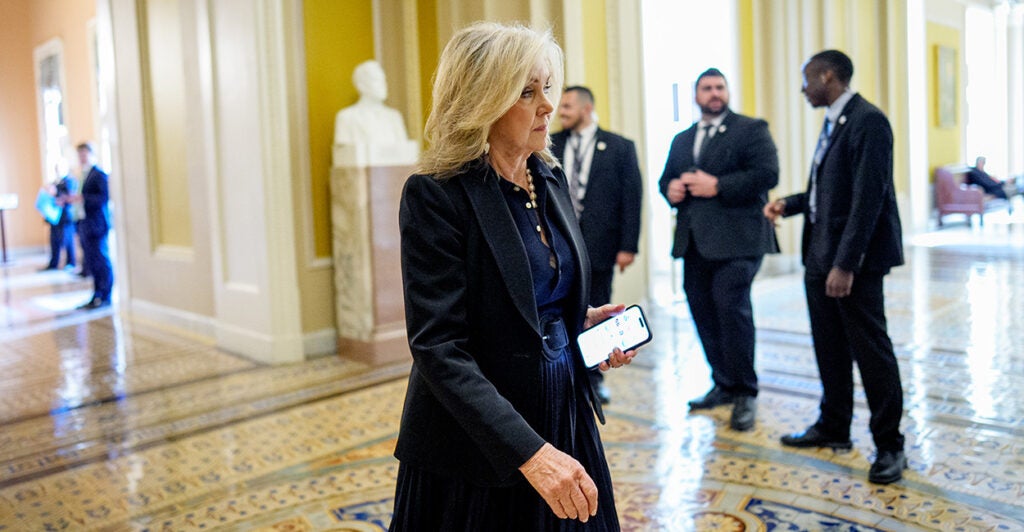
Sen. Marsha Blackburn wants her vision for the future of American artificial intelligence, with strict child safeguards, to prevail over a tech accelerationist push that overrides state regulations while including only minimal safeguards.
The Tennessee Republican’s bill differs in key aspects from the White House National Framework on AI, but she believes it will fulfill President Donald Trump’s request for Congress to pass the first national standard for AI.
“I do think this is the vehicle that is set to travel forward at committee,” she said.
President Donald Trump signed an executive order on Dec. 11 ordering the White House Office of Science and Technology Policy to recommend federal AI legislation preempting any state laws in conflict with the administration’s policy.
Blackburn introduced her “TRUMP AI Act” March 18, two days before the White House released its AI framework.
Blackburn’s bill diverges from the White House framework in several ways. It places the obligation for the platform’s safety on the AI chatbot developer, but the White House places the responsibility on parents.
After courts in New Mexico and Los Angeles found that social media companies, including Meta, intentionally harmed children’s mental health, Blackburn said it’s particularly important that Congress impose the duty of care for children on the companies.
“There are some in the House that said, well, that would be infringing on free speech,” she said.
“Protecting children and keeping children from child endangerment is not an infringement of free speech, and now the court has spoken on these addictive designs and features that are being put into these online platforms and chatbots,” she said, “and have said, indeed, there need to be some safety by design and duty of care responsibilities.”
Blackburn’s legislation codifies a minimum floor for child safety protections, and the White House framework establishes a ceiling.
Blackburn is aware that “additions and subtractions” will have to be made for her bill to pass both the Senate and the House, but she sees it as a “starting point” for ultimately enacting a framework by the fall that both tech-accelerationist Republicans and Democrats can support.
House leadership will likely try to kill substantive measures in Blackburn’s framework in exchange for broad preemption of state regulations with minimal kids’ safety standards, according to Daniel Cochrane, tech policy expert at Institute for Family Studies.
Yet two key provisions of Blackburn’s framework—the Kids Online Safety Act and the GUARD Act—may have the support to pass both chambers if separated from the rest of the text, Cochrane noted.
Rep. Erin Houchin, R-Ind., the chair of the House Kids Online Safety Committee, agrees with Blackburn that states should be able to legislate more protections for kids.
“When we talk about preemption, I would want states to be able to go farther,” she told The Daily Signal, “so I would prefer to see a floor rather than a ceiling, for their ability to innovate and respond to kids online safety concerns, because the states are going to be way more nimble at addressing concerns from parents than the federal government.”
Texas Republican Sen. Ted Cruz—chair of the Commerce Committee, where the bill will move forward—will also play a large role in passing the framework. Cruz has fought for preempting state AI laws in the past, including an attempt to put broad preemption powers into the “One Big, Beautiful Bill.” The Senate overwhelmingly rejected that attempt.
“He’s made a commitment to move KOSA forward soon,” Blackburn said, “and we’re looking forward to working with him on that.”
Though Blackburn will accept changes to the framework, she said her red lines are strong protections for children through the Senate version of KOSA and the GUARD Act.
“The Senate version is, by far, the stronger,” Blackburn said of KOSA. “The House version deletes a duty of care and the product safety standards.”
“The product design safety standard has to be there,” she told The Daily Signal. “I think it’s important to realize that the only industrial sector in this country that does not have safety by design is virtual space.”
The House Energy and Commerce Committee passed a version of KOSA with weaker protections for children, removing the duty of care for online platforms in exchange for broad preemption language that prevents states from enforcing any laws that conflict with federal provisions. But Blackburn wants to see the Senate version codified in the final framework.
AI innocation advocate Nathan Leamer denounced Blackburn’s bill as the “name, image, and likeness” version of the White House’s framework, but Blackburn said Trump specifically asked her to write her bill and that she has been in frequent contact with him about it.
“I’ve had conversations directly with the president as we got ready to draft and work on this,” she said. “I’ve also worked with a coalition and then included individuals that are there in the White House.”