
















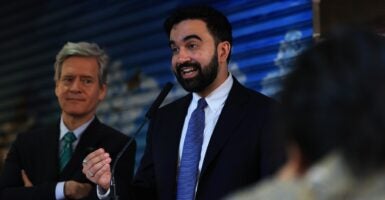
New York City Mayor Zohran Mamdani intends to keep one of his most controversial campaign promises: city-owned grocery stores.
In his 100-day address on Sunday, he announced the city’s first socialist supermarket will be up and running in East Harlem in 2027. The only thing slower than Mamdani opening the store next year will be the checkout line once it finally opens—and that’s assuming the shelves aren’t empty.
The mayor plans to manage five government-run stores by the end of his first term, one located in each of New York City’s five boroughs, that will be run for no profit with the objective of keeping prices artificially low for a select basket of staples (e.g., bread, milk, eggs). Addressing food affordability in an already expensive city is important, but this “solution” is central planning dressed up as compassion.
Rather than addressing the web of city regulations, labor costs above national averages, and high real estate expenses that inflate prices for small grocers, the mayor suggests government intervention. This could harm small businesses by crowding them out.
Private grocery stores operate on thin profit margins of only 1% to 3% while simultaneously navigating labor costs and theft. Owners are not “greedy capitalists,” despite what communists might say. The incentive to maximize profits actually facilitates competition and naturally drives prices down. When a public option enters the market with artificially low prices and no barriers to entry, mom-and-pop shops get pushed out.
In a free market system, private grocers outperform public options. When asked about the private sector’s natural advantage over his socialist marts, Mamdani stated, “I look forward to the competition. May the most affordable grocery store win.” However, the city will be funneling tens of millions of taxpayer dollars into stores that do not pay rent or property taxes—hardly fair competition.
Taxpayer-funded stores will distort the market and create surges in demand that the government is ill-equipped to handle. The lesson here is that the productive private sector outperforms the unproductive public sector. For example, take the notoriously slow and cost-inefficient government-run postal service or Department of Motor Vehicles; now, imagine the government in charge of food supply.
Not only would shoppers face long lines and stores face food shortages, but the city would have spent tens of millions of dollars that it cannot afford. Estimated costs are projected at $30 million for the first grocery market, nearly half of the mayor’s original $70 million budget for five.
As valuations for these Marxist marts keep rising, so does the burden to taxpayers—this at a time where New York City has a $7 billion budget gap over the next two years and nearly $100 billion in total debt.
The reality is that nothing is truly free in a socialist system. Everything is paid through higher taxes, larger deficits, or hidden costs passed to consumers. Such reckless spending is never prudent, especially on policies that fail in both principle and practice.
Cities like Erie, Kansas, or Baldwin, Florida, left taxpayers on the hook for inefficient, government-run grocery stores that created scarcity and failed to alleviate food unaffordability. Each municipal government found the public store too difficult and too costly for taxpayers to operate.
The Soviet Union infamously nationalized food production and distribution as a part of its centralized economy—to the detriment of its citizenry. Shortages, empty shelves, rationing, and bread lines were unfortunate outcomes of the failed socialist experiment. Compare that to the American grocery experience of full shelves and food variety, all made possible by free markets.
Despite the obvious dichotomy between pro-growth free enterprise and restrictive nationalization, Mamdani still believes his government-owned bodegas can do business better. Soviet Russia, Communist China, and Socialist Cuba followed the same script, promising affordability through central planning but delivering scarcity, corruption, and poverty.
New Yorkers are about to learn the hard way what millions already discovered in the last century: socialist “solutions” to everyday problems fail spectacularly.
Private grocers already feed millions of New Yorkers daily without government interference. Mamdani’s city-run stores would distort the market and impose higher costs on taxpayers, leaving residents worse off.
If a government-owned grocery store does open in the Big Apple in 2027, New Yorkers will experience the real costs of “free” socialist proposals: they charge residents once in taxes and once at the register.

