


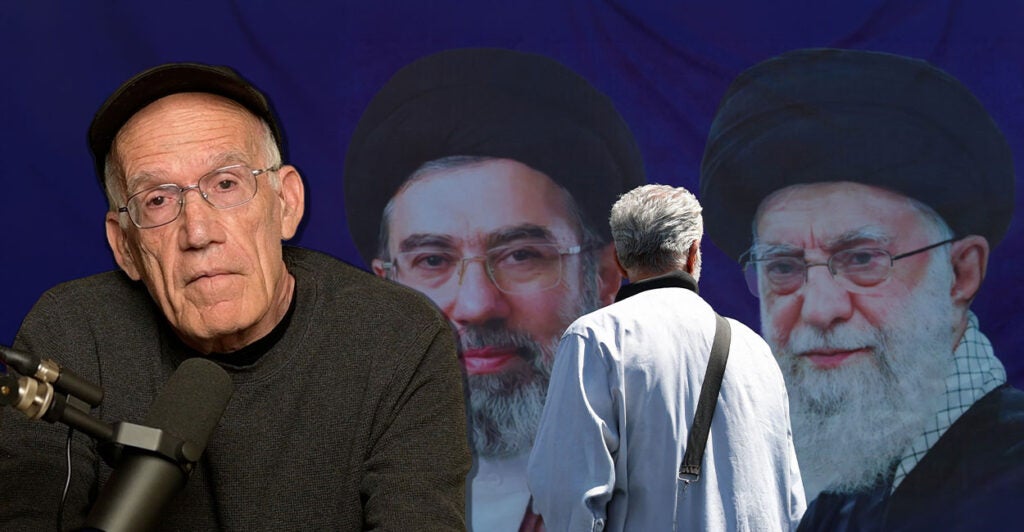
Editor’s note: This is a lightly edited transcript of today’s video from Daily Signal Senior Contributor Victor Davis Hanson. Subscribe to our YouTube channel to see more of his videos.
Hello, this is Victor Davis Hanson for The Daily Signal.
I think we should take another look at the Iranian war, and I would call it a longer view, not the short-term 24-hour news cycle.
What’s happening right now is the media and the left wing of the United States political spectrum, the Democratic Party, and they are a nexus now, a Borg, they react in 24-hour cycles. So, anything that looks unfortunate, from the point of the American success in Iran, they cling to.
So, last Monday, it looked like President Donald Trump, after his tweet on Easter that he was going to end the civilization of Iran—and I mentioned before he meant the regime, the theocracy, the civilization of radical Shiite jihadism in Iran—they wanted to impeach him. They said he was a “warmonger,” a Hitlerian figure.
The next day, he announced that negotiations would take place, and then he was a TACO, a Neville Chamberlain, a George McGovern, a Jimmy Carter, “Trump Always Chickens Out,” but it’s indicative that they don’t look at the war empirically, they look at it entirely in political terms.
In fact, people as diverse as Tom Friedman or Bill Kristol, if you collate what they have written, they almost feel that anything that happens negatively in Iran might be positive because it would hurt Donald Trump, and then, therefore, that would be in the long-term interest.
Forgetting that we have 100,000 soldiers in the theater risking their lives, and they’re risking their lives to eliminate the real opportunity, the real likelihood that Iran could get nuclear-tipped missiles very quickly, not just aimed at Western Europe, but in two or three years, perhaps the United States as well, given the participation of North Korea, China, and Russia in their arms industry and their agenda.
So, we have to look at the long version, and the only way we can do that is look at history, and history says it’s very unusual that one side has been so victorious in an asymmetric war, especially against the strongest power in the Middle East by all accounts, 93 million people, a huge territory. And people were terrified of it, not just the Gulf monarchies, but the Europeans.
We say the strait was open before the war. Yeah, it was open, but it was open on the condition that Iran would close it at any minute or could make things difficult. Prior to this closing, it had closed it in 1979 and 1980, and again in 2019, and had threatened to do it on many occasions. It’s not going to be able to do that when this war ends.
So, if you look at it realistically, very quickly, they don’t have a military, so to speak. They have lost probably hundreds of billions, if not half a trillion dollars, in a half-century investment in missiles and now in drones, sophisticated aircraft and submarines and capital ships.
Their command and control is down to the second and third tier, and no one knows who’s in power. We don’t know if it’s the Islamic Revolutionary Guard Corps. We don’t know if it’s the political class. We don’t know if it’s the theocracy. We don’t know if it’s the army.
But we know two things: that they are each afraid of each other. They don’t want to seem as if they’re too compliant, so they want to be as hard-line as possible, but we don’t know what that really represents. All of these communiques that are so lunatic may be just intended for internal consumption.
And the other fear they have, any one of them, is looking at these four different groups and says, if they cut a deal with the West or the United States in particular, and there’s a transitional figure and the people take over, we’re all going to be dead for what we’ve done.
And so, it’s a very fluid situation politically, but militarily, it’s clear that this has been an overwhelmingly devastating war for Iran. And who were the winners and losers of it? Take Russia. Russia has no presence in Venezuela now. It has no presence in Latin America. It has no presence in the Middle East. Its Assad regime is gone.
It had a drone back-and-forth relationship with Iran. Maybe it’s supplying some weaponry across the Caspian Sea we don’t know about, but for all practical purposes, that’s been severed.
It’s bogged down in a war with Ukraine. It’s lost over 1.5 million people. It enjoys a little spike in oil prices, and that may help it, but it would be much more likely that they would want now to get out of the Ukrainian war, have some kind of deal, armistice, and then have sanctions lifted off them because they feel that the Strait of Hormuz doesn’t have a good future.
Which turns us to the Gulf itself. The Strait of Hormuz has 20%, not 80%, 20% of the world’s oil going through it every day. The Saudis are going to expand their Red Sea pipeline. The Emiratis are going to expand their pipelines that serve other countries that are oil producers in the Gulf of Aden. They’re talking about going across the desert through Jordan to Haifa, and you could envision in four or five years the Gulf might only serve Iran.
Instead of being an asset, it could be a liability. If anybody wanted to close it, it would’ve hurt Iraq and Iran more than anybody else.
I mean, Iran has other ports, but it would be an inert asset. And so, holding onto the strait and threatening the world means that people are going to find alternative oil supplies, and they’re already doing it with the U.S. and Venezuela.
And if Russia is smart, it will try to find a ceasefire and join in this alternate supply that’s non-Gulf.
China has been hurt because it got 80% of all Iranian oil, and that’ll be contingent on the United States. It’s already contingent, whether they get Venezuelan oil, on the United States. It won’t be sold to them at a discount.
They look at the war, and what do they say? What do they see? They see that drones—submarine drones, surface craft drones, aircraft drones—and now the United States has broadcast to the world they’re going to acquire what, a half-million, a million of them. They’re late to the party, but when we get riled up and we get activated, we can outproduce almost anybody.
And the idea that they were going to go across 110 nautical miles into Taiwan after what they’ve seen in Iran would be very foolhardy. The United States fleet could sit on the other side of Taiwan, arm Taiwan to the teeth, which they’re doing now, and it would be very hard for hundreds, if not thousands, of Chinese shipping to come across that strait without being under constant fire from a sea of ballistic missiles and drones.
Europe is a big loser. We didn’t ask all that much of them. We just said supply us by letting us use your bases and your airspace. That was very modest … they wouldn’t do that. The Spanish closed their embassy in Israel, and they kept it open in Iran. For all practical purposes, Spain is a belligerent.
France wouldn’t let us use its air power. They won’t even go into Lebanon, their special post-colonial friend and responsibility, and help get rid of Hezbollah.
Britain said they were going to protect their interests in Cyprus. They have a base that was targeted. They can’t even send one destroyer there.
Turkey is a NATO member. And what has Turkey been doing? It’s been really siding with Iran, and it’s threatened to invade and attack Israel, a NATO partner.
Italy we thought was a close conservative friend. They wouldn’t let bombers land in Sicily.
The U.K. has been the most disappointing. Maybe it’ll try to help. It doesn’t have many resources anymore. It’s sad to say, given the history of the Royal Navy. But my gosh, if we had said to Margaret Thatcher when she asked our aid in 1982 to help the Falklands, we could have just quoted what Prime Minister Keir] Starmer would later say, “This is not our war. It’s not our war.” It’s not our war in Serbia. It’s not our war in Libya. It’s not our war in Chad.
So, you can see the problem with NATO in name only, and it will be a bilateral alliance. I think more and more the United States will pick and choose which NATO members it will fully work with because the rest are either neutral or hostile to the United States.
And finally, the United States. If this war ends in two or three weeks, it’ll still be seven months for the economy to recover, and oil will start flowing out of the Gulf.
And more importantly, Venezuelan oil, American oil, and even perhaps Russian oil will get on the market to capture these high prices, and people will avoid the Gulf as much as they can, and the Gulf will be opened one way or the other.
And so, there’s a good chance the economy can return, and there’s a better chance people will come to the realization after this 24-hour hysteria and media cycle and left-wing fanaticism is over, when they look at the situation empirically, they’re going to say, my gosh, Iran is not threatening the Middle East.
My gosh, they don’t have a ballistic missile threat. They do not have an immediate avenue to get nuclear weapons. They have no military. Their entire command and control has been wiped out. Their population is furious. It’s stewing.
This could be like the fall of the Berlin Wall, which, not the next day, not the next week, not the next month, but within months, or in the case of the Soviet Union, within two years, you could see a regime change.
So, the United States is in a good position, especially because we chose not to fight on the conditions that we did in Iraq and Afghanistan, where we’re fighting house to house in Taji or Fallujah, or we don’t know who’s friend, who’s the enemy in a village in Afghanistan. Now this was fought on Western American terms, and the asymmetry shows it.
So, we don’t know what the ultimate prognosis of this war is, but if we take the long view, it’s far more favorable to our interests than it is to our enemies.
We publish a variety of perspectives. Nothing written here is to be construed as representing the views of The Daily Signal.