

















The Transportation Security Administration (TSA) has been in the news a lot lately.
The TSA is part of the Department of Homeland Security (DHS), and today it is responsible for securing the nation’s transportation systems. This most visible part of this is screening passengers and baggage at airports. Democrats in Congress, upset about how a different part of DHS, Immigration and Customs Enforcement (ICE), is conducting itself, have refused to provide funding for DHS.
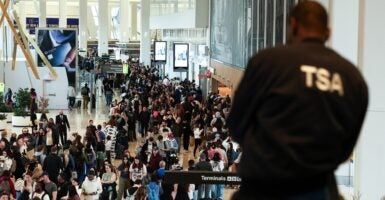
The result is that, starting Feb. 14, TSA agents were required to work while not being paid. Facing economic hardship or just frustration, many of them chose to take other jobs or take advantage of accrued sick and vacation leave rather than work without being paid. This situation left TSA checkpoints understaffed, with the predictable result of hours-long waits at some airports. This inconvenienced millions of Americans who are just trying to fly from one place to another as efficiently as possible.
The irony is that ICE—the target of the Democrats’ ire—was not affected by the DHS funding lapse; ICE and Border Patrol were fully funded by the One Big Beautiful Bill Act that was passed last summer. But Democrats in Congress needed to show their anti-ICE voters that they were trying to do something, and they chose to make American travelers and TSA staff suffer in pursuit of their ideological ends. And while President Donald Trump took action to pay TSA employees, that is legally questionable, and it has done nothing to make the Democrats less intransigent.
It does not have to be this way.
In the wake of the September 11, 2001, terror attacks, Congress attempted to mitigate the continued targeting of the airline system by creating a federal agency that could counter that threat, as opposed to the disparate private entities that had been providing airport security up until that point. Most people do not realize that the law does not require government employees to perform security functions at airports.
Even in creating the TSA, the law allowed for the Screening Partnership Program (SPP) which allows airports to use private companies to conduct screening services. Subject to federal oversight, any private companies undertaking this work must comply with TSA requirements, including screening procedures. What they do not do is use TSA employees, which means that their operations are unaffected by any fights in Congress over funding the TSA. Currently, 20 airports participate in the program, including two that see substantial traffic: Orlando and San Francisco. In fact, San Francisco’s airport has only been using private contractors for security screening for over two decades.
The question isn’t why 20 airports participate in this program. It is why every airport doesn’t participate in this program.
While the legislators who created the TSA were no doubt doing what they thought was best in the face of real concerns about waves of terrorist attacks, for reasons both theoretical and practical the creation of the TSA may have been a mistake. It was a mistake as a theoretical matter because the creation of the TSA (at least with regard to air travel) was just the government assuming a task that the private sector had been doing.
There is nothing inherently governmental about conducting security screenings before getting on an airplane such that it needs to be done by government employees, and the existence of the SPP shows that the government agrees. The government has no special competency in security screening, and Congress should try to avoid taking over functions that can be adequately handled by the private sector. It is vital to national security to keep America fed, but it would be a disaster if we sought to federalize all of America’s farmers in response to that realization. The same is true for airport security.
The government should avoid assuming that which can be done by the private sector. This has been made clear in the case of the TSA. The creation of the TSA eventually brought a large unionized workforce, which increases costs to the government and makes operations more rigid and less nimble. In a time of massive technological advancement, innovation at security checkpoints has been less than lackluster. Imagine what could be if the TSA focused on intelligence and counter-terrorism while allowing the private sector to focus on efficiency and customer experience.
Moreover, as we are experiencing right now, the current TSA paradigm turns efficient, convenient air travel into a political football. Government shutdowns make metaphorical hostages of airline passengers by making trips to the airport more time-consuming and less convenient. Why do we stand for such a thing? Transitioning all airports to the SPP would allow Americans to keep living their lives while politicians in Washington fight over government funding.
Americans know that the private sector generally does things better than the government. Despite efforts to the contrary, that’s why we do not have government-run grocery stores, car manufacturers, or film studios. And we should not have government-run airport security.
Airports would be wise to switch their security operations to SPP rather than allow their operations and the flying experience to be subject to the whims of Congress.
We publish a variety of perspectives. Nothing written here is to be construed as representing the views of The Daily Signal.

