































Throughout recorded human history, military power has been a universal value regardless of civilization, culture, or epoch. Sadly, individual freedom and democracy have not been (and still are not) recognized as universal values.
The recent U.S. military success in Venezuela has been the source of considerable benefits to the U.S. and its citizens. To wit, enabling the U.S. to safeguard its geopolitical national interest in the Americas, significant curtailment of illegal drug smuggling into the U.S., enhancement of U.S. military credibility internationally, and ending cheap/free Venezuelan oil for countries hostile to the U.S.
The ongoing U.S. military successes in Iran have benefited the U.S. in multiple significant ways.
First, the almost complete destruction of Iran’s nuclear and ballistic missile programs has ended a very significant military threat to the U.S. and allies.
Second, the complete destruction of Iran’s air defenses (supplied by powers hostile to the U.S.), air force, and navy sends a very tough and credible message to U.S. adversaries and allies about the strength, lethality, and effectiveness of the U.S. military.
Third, the destruction of Iran’s terrorist proxies and Iran’s military, and the realignment of alliances in the region has provided an opportunity for peace in the region after many centuries of bloodshed and strife.
Finally, this was a much needed and long overdue retribution for the U.S. soldiers injured or killed by Iran in the past 47 years.
While the U.S. military action in Iran has been a source of many benefits to the U.S., a collateral negative effect has been the increase in world oil prices, and the associated increase in gas prices at the pump for U.S. consumers. An analysis of the increase in gas prices in the context of U.S. gas prices during the past two decades would allow for a more informed and rational discussion of the pros and cons of this Iran conflict.
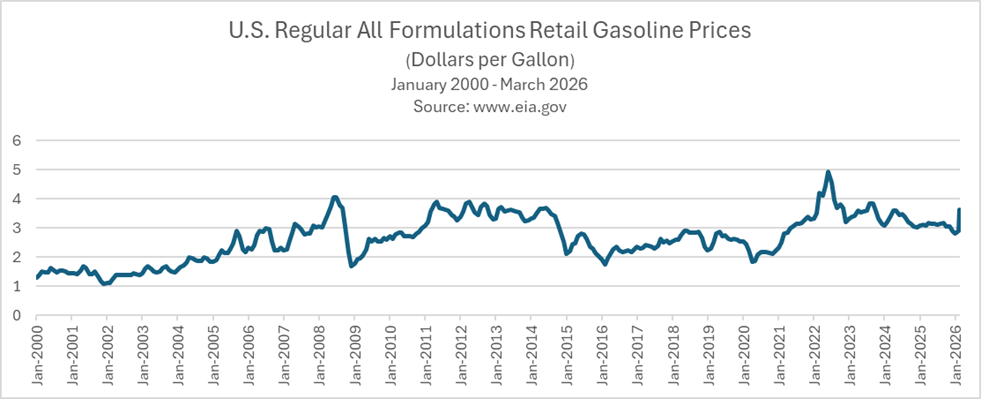
The figure above illustrates U.S. gas prices 2000-2026. During the Obama administration, gas prices quickly increased to $4 and generally stayed between $3 and $4 for most of his term. During Trump 1.0, gas prices mostly stayed between $2 and $3. During the Biden administration, gas prices quickly rose to about $5 and then declined to about $3. During Trump 2.0, gas prices mostly declined, with the exception of March 2026 when prices increased to about $4.
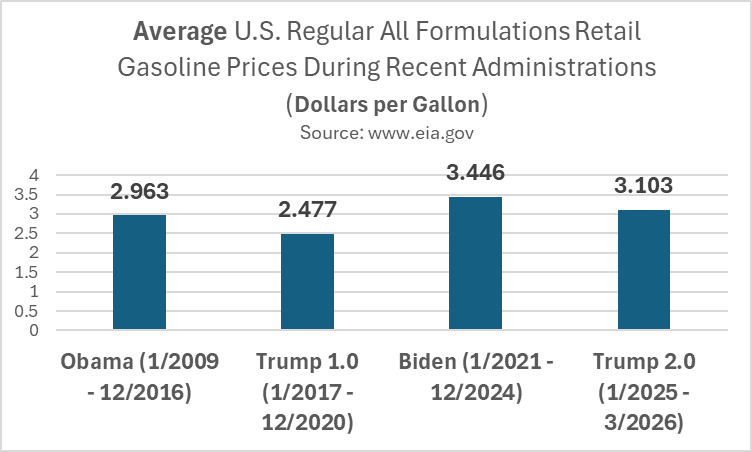
The table below documents the average gasoline prices during recent U.S. administrations. Average gas prices during Trump 1.0 were about 16% ($0.49 per gallon) less than under Obama. Average gas prices during Trump 2.0 have been about 10% ($0.34 per gallon) less than during the Biden administration.
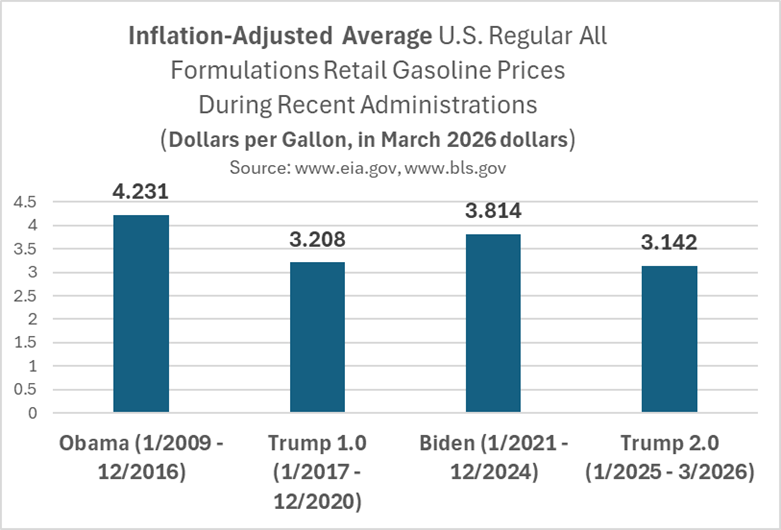
The above are the prices paid at the pump, and they do not take inflation into account. Due to inflation, a dollar in 2010 was worth more (in terms of goods and services that dollar could purchase) than a dollar in 2020, which was worth more than a dollar today.
The table below documents the inflation-adjusted average gasoline prices during recent U.S. administrations. Inflation-adjusted average gas prices during Trump 1.0 were about 24% ($1.20 per gallon) less than under Obama. Inflation-adjusted average gas prices during Trump 2.0 have been about 18% ($0.67 per gallon) less than during the Biden administration.
Gas prices in the U.S. have increased during the past month. This increase should be viewed in context.
Average gas prices during the current Trump administration are about $0.34 per gallon less than during the Biden administration. Inflation-adjusted average gas prices during the current Trump administration are about $0.67 per gallon less than during the Biden administration.
The cause of the current increase in gas prices is the military conflict in Iran. As noted earlier, the ongoing U.S. military successes in Iran have benefitted the U.S. in significant ways.
We publish a variety of perspectives. Nothing written here is to be construed as representing the views of The Daily Signal.

