



























NASA is set to launch four astronauts on a 10-day mission into space. Artemis II will test NASA’s crew capabilities in deep space and gather more information that could ultimately help send astronauts to Mars.
The astronauts aboard Artemis II will not land on the moon. Rather, the spacecraft will travel around the moon and back to Earth, using the gravitational pull of the planets as a slingshot.
The crew will mark the first trip around the moon in over 50 years, and the trip will mark the farthest humans have ever been from the Earth’s surface.
“Tomorrow, America once again sends crew into deep space after more than half a century,” Rep. Brian Babin, R-Texas, told The Daily Signal. Babin chairs the House Committee on Science, Space, and Technology and is on site at the launch in Florida this week.
This trip, set for takeoff April 1 from the Kennedy Space Center in Florida, marks the first crewed flight of the Artemis program. It will also be the first flight aboard the Orion spacecraft launched atop NASA’s Space Launch System rocket.
NASA says Artemis will eventually return humans to the moon for the first time since the Apollo era. After Artemis II, there will be two more increasingly difficult Artemis missions. Future Artemis missions will deploy nuclear reactors on the moon to create a lunar base.
“Artemis is the most consequential step yet in proving the technologies needed for a sustained human presence on the moon and, soon, missions to Mars and beyond, while ensuring the United States sets the standard for responsible exploration,” Babin continued.
Artemis II is launching days after NASA announced a plan to build a base on the moon. NASA has already allocated $20 million to the lunar base project. America’s goal is to become the first country to have a lunar base, which it hopes to establish in seven years’ time.
“The goal is not flags and footprints. This time, the goal is to stay,” Jared Isaacman, NASA administrator, said at the announcement. “We intend to work with no fewer than two launch providers with the aim of crewed landings every six months, with additional opportunities for new entrants in the years ahead. America will never again give up the moon.”
The White House has pushed for more space exploration, calling NASA’s mission “America First.” The Artemis program was originally announced under President Donald Trump in 2017.
In 2020, NASA partnered with the State Department to launch the Artemis Accords, a nonbinding international agreement regarding space exploration.
“This mission speaks to the very best of the American spirit, and I join the nation in praying for a safe and successful launch,” Babin concluded.
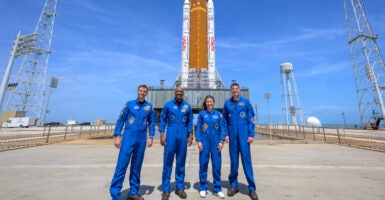
The Artemis II crew of four includes three Americans and the first Canadian to ever venture to the moon. Commander Reid Wiseman is from Baltimore, pilot Victor Glover is a California native, and mission specialist Christina Koch is from Michigan. Jeremy Hansen is the Canadian Space Agency astronaut joining the American crew.
“Pushing yourself to explore is part of being a human,” Glover said of the mission.
The flight was originally scheduled for February but was delayed due to a leak during a test run. In mid-March, NASA finalized the April 1 launch date. NASA will provide live coverage of the launch scheduled for 6:24 p.m. local time, weather permitting.

