



















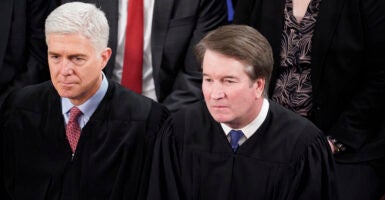
Supreme Court justices grew fiery at times, and occasionally comical, during Monday’s arguments in the case of a former Twitter employee who was a paid informant of the Saudi Arabian government.
Justices considered a narrow legal question about venue—whether a defendant can be prosecuted in a place where the alleged conduct didn’t occur.
In the case of Abouammo v. United States, plaintiff Ahmad Abouammo worked at Twitter’s San Francisco headquarters from 2013 to 2015 and had access to users’ data. Prosecutors charged him with providing information about Saudi dissidents to the Saudi government in return for lavish gifts and cash payments.
After Abouammo left Twitter (a social media platform now known as X), FBI agents from California questioned him at his Seattle home about his conduct. While there, he created a false document and emailed it to the FBI, according to prosecutors.
Abouammo and his lawyers argued that he should never have been charged in California for falsifying documents, as the crime happened in Washington state.
The administration argued that the crime should have been charged in California. “It’s no different than pointing a gun and shooting. He shot the e-mail, and he hit Northern California.” Anthony Yang, assistant to the solicitor general, said before the court.
None of the justices seemed to buy the argument. Two justices—Amy Coney Barrett and Brett Kavanaugh—brought up hypothetical scenarios that prompted chuckles in the courtroom.
Kavanaugh asked if the venue would have been Washington state rather than California if Abouammo had instead shredded evidence.
Yang said the venue would still likely have been Washington state, noting that the law on destruction of evidence differs from the prohibition of creating fake invoices.
Justice Ketanji Brown Jackson intervened to say, “Now, I am completely baffled.”
After Abouammo left Twitter in 2015, he moved to Seattle and was a freelance social media consultant.
At the same time, the FBI’s San Francisco field office investigated several Twitter employees over alleged unauthorized access to personal information. Two agents from California and an assistant U.S. attorney questioned Abouammo, SCOTUS Blog reported.
During questioning by federal agents, Abouammo asked to excuse himself to look for documents demonstrating the Saudi payments were legitimate consulting income. He fabricated a document, then emailed it to the agents in his home.
A federal jury in San Francisco convicted Abouammo of falsifying records in connection with a federal investigation, among other charges that included his acting as an unregistered foreign agent. He was sentenced to 42 months in prison.
The 9th U.S. Circuit Court of Appeals upheld the conviction but remanded the sentence to the district court, which reduced the remainder of his sentence.
Abouammo argued that the Northern District of California was the wrong trial venue for the charge of falsifying records, since that occurred in Seattle. The 9th Circuit Court held that his act influenced the federal investigation of the larger crimes in San Francisco.
Yang stressed that the investigation “was for the completion of another crime,” adding, there is “no doubt he [Abouammo] intending to obstruct this investigation in the Northern District of California.” He noted a tradition on this dating back to British common law.
On that point, Chief Justice John Roberts and Justice Neil Gorsuch pressed Yang about why, under that logic, the Boston Tea Party wouldn’t have been tried in England, given that it affected King George and the British Parliament.
However, justices also pressed Abouammo’s lawyer, Tobias S. Loss-Eaton.
He argued that Article III of the Constitution requires that trials for crimes “shall be held in the State where the said Crimes shall have been committed.” Also, the Sixth Amendment provides the right to an impartial jury.
Loss-Eaton argued that “the government wants to have it both ways” on picking the venue for a case, saying, “The offense started and ended within 30 minutes, and he [Abouammo] never left his house.”
Justice Clarence Thomas asked, “Are you saying that if he simply saved the draft to his computer that the crime would have been complete?”
Loss-Eaton answered in the affirmative because the crime was the mere creation of the false document.
Justices spent much of their time questioning the plaintiff’s lawyer on this point.
Justice Samuel Alito, who seemed skeptical of the government’s case, pressed Loss-Eaton about precedent. He cited the case of a man defrauding New Yorkers by impersonating a public official over the phone. The calls were made from outside of New York, but the court held that the fraud could be prosecuted in the Southern District of New York.
“What’s the difference there and here, except for technological changes?” Alito asked.
Loss-Eaton replied, “A phone call works on both ends.”

