


House Republican leadership and the party’s hardline conservative faction rejected the Senate’s homeland security funding deal, which omits funding for border security.
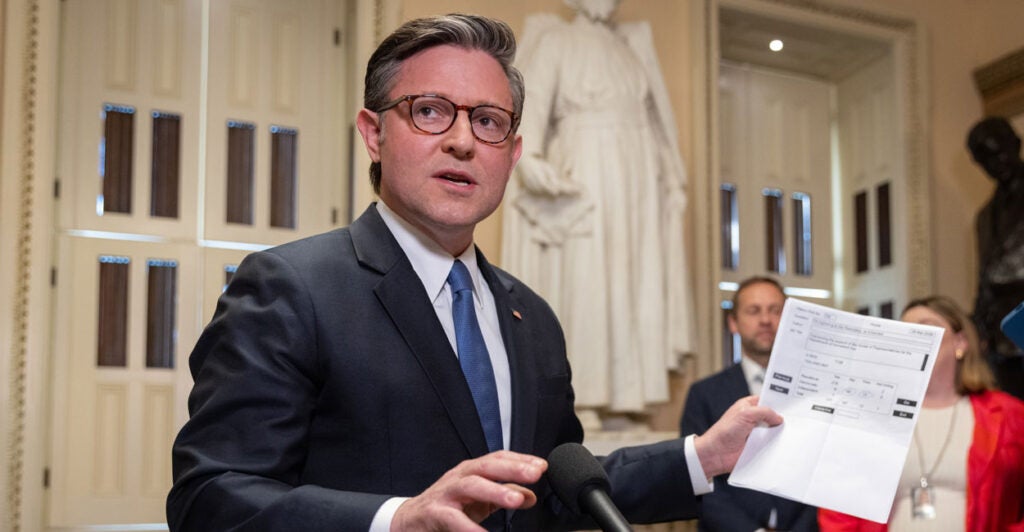
“The Republicans are not going to be any part of any effort to reopen our borders or to stop immigration enforcement,” Speaker of the House Mike Johnson, R-La., said Friday afternoon as he announced his intention to advance an eight-week stopgap funding bill for the Department of Homeland Security instead.
“We are going to deport dangerous criminal illegal aliens because it is a basic function of the government. The Democrats fundamentally disagree,” he said.
The bill, which would extend funding of the agency to May 22, has little chance of passing the Senate as written. Democrats have demanded additional restraints on immigration enforcement as a condition of funding the entire department.
Early Friday morning, the Senate agreed by unanimous consent to fund key agencies within the Department of Homeland Security, such as the Transportation Security Administration, the Federal Emergency Management Agency, the Coast Guard, and the Cybersecurity and Infrastructure Security Agency, before leaving for recess.
However, the bill did not fund Immigration and Customs Enforcement and most of Customs and Border Protection.
House conservative hardliners outright rejected the Senate proposal, stating their desire to fund immigration enforcement and include a requirement for photo identification to vote in federal elections.
“It’s absurd,” said Rep. Chip Roy, R-Texas, at a Friday press conference with fellow Freedom Caucus members.
“I mean, could the Senate be any more lazy than to send us a bill that doesn’t do the job and then leave town?”
Rep. Riley Moore, R-W.Va., a member of the House appropriations committee, said, “We can’t take a bill up that literally is defunding the priorities of the president, the things that we ran on, the reasons that we were elected.”
Moore added, “We need to amend that bill, put our priorities back in it.”
The House Rules Committee, the leadership-controlled panel that determines the conditions for debate of bills on the House floor, would also need to support a funding bill before a floor vote.
Committee member Rep. Austin Scott, R-Ga., called the Senate’s work “ridiculous,” attributing it to “pure laziness and desire for the Senate to go on vacation instead of doing their job.”
On the ensuing House Republican conference call, Johnson announced his alternative plan of a clean extension of funding for the department.
Rather than clear a path for ending a six-week shutdown, the Senate’s after-midnight deal may be more of a setback.
Senate Minority Leader Chuck Schumer, D-N.Y., was quick to speak on behalf of his party in opposition to the House Republicans’ plan.
“A 60-day CR that locks in the status quo is dead on arrival in the Senate, and Republicans know it,” wrote Schumer on X.