









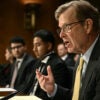

















When Stanford biologist Paul Ehrlich appeared on “60 Minutes” in 2023, he warned that humanity was on an unsustainable path and that “the next few decades will be the end of the kind of civilization we’re used to.” He explicitly linked overpopulation and consumption to climate disruption, claiming it was already killing people.
Ehrlich recently died at 93, and the media offered respectful tributes to his 1968 bestseller “The Population Bomb,” yet almost no outlet asked the glaring question: why should anyone trust predictions from a man whose most famous forecasts were spectacularly wrong? In fact, all of his doom predictions were wrong—similar to the climate doom predictions of today.
Ehrlich predicted mass starvation would kill hundreds of millions in the 1970s and 1980s, that England would cease to exist by 2000, and that the U.S. would face widespread famine. None of that happened. Instead, the population doubled to 8 billion.
Prosperity soared. The Green Revolution—powered by better seeds, fossil-fuel-derived fertilizers, and fossil-fuel-enabled agriculture—fed billions more people than Ehrlich believed possible.
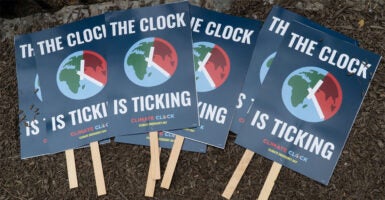
This same pattern of failed apocalyptic forecasts now dominates mainstream climate information. For decades, prominent voices have warned of entire nations underwater, no snow in the U.K., mass extinctions by 2010, and permanent global famine with timelines that have quietly slipped while humanity has thrived.
The media never holds these climate doomsters accountable, just as it spared Ehrlich while continuously going back to the same people for more of their failed predictions and never asking why we should believe them in light of their spectacular failings.
The data reveals the opposite of collapse. According to Our World in Data, deaths have instead plummeted by ten times from both famines and climate disasters compared to historical highs, contradicting Ehrlich’s dire vision.
While tragic events still occur, in recent decades the long-term mortality rates have plunged to historic lows. Billions are living longer and better lives than ever before thanks to our civilization providing reliable, affordable energy for billions through fossil fuels. The more energy a society has, the better its citizens’ lives. Climate doomsters tell us that crops will fail, and people will die from rising seas.
Annual deaths now average roughly 40,000–50,000, a tiny fraction of historical levels on a per-capita basis, thanks to early warning systems, better infrastructure, and increased wealth, on top of the fact that weather disasters and hurricanes are no more frequent than historical norms, while some, like tornadoes, are arguably on the decline.
Crop yields have exploded; since 1961, global wheat yields have risen 225%, corn nearly doubled, rice production has increased 146%, and cereal production has grown 3.5 times (a rate faster than that of population growth), leaving the world better fed than ever before.
Climate alarmists tell us food prosperity will reverse sometime in the future if we don’t kill our economies and lifestyles today, never mind that many crops see far greater production in the warmth than the cold, need less water, and tolerate heat better. For this reason, greenhouses add CO2.
Most ironically, the planet itself is getting greener. In a landmark 2016 NASA study, using decades of satellite data, they found that between a quarter and half of Earth’s vegetated lands showed significant greening over 35 years—roughly 70% of this effect was driven by CO2 fertilization.
The very gas vilified in climate narratives is acting as plant fertilizer on a planetary scale, adding greenery equivalent to two continents, while enhancing ecosystems and regrowing forests the size of Texas and greening dry areas of the world.
None of these trends, from fewer famine deaths and fewer disaster deaths to record harvests and a dramatically greener Earth, fit the climate narrative of inevitable doom. Yet when Ehrlich claimed civilization was doomed on national television, “60 Minutes” lobbed softballs instead of demanding accountability for his failed track record. The media does this repeatedly with climate alarmists: failed predictions are memory-holed, new ones amplified, and positive data ignored.
This isn’t journalism; it’s narrative protection. By shielding serial predictors like Ehrlich and today’s climate doomsayers from scrutiny, outlets don’t just mislead the public—they push policies based on fear rather than evidence, even as humanity has repeatedly defied the collapse narrative.
Paul Ehrlich was wrong about the population bomb. Many climate prophets are repeating the same mistake with the climate bomb. Before we upend economies and living standards based on their latest forecasts, the media owes us something it rarely delivers: an honest examination of the actual track record.
Data, not dread, should guide the climate conversation. The world is not ending. In fact, on the metrics that matter most, we are doing better than ever.
We publish a variety of perspectives. Nothing written here is to be construed as representing the views of The Daily Signal.

