





























This is an adapted excerpt from Emma Waters’ new book “Lead Like Jael: 7 Timeless Principles for Today’s Women of Faith,” out March 24 from Regnery Faith.
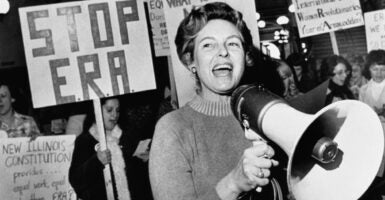
In the autumn of 1973, the Illinois State Capitol in Springfield became an unlikely battlefield. As legislators prepared to vote on the ratification of the Equal Rights Amendment (ERA)—an amendment that had already passed both houses of Congress and was steamrolling toward ratification—one woman led the opposition’s charge.
Poised, articulate, and clad in a tailored dress with pearls on her neck, Phyllis Schlafly looked nothing like the political revolutionaries of her time. The 1970s was a time of profound cultural and political upheaval in America. The sexual revolution, second-wave feminism, and Cold War anxieties collided in the public square. Betty Friedan’s book “The Feminine Mystique” had ignited widespread discontent among American housewives, catalyzing the women’s liberation movement and setting the stage for political reform.
Among the movement’s most ambitious goals was the ERA, a proposal to enshrine gender equality into the Constitution with only twenty-four simple words: “Equality of rights under the law shall not be denied or abridged by the United States or by any State on account of sex.”
To many Americans, the ERA seemed like common sense as a simple extension of the civil rights movement to women. By 1973, thirty states had ratified the amendment, and momentum seemed unstoppable. Political elites, media institutions, and major women’s organizations rallied behind it.
Schlafly, then forty-nine years old, appeared to be no match for such a juggernaut. She had no staff, no grants, and no institutional support behind her. What she had, however, was conviction, strategic wit, and a powerful vision of family flourishing. In her view, the ERA’s bland and neutral wording concealed its radical consequences: drafting women into combat, loss of spousal benefits and protections for mothers, and the erosion of legal distinctions that safeguarded women’s roles in family, athletics, and society.
In her estimation, the ERA wasn’t about equality; it was about sameness—and sameness, she argued, was the enemy of both justice and nature. Schlafly had no office in the formal sense. She worked from her home, with multiple telephones ringing off the hook and children frequently nearby, as her daughter Anne described to me in one conversation. Yet her grasp of political craft was formidable.
She organized her volunteers with military precision—referring to them as “combat units”—training them in public speaking, debate, and professional presentation. She held conferences to equip ordinary women for extraordinary public action.
By 1982, the deadline for ERA ratification expired. It fell just three states short. What had seemed inevitable in 1973 had been soundly defeated, due in large part to one woman’s leadership in and for the home.
What I love about Schlafly’s legacy is that she taught women how to use the tools and resources in their hands to faithfully defend their family, their faith, and the American way of life.
Unlike the feminist movement, Schlafly and her followers did not turn to academia to argue for so-called liberation apart from one’s sex or family; nor did she teach women that marriage, children, and homemaking were a barrier to their advocacy.
Many hardcore feminists placed second things first. They prioritized pressure campaigns in the name of equality, career advancement to break the glass ceiling, and efforts to redefine the family around free love, hook-up culture, and homosexuality. Schlafly, by contrast, taught women to turn the gifts of family, homemaking, and community involvement into a powerful movement. That movement ultimately succeeded.
The key to understanding Schlafly, and all wise women, is to understand their lives through the lens of seasons. The arc of a woman’s life is long. We mature quickly, and on average, we live longer than men. So instead of adopting the life script pushed by modern universities and girl-boss feminism—one that pressures women to pursue the highest levels of education and professional achievement all at once, and as early as possible—a seasonal view offers something wiser and more humane.
Schlafly lived this kind of life. It allowed her to prioritize first things first: raising children during the crucial early years, working and volunteering as time allowed, and gradually shifting her public commitments as her children grew older. This model of traditional womanhood encourages public engagement, but only after family duties have been honored.
And this is precisely why Phyllis Schlafly’s story matters for us today. She didn’t win by acting like a man. She didn’t abandon her home, her femininity, or her faith. She led through them. Her army was made up of volunteers, often mothers, trained in persuasion, hospitality, and disciplined engagement. She understood how to use the tools God had given her, and she taught others to do the same.
This is the kind of womanhood we need to recover: a generation of wise women rising in faithful obedience using the tools God has placed before them to crush the heads of sin, shame, and evil that are around us.
Copyright © Emma Waters 2026. Excerpted by permission of Skyhorse Publishing Inc.

