























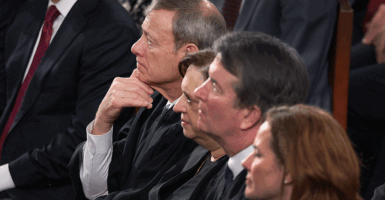
The Supreme Court’s conservative justices on Monday seemed particularly skeptical of arguments by the state of Mississippi that mail-in ballots arriving after Election Day should still be counted.
Mississippi counts ballots that arrive up to five days after Election Day. At least 17 states and the District of Columbia count ballots that arrive late, with at least two allowing them to arrive up to two weeks after Election Day.
The case before the high court is Watson v. Republican National Committee. Mississippi’s Secretary of State Michael Watson is a Republican who oversees state elections.
Justice Amy Coney Barrett pressed Mississippi Solicitor General Scott Stewart about the security of mail-in ballots and what prevents someone from designating their neighbor to deliver a ballot.
“That submission to mail to a common carrier is different in kind than, say, submitting it to a relative or a neighbor,” Stewart answered.
“What’s the difference?” Barrett asked, “They’re not government officials.”
Stewart followed, “They are impartial third parties that have a duty to deliver what they’re owed without altering it.”
But Barrett noted the state law and the state’s brief did not clearly state that line of argument.
“Your definition didn’t say final, as submitted to an impartial third party, or final, as submitted to a common carrier,” Barrett asked.
Justice Neil Gorsuch used the corporation Federal Express as an example of a private delivery service, since Mississippi law didn’t require the U.S. Postal Service to deliver ballots.
“FedEx isn’t an election official,” Gorsuch said.
Stewart said, “The recipient is certainly the person you are sending the mail to.”
Gorsuch replied, “You submit it to FedEx and they deliver it to an election official. You say it has to be submitted to an election official in your brief. Then you say a common carrier is OK. Those two things don’t add up.”
The liberal justices argued against the preemption of state election regulations by courts.
States have regulated mail ballots since the Civil War, noted Justice Sonia Sotomayor.
“People should decide this issue, not the courts, but Congress, or states and Congress,” Sotomayor said.
Stewart agreed, “That is the history of voting and election law in the country.”
Stewart said that in 2020, Mississippi adopted the policy of counting late-arriving ballots during the COVID-19 pandemic.
“There has not been a showing of actual fraud from after-election counting,” Stewart said.
President Donald Trump’s 2025 executive order on election integrity included a provision that would deny federal election funding grants to states that continue counting ballots arriving after Election Day.
The counting of late-arriving ballots by states does not break along party lines.
Illinois and Utah count ballots arriving up to 14 days after Election Day, according to the National Conference of State Legislatures, as long as the ballots are postmarked by Election Day. Alaska and Maryland allow ballots postmarked by Election Day to be counted up to 10 days after the election.
California, the District of Columbia, New York, and Oregon count ballots arriving seven days after the election. New Jersey counts ballots arriving up to six days post-election, while West Virginia’s grace period is five days.
Nevada and Ohio count to four days after Election Day, while Kansas, Massachusetts, and Virginia count ballots arriving up to three days after Election Day.
Washington state law says that ballots received after the election with postmarks before Election Day are counted, but no deadline is specified for when they must be received, according to the National Conference of State Legislatures.
The 5th U.S. Circuit Court of Appeals ruled in October 2024 in the case from Mississippi that federal law requires mail-in ballots to arrive by Election Day. The ruling didn’t affect the election that year.
The three-judge panel’s opinion said, “Federal law does not permit the state of Mississippi to extend the period for voting by one day, five days, or 100 days.”
In April 2025, U.S. District Judge Louis Guirola Jr. of the Southern District of Mississippi ordered a stay on further litigation in the case until the U.S. Supreme Court decides on the matter.

