





























Since I last lived in London 30 years ago, Britain has seen the largest inward migration in its recorded history of more than 2,000 years, most of it from outside Europe. In 1996, the country was more than 90% indigenous English, Irish, Scottish, and Welsh. Today it is only 73%.
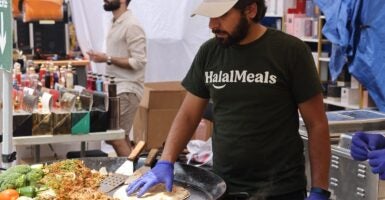
One story that really captures the mass migration and assimilation crisis of modern England is that of Harman Singh Kapoor, a Sikh immigrant who owns a restaurant called Rangrez in Hammersmith, north London. Kapoor publicly declared that he would not serve halal meat. “Halal” is the Arabic term for permitted, or clean, as opposed to “haram”—forbidden, or unclean. Observant Muslims will only eat halal food, just as observant Jews will only eat kosher.
Singh’s need to declare that he would not serve halal meat, or his manner of doing so, could be questioned. But it’s his restaurant and his call. The simple thing for any objecting Muslims to do would be not to eat there.
But this is “multicultural” London, where indigenous English are barely a third of the population. Conflicts from the old country are imported intact. Magnified on social media, the halal issue resulted in confrontations at Rangrez. At one point, a large group of men showed up outside. Singh had said he carried a knife for defense (one of five items a religious Sikh man must carry at all times, incidentally) and he was arrested. He has now apparently decided to close up shop.
This spat highlights a bigger one: To what degree should natives in Britain, or Western countries that take in large numbers of immigrants, concede to the religious and cultural demands of the newcomers?
Should inhabitants of Minneapolis, who are mostly not Muslim, be obliged to hear the Muslim call to prayer broadcast five times a day from dawn to dusk? Should all of us have to eat food prepared according to the sensibilities and rituals of a minority?
There are over 200 schools in Britain that serve halal food. Halal, like kosher for Jews, requires a specific method of killing animals. One provision is that the animal’s “wind pipe, gullet, and preferably 2 cartoid [sic] arteries and 2 jugular veins must be cut in a single action,” by a Muslim man, with a knife, according to the Association for Public Service Excellence.
British law, with the intent of avoiding unnecessary cruelty to animals, requires that they be stunned prior to slaughter. But in 1995, a law was passed to make an exception for religious slaughter. Presumably, that was thought at the time to be a fairly minor exception, but now, with a growing Muslim population, it is a controversial issue affecting the mass market.
Vegetarians don’t have a dog in the fight (excuse the pun). But carnivores divide into those who want their meat killed humanely versus religiously. Large institutions in Britain—as in the U.S.—are often woke, so happy to pander to special interests. Just look at Budweiser, Disney, and Hollywood. But they also want to avoid negative publicity. For those in the food business, sometimes the sly but easy way out is to make everyone eat halal—whether or not they know it.
In 2010, the Daily Mail reported that a large government-run London hospital chain was serving halal meat in its cafeteria without labeling it as such. So were some sporting events, private schools, pubs, and restaurants. In 2014, The Sun newspaper reported that all chicken served at the national chain Pizza Express was halal.
In 2017, a London hospital told Breitbart that it served only halal food in its cafeteria “so that it caters for all visitors, staff, and patients who visit the restaurant.” In other words, halal was the default, making it “inclusive” for those who are observant Muslim meat-eaters, but not those who object to religious verses from the Quran being part of their meal preparation.
In 2019, an English college student was suspended for stating during a debate that halal was “an inhumane and barbaric way of slaughtering animals.”
Deciding how far to accommodate those with the strict religious rules about what they eat is a dilemma for big chains, including American ones. The requirements are not only that halal meat is served, but that the premises be clear of “haram” items. So, no bacon bits on your salad. Today, 20% of Britain’s 1,000 Kentucky Fried Chicken outlets serve halal chicken. McDonald’s in Britain, meanwhile, does not have halal restaurants, although some franchises obtain halal supplies for certain menu items.
Buddhists, Christians, Hindus, Sikhs, and other religions have their rituals and food preferences, but they don’t demand everyone else accommodate them. Many Muslims also feel that their religious needs can be accommodated in private without coercing the behavior of others. But some more militant Islamists feel otherwise. They are willing to use political and economic power, and sometimes intimidation, to get their way.
Where Muslim immigrants decide to go with this issue is at the heart of whether this latest, largest cohort of migrants to historically Christian countries will succeed or fail.

