


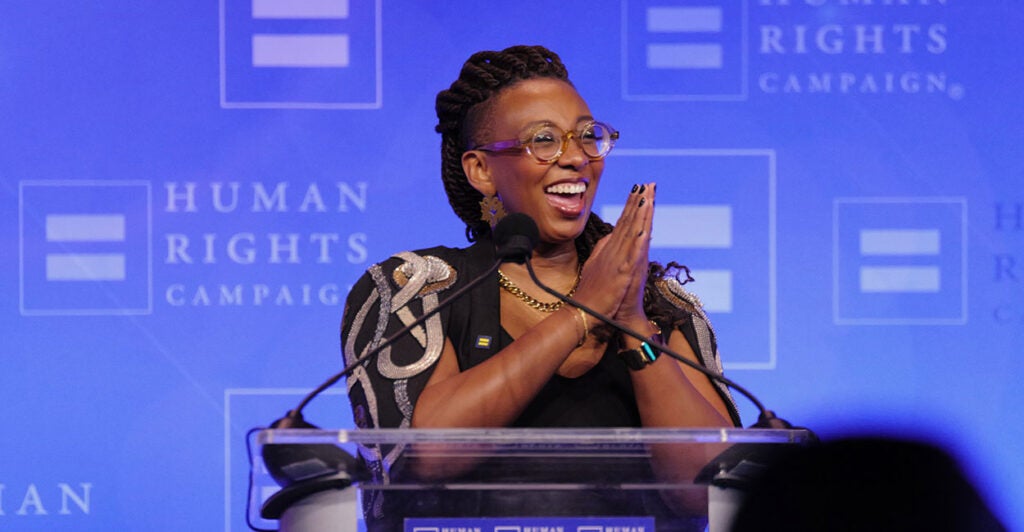
Even as transgender “health care” is losing steam in the medical industry, a powerful LGBTQ+ activist group is expanding its demands for the kind of “gender-affirming care” that companies provide—including cosmetic interventions like an Adam’s apple shave and liposuction.
The Human Rights Campaign, which bills itself as America’s “largest LGBTQ+ civil rights organization,” has long employed mafia-like tactics to pressure companies to toe the line on gender ideology. Even though its influence campaign is on the back foot after a devastating 2025, HRC is actually ramping up its demands for transgender “health care.”
Over the years, HRC has expanded its requirements for companies to get a 100 “perfect score” on its “Corporate Equality Index.” The index has always included non-discrimination policies and diversity trainings, but it has increasingly required LGBTQ+ activism and coverage for sex-rejecting procedures.
HRC’s Social Credit Score
Like the mafia or Al Capone, the Human Rights Campaign promises brands protection from the Left’s activist investors and protester shock troops in exchange for a generous cut—and not just in terms of money. To demonstrate their “equality,” companies take pro-LGBTQ+ stances, contribute to activist groups, and promote rainbow-themed products. Investors in the environmental, social, and governance movement used HRC’s index to determine where their money went.
Under President Joe Biden, HRC prodded the federal government to implement at least 75% of its 2020 demands.
As the index grew more powerful, the LGBTQ+ mafia kept moving the goalposts. The first edition of the index (2002-2005) focused on non-discrimination, diversity trainings, and affinity groups.
The second edition (2006-2012) required “parity in at least one transgender wellness benefit,” including counseling, coverage of cross-sex hormones (such as estrogen for men or testosterone for women), medical visits, or “medically necessary surgical procedures such as hysterectomy.” The 2006 index gave companies 5 out of 100 points for this transgender “wellness” benefit.
The 2012 edition began awarding 10 points for “transgender-inclusive health insurance coverage.” This required that insurance contracts contain “no blanket exclusions for coverage” and that they be “based on the World Professional Association for Transgender Health Standards of Care.” WPATH, an activist group masquerading as a health authority, hid doctors’ concerns about the negative effects of sex-rejecting procedures.

An Adam’s Apple ‘Shave’
In 2023, HRC moved the goalposts again. Rather than 10 points, the transgender health care benefits would be worth 25 points. The old 2012 standard would count for 15 points, and to earn the remaining 10, companies would need to offer coverage of five of the following:
- Hair removal
- Hair removal specifically for reconstructive surgery
- Tracheal shave/reduction
- Facial feminization surgeries
- Voice modification surgery
- Voice modification therapy
- Lipoplasty/filling for body masculinization or feminization
- Travel and lodging expenses
Men tend to have more cartilage in front of our voice boxes—often referred to as an “Adam’s apple.” If a man who identifies as a woman still has this feature, it may “out” him as transgender, so these men want to get rid of their “Madam’s apples.” A “tracheal shave” refers to the process of shaving that cartilage to hide a man’s true sex.
“Lipoplasty,” commonly known as liposuction, involves removing stubborn fat for body contouring. While companies may object to the idea of footing the bill for a woman’s liposuction to appear more attractive, HRC demands that they consider offering the same treatment for a different woman—if she wants to appear male.
As Americans might expect, this new requirement proved too much for HRC’s corporate partners.
In July 2024, HRC granted companies a reprieve from the new requirements. They only had until this year to get their affairs in order, however, and the 2026 Corporate Equality Index scores included the Madam’s apple requirements.

A Shave Too Far?
Hundreds of companies opted out of the LGBTQ+ mafia’s protection racket last year, and these new requirements may have contributed.
At the beginning of 2025, 377 Fortune 500 companies filled out HRC’s survey for the Corporate Equality Index. This year, that number plunged by 65%, with only 131 companies in the Fortune 500 opting to work with HRC.
Both Target and Bud Light faced strong backlash for public transgender stances in 2023, and pressure built from there.
Conservatives and their allies began launching their own indices to encourage ideological diversity and bring companies back to neutral. Conservatives have also used shareholder resolutions to get companies to reject leftist social activism.
This backlash also helped President Donald Trump secure a second term in 2024.
Health Care’s Return to Sanity
HRC is also rowing against the tide when it comes to health care.
The Department of Health and Human Services has concluded that there is little evidence for positive impacts from transgender medical interventions on minors, but it found many documented harms.
A jury awarded a detransitioner $2 million, finding that the medical professionals who carried out sex-rejecting procedures on her were liable for medical malpractice.
The American Society of Plastic Surgeons released a statement recommending against transgender surgery for minors under 19, leading other medical associations to follow suit.
These developments will make HRC’s preferred “health care” more and more expensive—and less and less palatable for the companies that couldn’t afford it in 2024.
HRC may be on the back foot, but conservatives and other Americans who want companies to prioritize business over leftist advocacy shouldn’t rest on their laurels. Investors can keep making HRC’s protection racket less valuable, and they need to keep up the pressure.
