


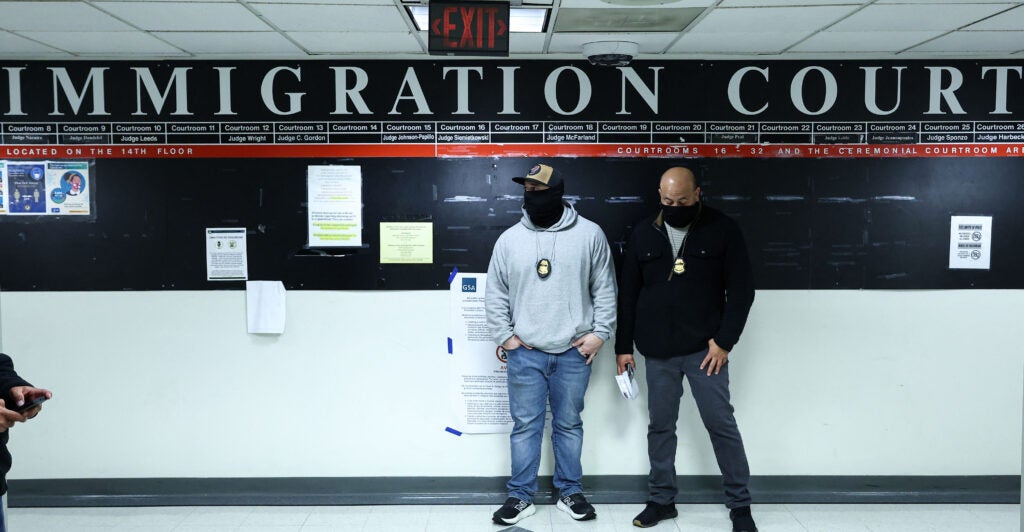
An Obama-appointed judge blocked key portions of the Trump administration’s policy to restrict the appeal process for illegal immigrants facing deportation.
In a Sunday ruling, U.S. District Judge Randolph Moss ruled in favor of immigration groups that sued the Trump administration in the case of Amica Center for Immigrant Rights v. Executive Office for Immigration Review.
Moss, appointed to the bench in 2014, was a former assistant attorney general in the Clinton Justice Department. Last year, he issued a separate blow to the Trump administration’s immigration policy, striking down President Donald Trump’s declaration of an “invasion” at the southern border.
The plaintiffs sought temporary relief from the interim final rule, issued on Feb. 6, titled “Appellate Procedures for the Board of Immigration Appeals,” set to take effect on Monday.
If a federal immigration judge rules in favor of deportation, the appeal can be filed with the Board of Immigration Appeals. Among the plaintiffs’ key objections to the administration’s rule was a “fast track” provision reducing the time to file most appeals from 30 days to 10 days.
The new Trump rule would have also allowed for summary dismissal of appeals unless a majority of permanent board members voted within 10 days to accept the case for review.
The judge also rejected a portion of the rule that allowed summary dismissal without full review of the case, and before transcripts were created.
To expedite matters, the administration issued the rule without the usual notice-and-comment of a federal rulemaking period. The judge held that the rule must be subject to that full process, but did not strike it down.
“At least three portions of the rule work hand-in-glove and, accordingly, need to be considered together,” Moss wrote.
He added, “If there is ever a case that satisfies the D.C. Circuit’s test for applying the notice-and-comment requirement … this is it.”
The Justice Department, arguing for the administration, said the rules were necessary so the Board of Immigration Appeals could target its limited resources to combat an overwhelming backlog of immigration cases, which increased from 37,000 in 2015 to more than 200,000 in 2025.
Moss wrote, “The court is unpersuaded that plaintiffs are entitled to emergency relief.”
The ruling “prevents the BIA from reaching the point of near self-destruction,” said Emilie Raber, senior attorney at the Amica Center for Immigrant Rights, the lead plaintiff in the case.
“We hope that this decision is the first step of many steps in ensuring that immigration courts reach decisions based on the law rather than on pre-determined outcomes,” Raber added in a public statement.
Moss has issued other high-profile rulings. In early 2021, the D.C. Circuit Court of Appeals reversed his decision that the Justice Department could not reschedule a federal execution before President Joe Biden took office.
Notably, as an assistant attorney general for the Office of Legal Counsel in 2000, Moss wrote a memo determining that a sitting president could not be indicted.