


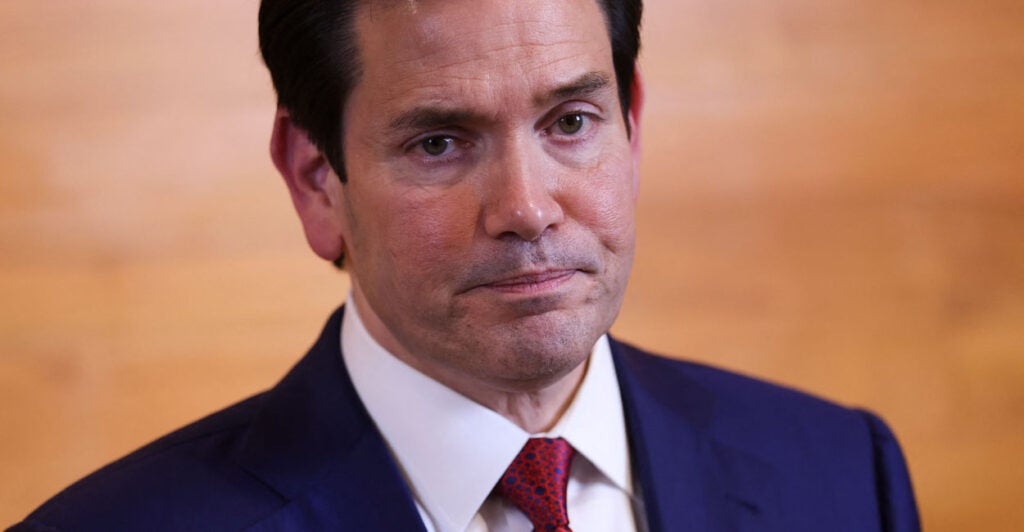
Before representatives from the United States and Iran engaged in a third round of nuclear negotiations in Geneva on Thursday, Secretary of State of Marco Rubio warned that Iran’s refusal to discuss its ballistic missiles is a “big problem.”
Rubio told press Wednesday evening on a visit to the Caribbean island of Saint Kitts and Nevis that “we hope progress can be made” in negotiations “because that’s the president’s preference: to make progress on the diplomatic front.”
“But it’s also important to remember that Iran refuses—refuses—to talk about ballistic missiles to us or to anyone, and that’s a big problem,” Rubio added.
The U.S. and Iran could reach a framework for a deal if Washington separates “nuclear and non-nuclear issues,” a senior Iranian official told Reuters, adding that remaining gaps need to be narrowed during talks in Geneva.
The negotiations have been intense and serious, said the official on Thursday, speaking on condition of anonymity.
Omani Foreign Minister Sayyid Badr Albusaidi said negotiators had taken a pause after the third round of talks got under way on Thursday morning, and that the negotiations would resume later in the day.
“We hope to make more progress,” Albusaidi posted on X.
Iran is estimated to have thousands of ballistic missiles, some of which have the capability of reaching parts of Europe, according to Rubio. Iran is actively working to develop “intercontinental ballistic missiles,” he said, adding, “the ranges continue to grow every single year exponentially.”
In addition to the threat of Iran producing nuclear weapons, the U.S. is concerned Iran will be able to develop a ballistic missile that could reach the U.S.
“For a country that’s facing sanctions, whose economy is in tatters, whose people are suffering—and somehow they still find the money to invest in missiles of greater and greater capacity every year. This is an unsustainable threat,” Rubio said.
Iran has said it wants negotiations to remain focused on its nuclear program and does not want to discuss missile development.
U.S. Special Envoy to the Middle East Steve Witkoff and former adviser to President Donald Trump Jared Kushner, the president’s son-in-law, are leading the negotiations for the U.S. in Geneva. Iranian Foreign Minister Abbas Araghchi heads the Iranian delegation.
The White House continues to stress Trump’s desires to reach a diplomatic solution with Iran while the U.S. continues to increase its large military presence in the region.
The USS Abraham Lincoln aircraft carrier strike group is already near Iran, and the USS Gerald R. Ford, the U.S. Navy’s largest aircraft carrier, is in the Mediterranean Sea.
Just this week, the U.S. sent F-22 fighter jets to Israel for the first time, The Wall Street Journal reports. Israel, America’s closest ally in the Middle East, is likely to be involved in a U.S. operation against Iran.
In June, Israel launched an attack on Iran’s nuclear program that was ended only when the U.S. struck Iran’s three key nuclear facilities during Operation Midnight Hammer.

Reuters contributed to this report.
This story was updated to clarify that Rubio’s remarks occurred before the negotiations.