


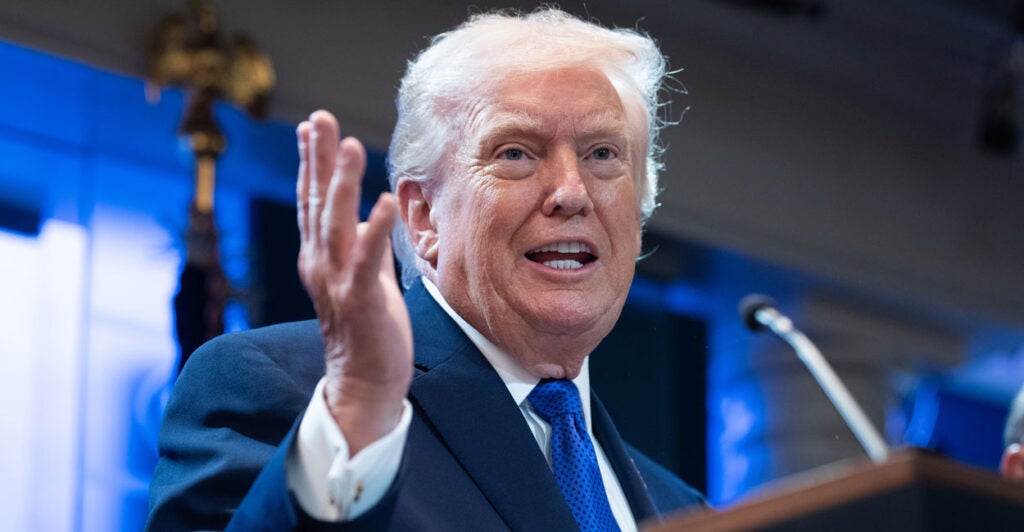
During his State of the Union address, President Donald Trump will celebrate his first year in office and lay out a vision for the next three in front of a Congress stuck in a partisan stalemate on multiple issues.
In Speaker of the House Mike Johnson’s invitation to Trump, he appeared to anticipate an optimistic speech focused on the accomplishments of his second term.
“The United States stands stronger, freer, and more prosperous under your leadership and bold action,” Johnson, R-La., wrote to Trump.
“Together in 2025, your administration and the 119th Congress delivered one of the most consequential agendas in history, and Americans across this great country will experience the tangible results of commonsense governance,” Johnson added.
But barring an unexpected, sudden deal between Senate Democrats and Republicans, Trump will deliver his address amid a shutdown of the Department of Homeland Security.
Unlike during recent shutdowns, Trump will have a major platform for his arguments in the form of the State of the Union address.
Senate Democrats have demanded restraints on immigration law enforcement agents—such as prohibiting mask use and requiring judicial warrants for deportations—in exchange for their votes to reopen the government.
Senate Minority Leader Chuck Schumer and House Minority Leader Hakeem Jeffries, both D-N.Y., will be in attendance at the event, but several prominent Democrats will boycott the event.
“The two options that are in front of us in our house is to either attend with silent defiance or to not attend and send a message to Donald Trump in that fashion, which will include participation in a variety of different alternate programming,” Jeffries said last Wednesday.
Democrats are also likely to chime in on the DHS issue in response to Trump’s address.
Schumer and Jeffries have selected Sen. Alex Padilla, D-Calif., to deliver his party’s Spanish-language response to Trump.
Padilla, who in 2025 was forcibly removed from a Department of Homeland Security press conference after accosting Homeland Security Secretary Kristi Noem, has been an opponent of Trump’s immigration law enforcement policies.
In a statement, Padilla previewed how he would speak on the issue of immigration.
“We refuse to accept a federal government that weaponizes enforcement agencies against immigrants and U.S. citizens alike,” said Padilla.
Trump is also coming to Capitol Hill as Congress raises questions over the White House’s war powers.
Rep. Ro Khanna, D-Calif., is preparing to force a vote on whether or not to advance their war powers resolution, which would restrain the White House’s ability to use military force against Iran.
Another elephant in the room is whether or not Trump will call on the Senate to find a way to overcome the 60-vote filibuster threshold required for most bills to pass.
Trump has previously called on the Senate to use the “nuclear option” of a Senate rules change to eliminate the need for 60 votes to end debate.
More recently, a faction of Republicans, among them Sen. Mike Lee, R-Utah, has been advocating for forcing a “talking filibuster” to pass the SAVE America Act, which would require proof of citizenship and photo identification for voters to participate in federal elections.
Lee, who argues that Senate Republicans could enforce Rule 19 of the Standing Rules of the Senate to force Democrats to continue talking in order to block the legislation from coming to a vote, has said Trump’s support is important for this to become a reality.
“I’ve told him, ‘If you like it, you’ve got to help,’” Lee recently told the Washington Examiner of his dialogue with Trump on the matter. “We’ll need encouragement if you want us to do this.”