


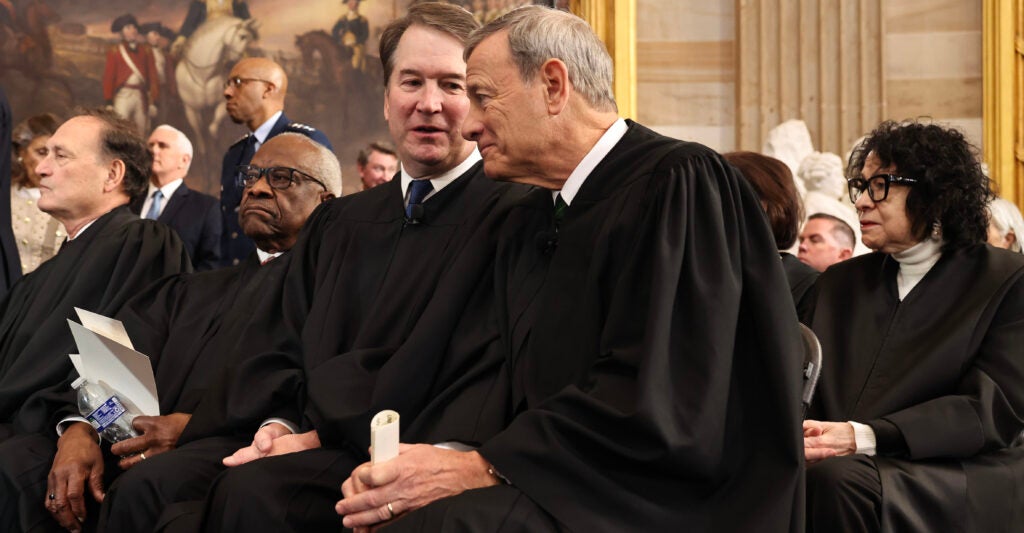
The Supreme Court announced it will release opinions beginning on Friday, amid speculation about the future of President Donald Trump’s tariffs, new congressional maps, and an expected strike at the “deep state.”
In addition to the Feb. 20 opinions, the high court indicated it would release additional opinions on Feb. 24 and Feb. 25, SCOTUS Blog reported.
Among the most anticipated rulings is on Trump’s tariffs, imposed last year without authorization from Congress. Tariffs are a core element of his economic agenda.
During oral arguments in November, Trump-appointed justices seemed skeptical of the government’s arguments for using an emergency law to impose tariffs.
At issue is whether the president exceeded his executive branch authority by imposing tariffs under the 1977 International Emergency Economic Powers Act, which is intended to address emergencies only. Normally, trade policy, including tariffs, is enacted through legislation in Congress and signed by the president.
The case marks uncharted waters for the Supreme Court, which has never ruled on how far the International Emergency Economic Powers Act extends.
Another major case could involve justices issuing an opinion that strikes a blow against the federal bureaucracy in Washington.
This specific case of Slaughter v. Trump regards Trump’s ouster of Federal Trade Commissioner Rebecca Slaughter. But the court’s ruling will affect other federal boards and commissions with members appointed by Republican and Democrat presidents.
The members, in theory, operate without political concerns. They serve for a set term until it expires, regardless of whether a new president of a different party assumes office during that term.
The high court, in the 1935 precedent in Humphrey’s Executor v. United States, ruled Congress could enact laws limiting the power of a president to fire executive officials of an independent agency.
In oral arguments, a majority of justices seemed near certain to scrap the 90-year-old precedent, which has protected the federal bureaucracy.
In another case that could be ruled on in the coming days, the high court also heard arguments in a redistricting case in October that could affect which party controls the House of Representatives.
A majority of justices seemed inclined to uphold the congressional and legislative maps in Louisiana.
Liberal groups have sounded the alarm that the forthcoming ruling in Louisiana v. Callais could net Republicans up to 19 new seats nationwide in the U.S. House of Representatives, as the decision could impact parts of the 1965 Voting Rights Act.
The dispute began after the 2020 census when Louisiana redrew six congressional districts with just one majority-black congressional district.
The NAACP and others sued, alleging the new map resulting from the 2020 census violated Section 2 of the federal Voting Rights Act, which bans race-based gerrymandering of districts.
The state had one majority-black district from the 2010 census, but NAACP and others contend that the state’s black population shifted and grew, resulting in the need for a second district.
In 2022, U.S. District Chief Judge Shelly Dick sided with the NAACP and ordered the state to redraw the map with two majority-black districts.
After the state created a new map, other state voters sued, asserting the new map violated the equal protection clause of the U.S. Constitution’s 14th Amendment, since the boundary lines of the second district had been drawn based on race. The 5th U.S. Circuit Court of Appeals struck down the new map.
Yet another high-profile case involves campaign finance law. Justices heard arguments in December in National Republican Senatorial Committee v. Federal Election Commission, and a majority seemed inclined to further roll back campaign finance limits
If the Supreme Court sides with the Republicans in the case, it would mean candidates can accept funding directly from a political party and also discuss with party officials how to use the funds.
The case emerged in 2022, when plaintiffs, including then-U.S. Senate candidate JD Vance, now vice president, as well as then-Rep. Steve Chabot, R-Ohio, sued the Federal Election Commission. The plaintiffs contend that coordinated expenditure limits violate the First Amendment.