


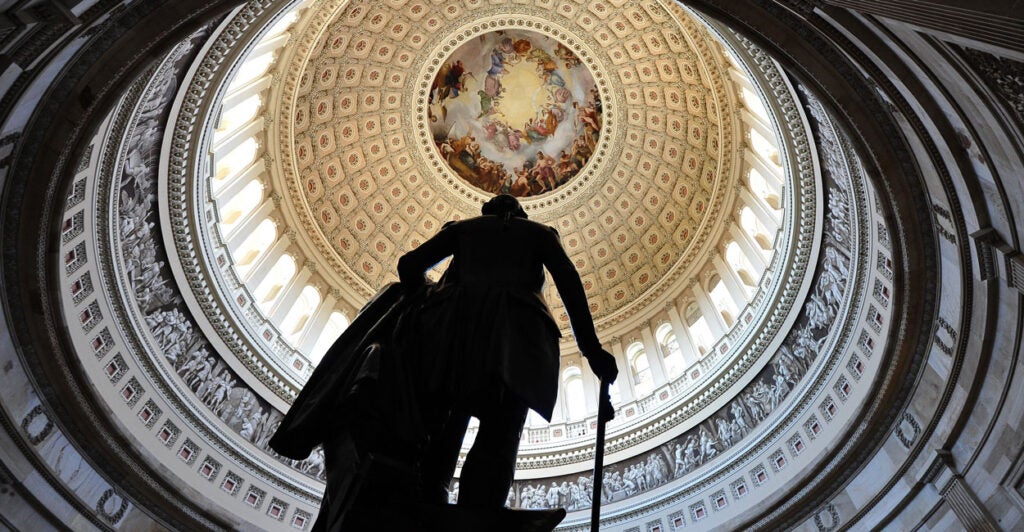
It is an unlikely union. America’s Cincinnatus—George Washington—and America’s Michelangelo—the Italian painter Constantino Brumidi—never met.
Washington was born in 1732, a third-generation Virginian. Brumidi was born in Rome in 1805 and emigrated to the United States in 1849, becoming a naturalized citizen soon after.
Yet both left indelible marks on the American republic.
Washington shaped the nation like no other military or political leader before or since, earning the title “America’s Indispensable Man.” Brumidi, who honed his craft painting frescoes and murals in Rome, would leave his imprint throughout the most important building in the country—the U.S. Capitol—earning his own distinction as the Capitol’s indispensable artist.
America’s Indispensable Man—and the Capitol’s
“Those beautiful hallways on the Senate side of the Capitol? Brumidi,” the U.S. Capitol Historical Society wrote. “The historic committee rooms and fancy reception rooms? Brumidi. The decorative band wrapping around the Rotunda with the scenes from American history? That would be Brumidi, too.”
Brumidi’s crowning achievement—among many throughout the Capitol painted over a 25-year period—is the mural known as “The Apotheosis of Washington.” Painted in just 11 months after the completion of the new Capitol dome in 1864, the massive fresco is suspended 180 feet above the Rotunda floor and spans 4,664 square feet.
How did an Italian immigrant earn such a commission? And why was George Washington chosen as the central figure of Brumidi’s masterpiece?
To answer the first question, it helps to answer the second—and to reflect on Washington’s singular role in the founding of our nation.
“Washington is the mightiest name of earth,” Abraham Lincoln declared in 1842. “To add brightness to the sun, or glory to the name of Washington, is alike impossible. Let none attempt it. In solemn awe pronounce the name, and in its naked, deathless splendor, leave it shining on.”
The Man Who Walked Away From Power
Those were not words of hyperbole, but of earned reverence. Washington led an upstart Continental Army to victory over the mighty British Empire—and then did something almost unimaginable: He resigned his commission.
When the American artist Benjamin West informed King George III that Washington was walking away from power, the monarch famously replied, “If he does that, he will be the greatest man in the world.” Washington returned to Mount Vernon, choosing civilian life over a crown.
Duty soon called again. In 1787, Washington was summoned to Philadelphia to preside over the Constitutional Convention. He was later unanimously elected as the nation’s first president. Among his many achievements, he signed the Northwest Ordinance of 1789 into law, barring slavery in new U.S. territories. After two terms, he again relinquished power and returned home.
An Artist Finds His Calling
But who was Brumidi—and how did he become the Capitol’s most important painter?
“As a boy in Italy, he studied at a famous arts academy and learned how to fresco, painting on wet plaster so colors could become a permanent part of the wall,” the Capitol Historical Society notes. In Rome, Brumidi painted palaces, chapels, and the Pope’s residence at the Vatican.
Forced to flee political upheaval during the Italian Revolution in 1852, Brumidi came to America. Living in New York, he traveled widely to paint private homes and churches, including a cathedral in Mexico City. On one return trip, he stopped in Washington, D.C., to visit the Capitol—a detour that changed his life.
Painting a Nation
The timing could not have been better. The Capitol had recently expanded to accommodate larger House and Senate chambers, leaving behind vast, empty walls. Brumidi was determined to fill them. He demonstrated his talent with a small painting in a Capitol meeting room, passed the audition, and soon became a permanent fixture—painting there for the next quarter century.
So constant was his presence that few could remember a day when Brumidi was not at work in the Capitol.
The scaffolding required for “The Apotheosis of Washington” became nearly as famous as the artist himself. According to the Capitol Historical Society, “Brumidi would lie down on the platform, working flat on his back as he painted on the curved surface seventeen stories above the Rotunda’s floor.”
It was dangerous work, and people often gathered to watch him get pulled each day to the scaffolding’s peak. One fall nearly killed him, saved only by the quick action of a watchful security guard who was able to save him.
Injured, Brumidi continued painting for another year before his death in 1880.
180 Feet in the Air
The most memorable creation of Brumaldi’s career is his effort to honor our nation’s founding father.
“In the central group of the fresco, Brumidi depicted George Washington rising to the heavens in glory, flanked by female figures representing Liberty and Victory/Fame,” notes Architect of the Capitol on its website. “A rainbow arches at his feet, and thirteen maidens symbolizing the original states flank the three central figures. The figures in the painting, up to 15 feet tall, were painted to be intelligible from close up as well as from 180 feet below.”
What was the significance of this God-like rendition of Washington? “The fresco is less a deification of Washington than a creative recording of his achievements,” wrote Nayeli Riano. “Like any historical painting, it’s telling us a story about how we understand our nation and its identity.”
Should art like Brumidi’s show such admiration for its subject? “We might easily mistake such a work as blind reverence,” Riano noted. “Indeed, this is not the case. Brumidi’s fresco demonstrates, instead, the purpose of art: to lift our spirits and grant us something—an ideal—worth striving for.”
One of our great historians, the late David McCullough, agreed.
“This isn’t ancestor worship, this is reality, this is the truth,” McCullough said not long before his death. “To be indifferent to people like Washington is a form of ingratitude. We ought to be down on our knees thanking God we’re a part of this country, and we ought to know about the people who made it possible.”
Two Lives, One Dome
That belief animated Brumidi. He honored Washington—and the nation that adopted him—not with speeches or essays, but with paint and paint brush.
Washington died at Mount Vernon on Dec. 14, 1799, mourned around the world. Brumidi died nearly 80 years later in Washington, D.C., largely forgotten, with one final work left unfinished: the Capitol’s “Frieze of American History.”
Thus ended the intertwined story of America’s Cincinnatus and America’s Michelangelo—forever connected in a fresco adorning the dome of the U.S. Capitol. One the American people have admired for centuries—and will be admiring for centuries to come.
Originally published in Newsweek.
We publish a variety of perspectives. Nothing written here is to be construed as representing the views of The Daily Signal.