


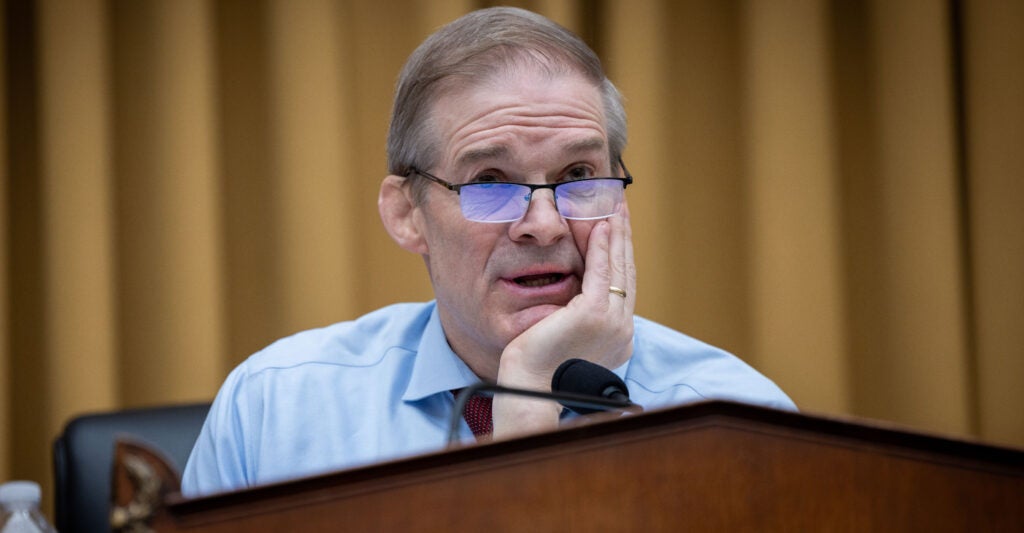
House Judiciary Chairman Jim Jordan, R-Ohio, said his committee could clear legislation in the next two weeks to crack down on sanctuary jurisdictions.
In an interview with Just the News, Jordan said sanctuary jurisdictions include 11 states, 18 major cities, and three counties, as well as the District of Columbia.
He said this represents about one-third of the nation’s population.
“We’re looking at passing a bill to deal with this sanctuary jurisdiction issue,” Jordan said.
“We think we’re going to have a markup in two weeks in our committee to address this. That may be, well, you know, there’s various ways to look at it.”
A sanctuary jurisdiction declares that it will not cooperate with federal immigration law enforcement, and in some cases places restrictions on federal immigration authorities’ capacity to conduct enforcement in public spaces.
Jordan brought this up amid the chaos in the Twin Cities region.
Jordan wasn’t specific on how the legislation would work, but said it would involve a requirement that state and local law enforcement contact federal law enforcement when they encounter criminal illegal aliens.
He said the sanctuary jurisdictions make it difficult for Immigration and Customs Enforcement agents to apprehend illegal aliens when they are released from state and local detention centers.
“They got a guy in their jail. ICE knows it’s an illegal migrant who’s also been charged with some other crime; they get a notice saying it’s a detainer notice saying, ‘Hey, if you’re going to let this guy out, just give us a heads-up. Give us 48 hours. We’ll come and arrest him there at the jail,’” Jordan said.
“Instead, they release him to the streets. That’s a problem there,” Jordan continued. “We should work at some way in our federal law that you can’t do that. You have to work with federal law enforcement when you have that scenario.”