


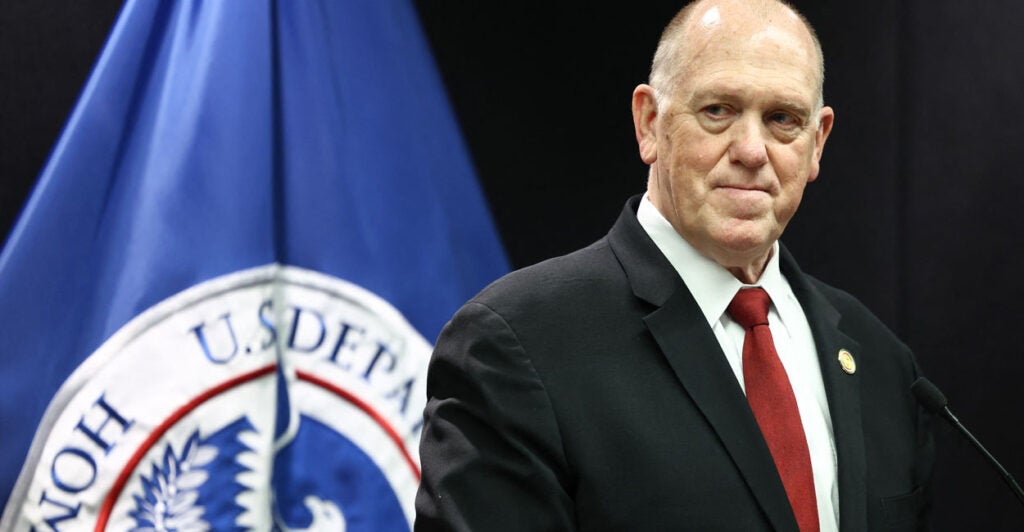
The Immigration and Customs Enforcement operation in Minneapolis is coming to an end, border czar Tom Homan announced Thursday.
Following increased coordination with state and local leaders, “I have proposed, and President [Donald] Trump has concurred, that this surge operation conclude,” Homan said, adding that “a significant drawdown has already been underway this week.”
Within the next week, the federal immigration officers on the ground in the Twin Cities will be sent back to their home states, according to Homan.
The Trump administration deployed 3,000 federal immigration agents to Minnesota in December and January as part of Operation Metro Surge.
Homan announced an initial drawdown in Minnesota of 700 immigration agents last week, crediting the change to increased cooperation with state officials.
Trump deployed Homan to Minneapolis about three weeks ago to oversee the immigration enforcement operation there after a Border Patrol agent shot and killed Alex Pretti, 37, on Jan. 24, and an ICE agent shot and killed Renee Good, also 37, on Jan. 7.
ICE will maintain a presence in Minnesota, according to Homan, who added that the targeted operation over the past six weeks has left “Minnesota safer.”
Since arriving in Minnesota two weeks ago, Homan has stressed that increased cooperation between state and local law enforcement and federal immigration officials would result in fewer ICE agents needed in the city.
“Many criminal aliens” have been arrested in the Twin Cities area during the operation, Homan said.
“We now have the ability to arrest criminal aliens in the safety and security of jails throughout the state at the time they’re being released, like we’ve done in other states,” Homan said.
Immigration officers have also been strategically placed across the state of Minnesota so they can respond quickly when a criminal illegal alien is about to be released from jail, according to the border czar.
“We need to be nearby, so they don’t hold them unnecessarily, so we worked on a strategic plan to reassign officers in those key locations,” he told the press. “Arresting a public safety threat in the safety and security of a jail is safer for the alien, it’s safer for the officer, and safer for the community. I think we all can agree on that.”
Homan added that state and local law enforcement have agreed to respond to cases where federal law enforcement are assaulted or impeded from doing their jobs, and will work to “shut down unlawful agitator activity.”
Federal immigration agents are facing a 1,300% increase in assaults and an 8,000% increase in death threats over the past year, according to the Department of Homeland Security.
Homan explained he has implemented changes to the operation in Minnesota since his arrival, including integrating Border Patrol agents on ICE teams, establishing a clear chain of command, “strengthened joint intelligence and targeting capabilities,” increasing the number of body cameras on agents, and more.
In recent weeks, Homan has met with Minnesota Gov. Tim Walz, Attorney General Keith Ellison, Minneapolis Mayor Jacob Frey, and a number of police chiefs and sheriffs, and says he expects those conversations to continue.
ICE will continue to prioritize the arrest of public safety threats, Homan said, but anyone in the country illegally is not immune from arrest and deportation.