


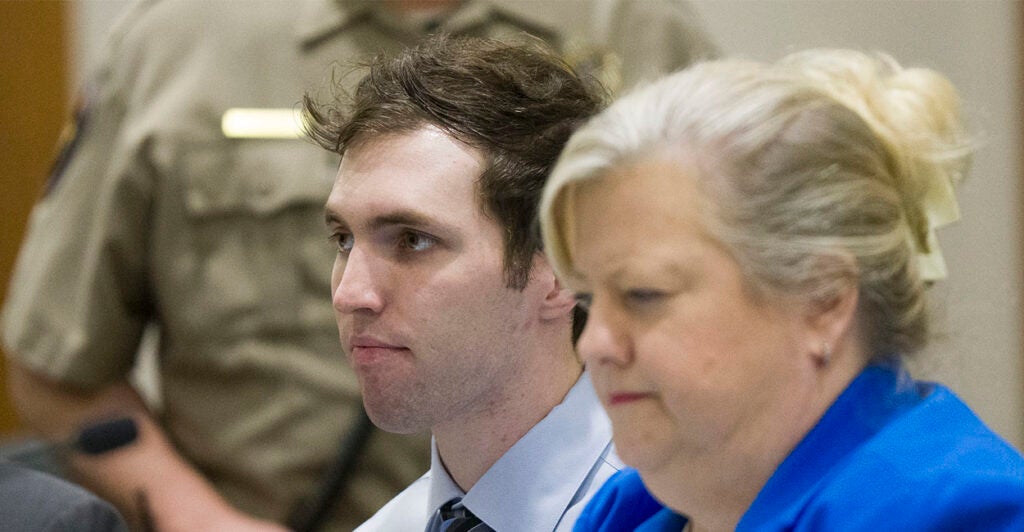
Last week’s hearing in the Charlie Kirk murder case was a legal harbinger of things to come.
As we await Utah State trial Judge Tony Graf’s written decision later this month on whether or not to recuse the Utah County Attorney’s Office from the capital murder case against Tyler Robinson, it’s becoming more evident that this case will dominate the news like no case in recent memory.
Before recounting how the highly unique hearing last week played out, and why it is unlikely the judge will recuse the Utah County Attorney’s Office, it’s worth pointing out some aspects of the case that have become glaringly obvious.
First, the judge and lawyers for both sides exemplify what has come to be known as “Utah nice.”
Lawyers for both sides were polite to each other, to the witnesses, and to the judge. They were so polite that they were almost friendly, even though this is a highly contested case. So far, there haven’t been any verbal jabs or snark or attitude, which we all have come to expect in high-stakes televised criminal trials.
Second, the defense team is highly experienced, strategic, creative, and very active, as you can see from the myriad motions they have filed to date detailed here. And at this early stage in the proceedings, the state is equally up to the task, matching or besting the defense’s motions and arguments.
The Recusal Hearing
As I predicted in my first piece on the case, the hearing on Feb. 3 showcased something you rarely see in a criminal case: defense counsel questioning the elected prosecutor and one of the lead prosecutors on the case.
Their questions were crafty, methodical, and designed to create the impression that there was an actual conflict of interest in this case, requiring the judge to recuse not only the lead prosecutor but the entire office. Whether they ultimately succeed in this motion to recuse, they did create an issue for appeal if Robinson is convicted.
The hearing, which Graf decided to keep open to the public under the terms of a standing decorum order, began with defense attorney Richard Novak continuing his questioning of the elected prosecutor, Jeff Gray.
Novak quizzed Gray on any written policies his office is required to follow regarding best practices for conflicts of interest. Novak got Gray to admit that he is the president-elect of SWAP, the Utah Statewide Association of Prosecutors & Public Attorneys, which acts as a lobbying group that advocates for the policy interests of statewide prosecutors.
Novak asked Gray if he was familiar with a SWAP document called “Utah Prosecutor’s Best Practices.” Gray said he was generally familiar with it. In the “Best Practices” document, Novak asked Gray about Section 1-3.0, titled “Conflicts of Interest,” which states that a prosecutor may not “engage in activities that conflict, have a significant potential to conflict, or are likely to create a reasonable appearance of conflict with the duties and responsibilities of the prosecutor’s office.”
Gray calmly responded that the “reasonable appearance of conflict” has to be rooted in a real conflict upon which there can be an appearance of that conflict. Gray noted that the standard is not based solely on the views of the public but instead based on case law generally. He added that he did not necessarily need to consult this document to inform his decision regarding a potential conflict of interest in this case because of his 25 years of knowledge about conflicts was sufficient knowledge in this area of the law.
Novak didn’t lay a finger on Gray.
The court then went into closed session to hear from the lead prosecutor’s daughter, to protect her identity. Who questioned her and what her answers were are not known at this point.
Failing to Trip Up the Prosecutor
The court moved to the questioning of the lead prosecutor Chad Grunander, conducted by defense attorney Michael Burt. Burt’s job, ultimately, was to get Grunander to lay out detailed facts about his involvement in the case, his close connection with his daughter, and then suggest via his questions that because of his actions in the case, his relationship with his daughter, and later interactions with his colleagues in the prosecutor’s office, that there was an actual or apparent conflict of interest in the case.
Grunander admitted that around noon on Sept. 10, he was at a convention center in Davis County presenting to the elected county attorneys in the state.
Shortly after he finished presenting, he was standing next to Gray and other state county attorneys when he began to receive texts from his daughter in a family group chat.
In a text that came in around 12:25 p.m., the daughter texted in all caps, “SOMEONE GOT SHOT,” and at the same timestamp, she texted, “I’m okay, everyone’s running inside.”
At 12:28 p.m., the daughter had a one-minute phone call with her father. Grunander testified that the purpose of the call was focused on her well-being, not the facts of what happened.
Like any parent, he was startled and concerned about her welfare but understood from the call that she was safe. He spoke with Gray about these text messages since they were together, and within a few minutes after receiving the last text message, he called his office and spoke with prosecutor Chris Ballard to put him on notice of what occurred at UVU, as well as another prosecutor in the office to make himself available for questions and to assist law enforcement.
By 12:50 or so, after making the final call to his office, Grunander left the conference to make the one-hour drive back to Utah County. He drove to Orem, where he met up with Gray, and from there they drove together to UVU to try and understand what was happening and make themselves available to answer questions and assist, staying at UVU late into the day.
Burt then asked whether he considered the public perception of the integrity of the prosecutor’s office and public confidence in their ability to handle the case given the fact that his daughter had been at the event.
Grunander retorted, “Sure, we considered the appearance of conflict here, but when we learned and had a good grasp of what her experience was, or most importantly, what her experience wasn’t, what she didn’t see, we felt confident that there was simply no conflict here, and once people become aware of the facts, there’s no appearance of conflict.”
Despite Burt’s best efforts to the contrary, Grunander testified that none of these events affected his ability to perform his duties as a prosecutor or influenced any of his decisions in the case.
Burt pivoted again and tried through his questions to suggest that the reason the Utah County Attorney’s Office made the decision to seek the death penalty before the preliminary hearing was because of Grunander’ s connection to his daughter.
Once again, Grunander calmly responded that it was the elected prosecutor’s decision whether to pursue the death penalty, not his, and that because of the facts of the case and the aggravating circumstances in the case, it was a death eligible case. He stood his ground and maintained the position that his daughter’s presence at the scene as a non-witness had no impact on any aspect of his professional actions in the case.
Abundance of Caution
Burt asked Grunander about an email he sent to the defense regarding the fact that his daughter had been at the event where Kirk was murdered. After disclosing the relevant facts to the defense, Grunander wrote, “We don’t believe the following creates a conflict for me in Tyler Robinson’s case, but it’s something that should be disclosed to you, his attorneys.”
Sensing he had the upper hand, Burt asked Grunander why he didn’t think it created a conflict or potential conflict.
The response was compelling: “The considerations were that I would be part of the prosecution team … and my daughter was present, and there’s an argument that can be made with respect to a conflict. So, our practice, my practice, is if there’s an argument, disclose it. We’re not in the business of hiding anything. And so, we knew from the outset that once counsel was appointed, we would be disclosing this to the defense and they would respond accordingly, however they thought they should.”
Finally, after being asked if the “Best Practices” document influenced Grunander’s decision to disclose his potential conflict of interest, he had an equally compelling response: “What motivated my behavior was to just act with professionalism and integrity, disclose this to the defense. But don’t mistake our disclosure, my disclosure, our abundance of caution, our professionalism, integrity, to be a concession that we believe there’s merit to this alleged conflict.”
Grunander’s answers were what one would expect from an ethical, honest, by-the-book prosecutor.
At the conclusion of the hearing, Graf said he will issue his ruling on Feb 24.
Based on the facts developed during the hearing from the three witnesses and the legal standard requiring recusal of a prosecutor’s office, I think the judge will likely not grant the motion to recuse the office as there is no direct conflict of interest nor is there an appearance of impropriety that would threaten the defendant’s due process rights.