



Capitalism versus socialism has become a topic of intense debate in senior political and business circles. The recent election of socialist-leaning candidates in major U.S. cities highlights the contemporary relevance of this topic.
A recent Gallup poll finds that Americans view capitalism more positively than socialism; the 54% viewing capitalism favorably is down from 60% in 2021. Americans view socialism more negatively (57%) than positively (39%), with little movement in these attitudes over time.
How have the people of a country fared that have adopted socialism? Not so well—the evidence below indicates.
How have the people of a socialist country that have adopted capitalism fared? Very well—again, the evidence below indicates.
The primary differences between the capitalist and socialist economic systems are the ownership of the means of production, right to private property, and the incentives to work and innovate. In a capitalist system, private individuals and for-profit corporations are the major owners of the means of production. In a socialist system, the state is the major owner of the means of production.
The right to private property is a cornerstone of capitalism; this right is protected and encouraged by the state. Individuals have very limited private property rights in a socialist economy.
The capitalist system provides individuals with powerful economic incentives to work and innovate; this contributes to and stimulates their economy. One of the major flaws of the socialist system is its complete disregard for human incentives—resulting in an ongoing and significant negative impact on their economy, and more importantly, on the lives of their citizens.
We highlight the differences in the economic well-being of citizens of socialist and capitalist economies. We consider the change in economic well-being of four countries that transitioned from socialism to a more capitalist economy, to wit, Poland, Bulgaria, India, and China. Also, we consider the change in economic well-being of Cuba and Venezuela that transitioned from capitalism to socialism.
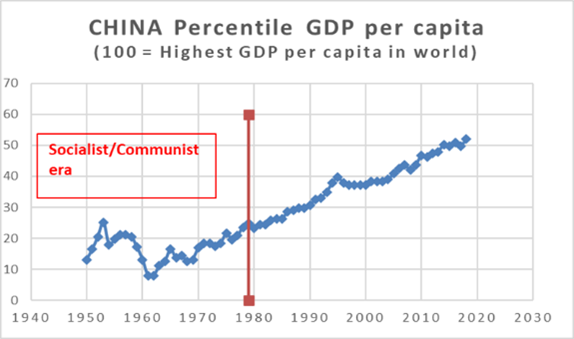
In Exhibits 1 through 4 below, the red vertical line represents the approximate time when the country started its transition from a socialist economy to a more capitalist economy. The gross domestic product per capita for the respective countries (and for the years noted) are obtained from the Maddison Project Database 2020 at the University of Groningen (Netherlands). We standardize this measure by considering the percentile rank of the respective country among all the countries in the world for the particular year. The percentile rank of 100 would be associated with the country with the highest GDP per capita in the world (in that particular year).
Exhibit 1

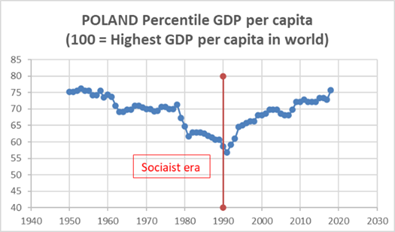
Exhibit 2

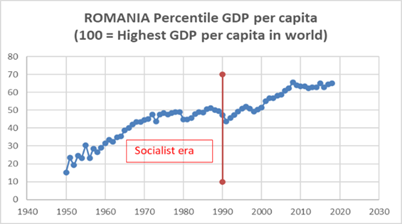
Exhibit 1 highlights the sharp decline in Poland’s percentile GDP per capita prior to 1990. As Poland moved to a more capitalist economy, starting in 1990 and after the collapse of the Soviet regime, its economy improved dramatically. Exhibit 2 highlights the stagnation in Romania’s percentile GDP per capita prior to 1990.
Similar to Poland, as Romania moved to a more capitalist economy, after the collapse of the Soviet regime, its economy improved significantly. The remarkable increase in Poland’s and Romania’s percentile GDP per capita after 1990 should be interpreted as a significant improvement in the economic well-being of tens of millions of citizens of these Eastern European countries once they instituted capitalist economy-friendly reforms.
In the early 1990s, India liberalized its international trade and deregulated its industries and businesses. In the early 1980s, the Chinese Communist Party instituted extensive adoption of free market policies. Exhibits 3 and 4 document a significant improvement in India’s and China’s percentile GDP per capita after their transition to a more capitalist economy.
A more relevant way of interpreting the data in Exhibits 3 and 4: After transitioning to a more capitalist economy, several hundred million Indians went from abject poverty to a quasi-middle-class standard of living, and almost a billion Chinese people went from subsistence living to a quasi-middle-class standard of living. Such a remarkable improvement in the lives of so many people in such a short period is unprecedented in the entire human history going back to the past three millennia.
Exhibit 3

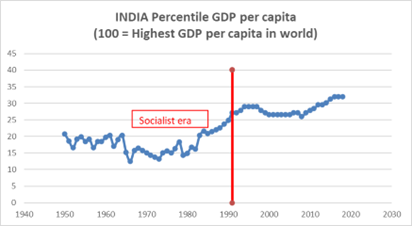
Exhibit 4

Prior to 2000, Venezuela was a very prosperous country (Exhibit 5). Subsequently, their leaders instituted socialist reforms—Hugo Chavez and his successor Nicolas Maduro nationalized major industries, and significantly increased government spending. As market forces and private incentives were pushed aside in favor of bureaucratic control over the economy, Venezuelans experienced a significant drop in their economic well-being.
Indeed, Venezuela’s embrace of socialism shattered the lives of tens of millions of Venezuelans and their families.
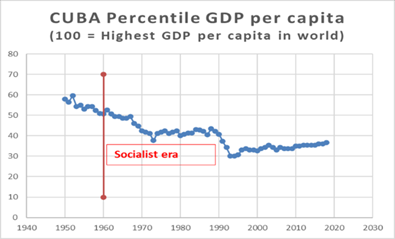
After a violent revolution, Cuba instituted socialist reforms circa 1960. Similar to the experience of Venezuelans, Cuba’s embrace of socialism shattered the lives of millions of Cubans and their families (Exhibit 6).
Exhibit 5

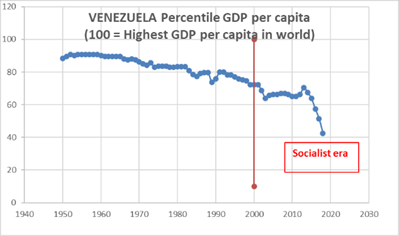
Exhibit 6

***
During the latter part of the last century, senior global policy makers raised the issue that the focus should be on human development and human wellbeing, rather than on just economic development. Partly in response to this—since 1990 the United Nations has annually published the Human Development Report.
The most salient feature of this report is the annual Human Development Index for the 180-plus countries in the world. The Human Development Index of a country provides a composite measure of human health, education, and standard of living in that country.
Health is assessed by life expectancy at birth, education by years of schooling for adults (and expected years of schooling for children), and standard of living is measured by gross national income per capita.
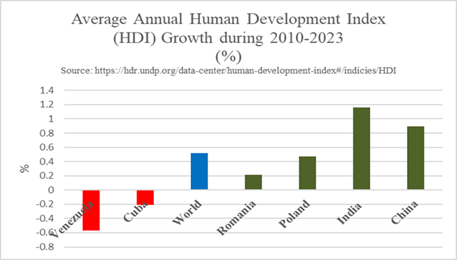
The average HDI of all the countries has seen a secular increase during 1990-2023. During 2010-2023, the average annual HDI growth for the 180-plus countries in the world was 0.52%.
In this same period, the Eastern European countries (that had a socialist economic system prior to 1990) had average annual HDI growth of 0.21% (Romania), and 0.47% (Poland); see Exhibit 7.
During this same 2010-2023 period, the average annual HDI growth in China was 0.89%, and in India it was 1.16%. This is evidence that after a country reforms its economic system and moves from a socialist economy to a more-capitalist system, the well-being of its citizens improves at a regular pace; well-being in terms of health, education, and income.
The two avowedly socialist countries today, namely, Venezuela and Cuba, had negative annual HDI growth in 2010-2023 (Venezuela had -0.57%, Cuba had -0.21% HDI growth). This is strong evidence that citizens of socialist economies are consistently (on a year-by-year basis) made worse off in terms of their health, education, and income.
Earlier this year, Venezuela has had a change in its political leadership; it is likely this leadership change may lead the country to a more capitalist system and greater economic prosperity for its citizens.
Exhibit 7

The above evidence is consistent with the argument that capitalism improves human lives, and socialism does the opposite. Socialism has been a failure everywhere it has been tried; it has been a failure for the human lives it has governed. Socialism’s legacy is the misery, tears, and suffering it has brought upon the hundreds of millions of human beings across the planet in the past century.
We publish a variety of perspectives. Nothing written here is to be construed as representing the views of The Daily Signal.