


There are three certainties in life: death, taxes, and the claim that any school choice proposal will spell doom for public schools.
With each new legislative proposal, the Chicken Littles arrive like clockwork, squawking that the sky is falling.
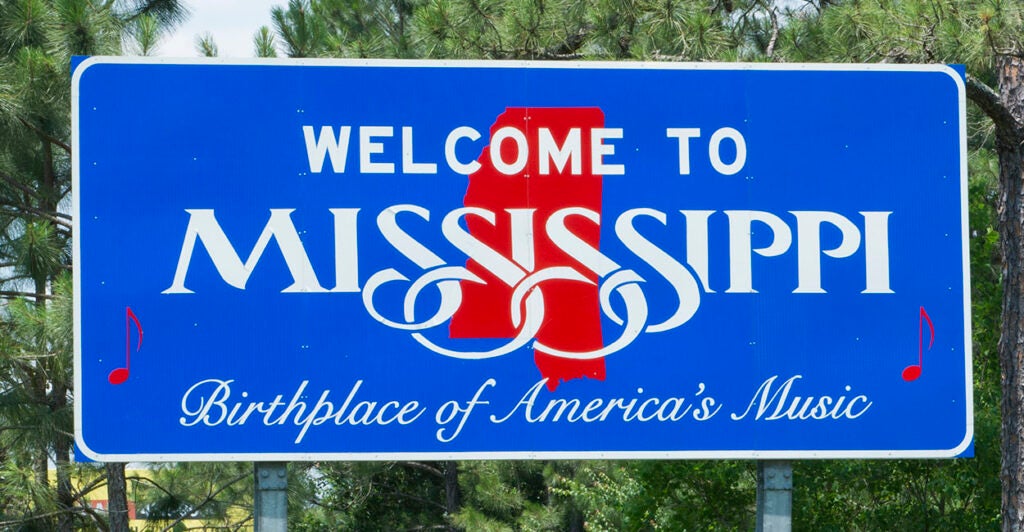
Case in point: Mississippi, where the state Legislature is considering the Mississippi Education Freedom Act, a bill sponsored by Mississippi House Speaker Jason White that would significantly expand education choice.
The bill would create Magnolia Student Accounts, a form of K-12 education savings accounts that families could use for private school tuition, tutoring, homeschool curricula and supplementary materials, education services for students with special needs, and more.
School choice policies are popular in Mississippi and nationwide. According to Morning Consult, 73% of Mississippi parents of school-aged children support K-12 education savings accounts.
The bill has the support of President Donald Trump and Mississippi Gov. Tate Reeves. It passed the Mississippi House earlier this month and will soon be taken up by the state Senate.
Predictably, opponents of education freedom are predicting doom and gloom.
“School choice will set Mississippi back decades,” claimed Biloxi Superintendent Marcus Boudreaux in a recent video. According to Boudreaux, school choice would “derail” the recent progress Mississippi has made in improving student outcomes.
These false prophecies are nothing new. In 1999, as Florida lawmakers were considering enacting a school choice policy, then-state Rep. Debbie Wasserman Schultz, a Democrat, predicted, “This is the day that will go down in the annals of Florida history as the day we abandoned public schools, and the day we abandoned, more importantly, our children.”
More than a quarter-century later, Florida is the highest-ranked state over and for education choice on The Heritage Foundation’s Education Freedom Report Card and the American Legislative Exchange Council’s Index of State Education Freedom.
If the Chicken Littles were right, Florida’s education system should be in the gutter. But as the left-wing Urban Institute recently observed, Florida is among the “top-ranking states across the four National Assessment of Educational Progress tests.”
The Chicken Littles should go touch grass. The sky isn’t falling.
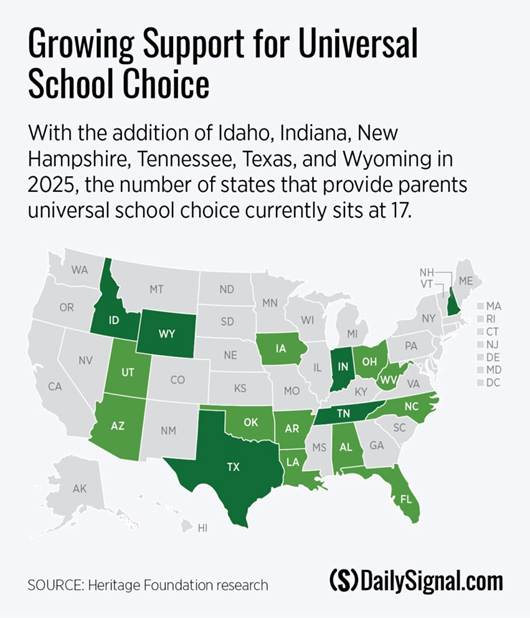
There are now 34 states with a school choice policy, including 17 publicly funded “universal” school choice programs that make every K-12 student eligible—yet there is zero evidence that school choice harms district schools, let alone “destroys” them.

In fact, the best available evidence shows that—as in nearly every other area of life—greater choice and healthy competition foster better outcomes.
An analysis of the research literature found a “strong and statistically significant association” between education freedom (including the robustness of a state’s school choice policies) and “both academic scores and academic gains.”
Indeed, 27 out of 30 empirical studies found that education choice policies have statistically significant positive effects on the academic performance of students who remain at their traditional public schools. One found no visible effect, and only two found a small negative effect.
But for the Chicken Littles, the evidence doesn’t matter. Nor do they have any sense of proportionality. As detailed in an EdChoice report last year, there is no correlation between the scope of school choice proposals and the rhetorical intensity of school choice opponents.
Critics of school choice programs tend to oppose them with equal intensity regardless of scale. Whether a proposal would serve all students or only a small subset, opponents raise concerns about negative impacts on public schools. Indeed, many predict catastrophic consequences despite evidence suggesting otherwise.
Fortunately, the Mississippi governor knows better. In recognizing this week as Mississippi School Choice Week, Reeves observed that “research demonstrates that providing children with multiple educational options can improve academic performance.”
The Mississippi Senate should follow the lead of Reeves and the Mississippi House of Representatives.
Policymakers should resist calls to scale back eligibility for the Magnolia Student Accounts proposal. Scaling back a school choice program won’t mollify critics—opposition will remain fierce regardless—but it would reduce support for the proposal.
When asked about their support for an education savings account policy open to all children, 74% of Mississippi parents supported it. But when asked about a program that is only available based on financial need, only 55% of Mississippi parents supported it.
Fortune favors the bold. Magnolia State lawmakers should pursue comprehensive reform that ensures every Mississippi child can access a quality education that meets his or her individual learning needs.