



















As the Right works to refine its stance on artificial intelligence, several coalitions are competing for the president’s attention, artificial intelligence experts tell The Daily Signal.
“Right now, behind the scenes, this is by far the most brutal fight in Washington,” former Chief White House Strategist Steve Bannon told The Daily Signal.
Because the stakes are high and AI regulation is a relatively new issue, the Right is divided over what the unified conservative position should be. AI is “one of the most controversial issues right now in the Trump administration,” a source familiar with the administration’s thinking on AI said.
“What that combination of those factors means is that it’s extremely controversial, and Big Tech interests are definitely extremely involved in this process and want to do anything to ensure that AI policies are created that help the bottom line,” the source said.
An administration official familiar with the matter agreed that AI is one of the most contentious issues facing the administration, saying the subject is “only controversial because of the way people are pushing for it and where those people come from.”
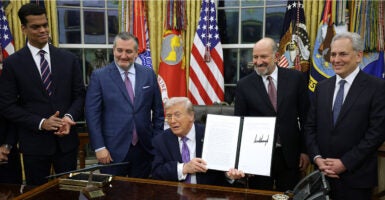
The lines were clearly drawn after Trump signed an executive order on Dec. 11, ordering the attorney general to establish an AI litigation task force that would challenge state efforts to regulate AI.
The president directed White House AI czar David Sacks and Michael Kratsios, science and technology adviser to the president, to recommend federal AI legislation preempting any state laws in conflict with the administration’s policy. That move drew backlash from conservatives like Gov. Ron DeSantis and Missouri Sen. Josh Hawley.
“Behind the scenes, this battle of AI regulation dwarfs everything else,” Bannon said.
Divisions in the Coalition over AI
The AI issue is bringing to the surface some of the wedge issues within the broader coalition that helped elect the president, said Tim Estes, founder of AngelQ, which seeks to use AI to make the internet safer for kids.
“The real division is between the free-market extremists up against the new right part of the coalition, which is going after protecting blue-collar jobs and rebuilding the manufacturing base,” Estes told The Daily Signal, “and the pro-family side that views, essentially, human dignity as the primary principle all things are built on, including economic freedom.”
The pro-family side has made an alliance with both the populist side and the national security side, which is concerned about Chinese influence in AI, according to Estes.
“These are three parts of the Trump coalition that actually are not aligned with the tech accelerationist crowd, and it represents the vast majority of the base, 80% plus,” Estes said. “And then you’ve got a small contingent that really is libertarian, plus the opportunistic tech community.”
“I’m not seeing a principled conservative leader get up and argue that acceleration is worth all these damages along the way,” he added.
Tech Accelerationist Coalition
On paper, the accelerationist coalition is by far the strongest, Bannon said.
“The accelerationists have deep roots into the White Office of Technology Policy—plus Elon and David Sacks, the crypto czar,” Bannon said.
Some tech experts believe Marc Andreessen of Silicon Valley venture capital firm Andreessen Horowitz is leading the accelerationist AI movement in the Republican Party. Andreessen, a former Democrat, flipped parties to donate millions to Trump’s 2024 campaign after former President Joe Biden’s efforts to regulate Big Tech.
Now, conservative tech policy experts warn of potential risks posed by members of the White House’s AI policy shop having ties to Andreessen.
“The White House Tech Policy shop is basically captive to the tech ‘Broligarchs,'” Bannon said.
Andreessen Horowitz did not respond to The Daily Signal’s request for comment.
Andreessen has praised Sacks as “a throwback to the era of American greatness.” Sriram Krishnan, senior policy advisor for AI at the White House under AI czar David Sacks, was a partner at Andreessen Horowitz before joining the administration.
Andreessen was a major backer of Character.AI, which has been sued by multiple families who say the AI chatbot contributed to their teenagers’ suicides.
Over the summer, Andreessen Horowitz backed a $100 million Super PAC, Leading The Future, which advocates against strict artificial intelligence safeguards. The PAC is running ads in Texas and New York, two states that have passed laws establishing safeguards on AI.
Texas has passed one law protecting minors from online content that glorifies suicide and other forms of self-harm, and another preventing the development or distribution of AI systems that produce deepfake child or other pornographic content.
Populist Coalition
The populist coalition is focused on protecting jobs and rebuilding the manufacturing base, according to Estes. Steve Bannon, a leader in this movement, believes Trump’s AI policy is costing him with Gen Z Americans who are worried about job losses from AI.
“I believe a major reason you do see President Trump losing some momentum with Gen Z in approval ratings is they are worried about losing jobs to AI,” he said.
New polling shows Trump’s approval rating with Gen Z voters has dropped 42 points in the past year.
“Remember in your 20s is the most important decade for getting into a profession—and AI is blocking that in administrative, managerial, and lower level tech,” Bannon said.
AI doesn’t currently have the capability to take away American jobs, but this could change as technology continues to improve, said Joe Allen, author of “Dark Aeon: Transhumanism and the War Against Humanity.”
“Let’s just imagine for a moment, the capabilities continue to increase,” he told The Daily Signal. “They continue to reduce the tendency towards hallucination, companies do have prompt engineers who are able to tease out these things, then it would be a drastic job loss issue.”
States can “throw sand in the gears” of harmful AI to prevent that from happening, Allen said.
“I think the states should be used as much as possible to impede these companies’ advancement and to give avenues for redressing grievance and to as best as possible, preemptively shield the most vulnerable people from the worst parts of these systems, for instance, luring kids into suicide, or systems that are prone to sycophancy and drawing out a kind of AI psychosis from the user,” Allen said.
Still, he doesn’t think the problems with AI can be solved politically. The future of AI will be determined by the culture: what Americans are willing to accept in regard to AI’s presence in their lives.
“The real effect happening over the next 5-10 years, is going to be some combination of what the public’s willing to embrace, what they completely reject, and that’s going to be different from different types of people in America and across the world,” Allen said. “And then also what these companies are willing to do, how brash they’re willing to pursue their ambition.”
He said a left-right coalition could form to address bipartisan fears about AI. Hawley already partners with Sen. Richard Blumenthal, D-Conn., on AI policy, and he sees such partnerships expanding.
“You could end up with someone like Bernie Sanders and Marsha Blackburn, or Bernie Sanders and Ron DeSantis stepping up to address the AI issue from the left and right,” he said.
Pro-Family Coalition
While Big Tech views AI as fragile and in need of protection through deregulation, the pro-family coalition wants to widen the scope of voices that are allowed to speak into AI regulation, said Michael Toscano, director of the Institute for Family Studies’ technology initiative.
“The fragile thing, the thing that needs to be taken care of, in our view, are the goods of family and family life, the well being of children, the ability of human beings,” he said.
Toscano said the White House and Congressional Republicans need to give Americans a platform to speak into the AI debate. He suggested an interagency working group on technology and the family, and an AI council to put Kratisios in conversation with a representation of religious Americans.
“Silicon Valley should not be charged with asking philosophical, religious, or moral questions,” Toscano told The Daily Signal, “and not that they should be excluded from it, but they certainly don’t have the wisdom that these communities that have been developed have been built up over the centuries, in some cases, to be able to ask the critical questions, the most important human questions, but also the most important questions of our time.”
The fundamental disagreement about AI isn’t one about technology, but about values, said Daniel Cochrane, tech policy expert at The Heritage Foundation.
“It’s a disagreement over what it means to flourish as a human being and as a society of humans,” he told The Daily Signal. “If you assume human nature is completely material and ultimately programmable, your view of what it means to flourish is very different from someone who thinks that humans are both soul and body.”
A White House official said the administration has undertaken a variety of measures to teach children how to responsibly use AI, such as the Presidential AI Challenge.
National Security Coalition
The national security coalition, which shares some concerns about AI with the pro-family coalition, is concerned about Big Tech advancing Chinese interests.
Sen. Josh Hawley, R-Mo., has extensively warned about the dangers of China accessing American AI innovation. He introduced legislation that would prohibit the import from or export to China of artificial intelligence technology and prohibit U.S. companies from investing money in Chinese AI development.
The national security coalition clashed with the Trump administration over the sale of Nvidia chips to China.
Hawley said constraining Chinese access to American semiconductors should be the priority, rather than expanding it.
“If we want to beat China, I think we need to constrain their ability to leverage our own technology,” he said.
“The Broligarchs are trying to convince the White House and Capitol Hill that we can provide the [Chinese Communist Party] the entire ecosystem as far as AI is concerned, and there is no risk to that,” Bannon said.
The U.S. needs to strike a balance between holding Big Tech accountable and ensuring that the U.S. doesn’t lose the AI race to China, according to Yusuf Mahmood, AI policy director at America First Policy Institute, said
“There is this balance that we have to strike between ensuring that we have transparency and accountability, to ensure that we don’t have complete, fully unaccountable reign by big tech elites over this technology,” he told The Daily Signal “but we also have to ensure that we don’t over regulate the technology either, so that we don’t lose to China.”
Marsha Blackburn’s Trump America AI Act
But there’s one way to unite the branches of the Trump coalitions, according to Estes, and it’s already been introduced in the U.S. Senate.
Sen. Marsha Blackburn, R-Tenn., said Trump asked her to introduce her “Trump America AI Act,” which would create one federal rulebook for AI, including protections for “children, creators, conservatives, and communities.” Estes thinks the entire coalition, apart from Big Tech donors, could rally behind Blackburn’s bill.
Blackburn told The Daily Signal that Big Tech contacts her to push back on her AI framework “every single day.”
“I have met with many of them, but I think it’s important to understand every industrial sector has regulation, whether it is logistics or manufacturing or communications, every sector has regulation,” she said in a phone interview. “The only people that do not have this are people that are working in the virtual space. So it is imperative that we establish the guardrails.”
Blackburn said the pro-Big Tech coalition is “generally not that interested in moving forward with any type of regulation.”
But “people that are concerned about kids and our creative and innovative industries,” and “people that are patent holders and trademark copyright holders” want regulations that will ensure they will be able to continue working without getting replaced by AI, she said.
“There are tremendous benefits from AI,” Blackburn said. “We see it in logistics, we see it in healthcare, we see it in advanced manufacturing. We see it in education. There are concerns, and addressing the concerns at the same time we establish the guardrails is our intent.”

